
Last Updated on Saturday, 9 May 2026, 16:07 by Writer
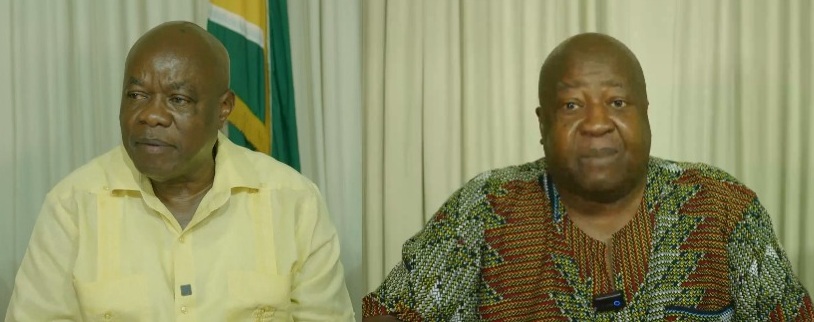
Leader of the People’s National Congress Reform (PNCR) Aubrey Norton on Friday denied that when his party was in government in the 1970s, it had considered giving up part of the Essequibo Region to Venezuela as part of a means to settle the border controversy.
“It is critical that we respond to Venezuela’s claim that under the PNC administration, there was consideration of a concession. This is untrue. When Venezuela made the proposal, it was rejected out of hand by the then PNC government,” he told a news conference.
International law professor Andreas Zimmermann, who is representing Venezuela at the International Court of Justice (ICJ) in Guyana’s case on the validity of the 1899 Arbitral Tribunal Award, told that United Nations (UN) court that during bilateral negotiations in 1977 the then Guyanese foreign minister had proposed a correction to the last section of the border lines, specifically at Punta Playa.
The lawyer said that the proposed rectification consisted of changing the northwest orientation of the current borderline and drawing it to the northeast end.
Dr Zimmermann also told the ICJ that some of those creative options that were then considered by Venezuela and Guyana in 1995 included the possibility of returning control over parts of the disputed territory to Venezuela.
He said that in that context, the parties notably also explored a possible lease back then by Venezuela in favor of Guyana of some portions of the territory.
Referring to then President Janet Jagan, Dr Zimmermann said in the same vein, he said she wrote a letter dated 18 August, 1998 reiterating that the purpose of the Good Officer Process, based on Article Four of the Geneva Agreement, was to “explore all avenues that would lead to the settlement of the border controversy.”
Mr Norton said, while he welcomed the United States’ (US) Secretary of State, Marco Rubio’s pledge to defend Guyana if it comes under attack from Venezuela, Guyana should have long embarked on stronger diplomatic action.
He stressed the importance of doing so in light of Venezuela’s refusal to recognise the ICJ’s jurisdiction in resolving the controversy over the validity of the 1899 Arbitral Tribunal Award that settled the land boundary with Guyana.
“There is need for a diplomatic strategy, one that includes education, ones that includes exercising political influence and control, and one that is based on economic diplomacy, where we use the resources at the expense, we resources we have to further our case, rather than just being transactional and other things,” Mr Norton said.
Meanwhile, the PNCR Leader said he had called for due recognition to be given to then foreign minister Rashleigh Jackson who was instrumental in ensuring the resources were provided to conduct vitally needed research. “It is unfair, and it should be rectified,” he said.
Co-Leader of the Working People’s Alliance (WPA) Professor David Hinds added his voice in making a stirring appeal for massive “structured public education programme” that Essequibo is part of Guyana.
“It is not too late to at least mount an aggressive social media education program that is aimed at educating our people, but also educating others in Venezuela, in CARICOM (Caribbean Community) about Essequibo, being our territory and belonging to us,” he said.
Dr Hinds said there were ways to get the people to “put pressure on the government to protect our territorial integrity and to educate our people.”