

Last Updated on Friday, 28 February 2025, 22:15 by Writer
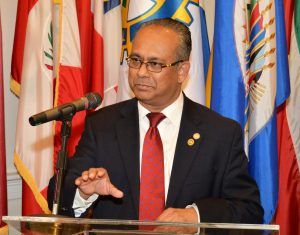
Caribbean Community (CARICOM) Foreign Ministers on Friday held talks on the United States’ (US) decision to impose visa restrictions on foreign government officials and their immediate families for their countries’ use of mainly Cuban healthcare workers in alleged “forced labour”, Suriname’s Foreign Affairs Minister, Albert Ramdin said.
He t0ld Demerara Waves Online News that the Council for Foreign and Community Relations (COFCOR) regarded US Secretary of State, Marco Rubio’s statement about visa restrictions as a “surprise”. Mr Ramdin said as far as he was aware no member state received official communication, particularly against the backdrop of the importance of Cuban healthcare workers in a number of CARICOM member states.
“The discussion was very clearly that if this is true and this is going to be implemented, it will affect the level of care in some countries more than in other countries because Cuban Medical Assistance Brigades provide important work in terms of medical care,” he said.
Ambassador Ramdin said the issue would have to be raised with the US administration during a meeting to be held “very soon”. No date has been set. He said the agenda would be expanded to include migration, security and the Haitian crisis, and firearms trafficking. Though those subjects are not new, he said a new administration needs to be briefed. He said the US has already announced that a delegation would be visiting the Caribbean “soon” but the aim is to seek an opportunity in Washington DC.
The Suriname Foreign Minister acknowledged that the US, as a sovereign country has a right to do what it wants, but he believed that “in a relationship you inform each other” about the decision. Mr Ramdin said “I’m sure that the US doesn’t want CARICOM countries to be in trouble” in providing healthcare.
Asked why should the sovereign nations of the Caribbean be worried about visa restrictions but should be free to access human resources from anywhere they see fit, Mr Ramdin said CARICOM does not want its relations with Cuba to be affected. “We don’t want anything to happen in that situation that can affect our own. We have students studying there. We have medical doctors and nurses of Cuba here. We don’t want that process to be disturbed so we need to be informed in the first place about what is really the measure taken and how it’s going to affect us,” he said.
The Suriname Foreign Minister said he did not hear any concerns raised about the impact of the US decision on Caribbean government officials and their immediate families.
The US Secretary of State, in his February 25 statement, said the American government was expanding its existing Cuba-related visa restriction policy that targets forced labor linked to the Cuban labour export program. He said The State Department has already taken steps to impose visa restrictions on several individuals, including Venezuelans, under this expanded policy.
Mr Rubio explained that expanded policy applies to current or former Cuban government officials, and other individuals, including foreign government officials, who are believed to be responsible for, or involved in, the Cuban labor export program, particularly Cuba’s overseas medical missions. This policy also applies to the immediate family of such persons, he said.
The State Department’s decision appeared hinged to its 2024 Trafficking In Persons Report which says the Cuban government failed to address trafficking crimes despite an increasing number of allegations from survivors, credible NGOs, international organizations, and foreign governments of Cuban officials’ involvement in facilitating serious human rights abuses and forced labour.
The TIP report states that the Cuban government has “policy or pattern to profit from forced labor in Cuba’s labor export program, which included foreign medical missions.” The TIP report says the Cuban government threatened, coerced, and punished government-affiliated workers, including medical professionals, and their family members if participants left the program.
“The government continued to deploy government-affiliated Cuban workers to foreign countries using deceptive and coercive tactics. In the majority of cases, the government kept a significant amount of workers’ wages; confiscated workers’ passports and professional credentials; subjected workers to surveillance and strict curfews; and did not consistently inform participants of the terms of their contracts, which varied from country to country,” the US State Department’s 2024 TIP Report states.