
Last Updated on Wednesday, 27 May 2026, 21:23 by Writer
Now that Guyana has leapfrogged technologically to perform long-distance complex, minimally invasive surgeries with the highest precision, the South American nation is offering sister Caribbean Community (CARICOM) member states to be part of the robotic-assisted system, President Irfaan Ali said on Tuesday night.
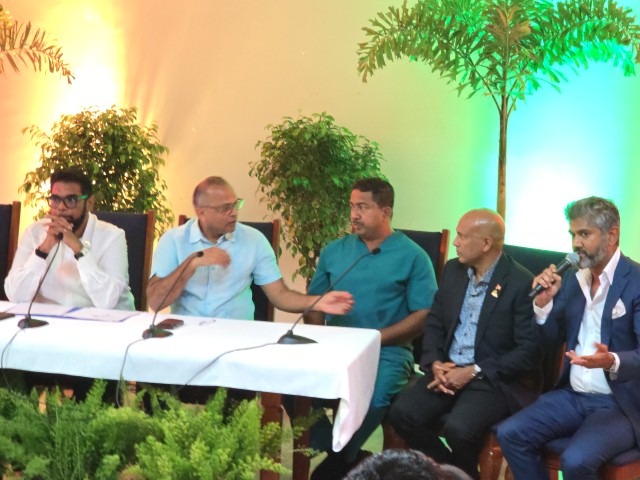
“This facility, everything that they experience in the most advanced facility in India, in the coming weeks will be available here in Guyana for the rest of the region as we build out the hub for robotics, surgery and care from Guyana and the spokes will be built out throughout the Caribbean and we will provide this training mechanism for all of the teams across the region,” he told a press briefing alongside health minister Dr Frank Anthony and a team of specialists.
The President said Guyana invested by purchasing the “entire training module”.
He said Guyana secured an agreement with the India-headquartered SSi Mantra to establish an international training hub in Guyana to train the country’s professionals. “We had to send our entire team to India to be trained,” he added.
Dr Anthony said the training programme would be accredited and would form part of postgraduate fellowship training at the University of Guyana and the Ministry of Health.
No questions were allowed after statements and comments were made by those present including Barbados’ Prime Minister Mia Mottley who said Guyana’s offer to the rest of the region would “hopefully help with easing the backlog and the timing of backlogs.”
The health minister said Tuesday’s heart surgery was conducted from the Georgetown Public Hospital (GPHC) on a patient in India, 20,000 kilometres away which President Ali hailed it as the “longest distance telesurgery ever completed in the world.”
The longest previously was done by SSi Mantra from Australia to India.
Officials said highly skilled robotic cardiac surgeon and founder of SS Innovations Dr. Sudhir Srivastava led the team from Guyana. Supporting him were a senior software engineer, the head of department for robotics instruments, a server network administration expert and a manager of digital media marketing.
The procedure in India was supported on site by two doctors.
The Guyana team for the cardiac surgery included Drs. Gary Stephens, Avalon Jeffrey, Pradeep Ramkumar, and Eric Martin, who is a vascular surgeon.
The GPHC said it was a “groundbreaking achievement” because Guyana successfully participated in and facilitated the world’s longest distance robotic telesurgery, a historic milestone in modern medicine, innovation, and healthcare transformation.
Demerara Waves Online News was told that there were several layers of Internet redundancy and the surgeons in India were also on standby to take over and continue the robotic surgery.
Meanwhile, President Ali said a robotics advisory committee has been established and is being co-chaired by prominent Guyanese cardiologist Dr Mahendra Carpen. Other members are Dr Anthony, Dr Riyad Gaffoor, and Satindra Prasad, and Steve Carryl.
The health minister said “detailed discussions” were already held to expand Guyana’s robotic cardiac surgery. “Where we have some gaps, he is going to work with us to make sure that we can fill those gaps. One of the expertise that we need is a perfusionist so they are going to work with us to make sure that we send somebody for training, and they are going to help us to find that placement, so that we can have our own perfusionist,” he said. A perfusionist operates a heart-lung machine, which is an artificial blood pump, which propels oxygenated blood to the patient’s tissues while the surgeon performs surgery on the heart.
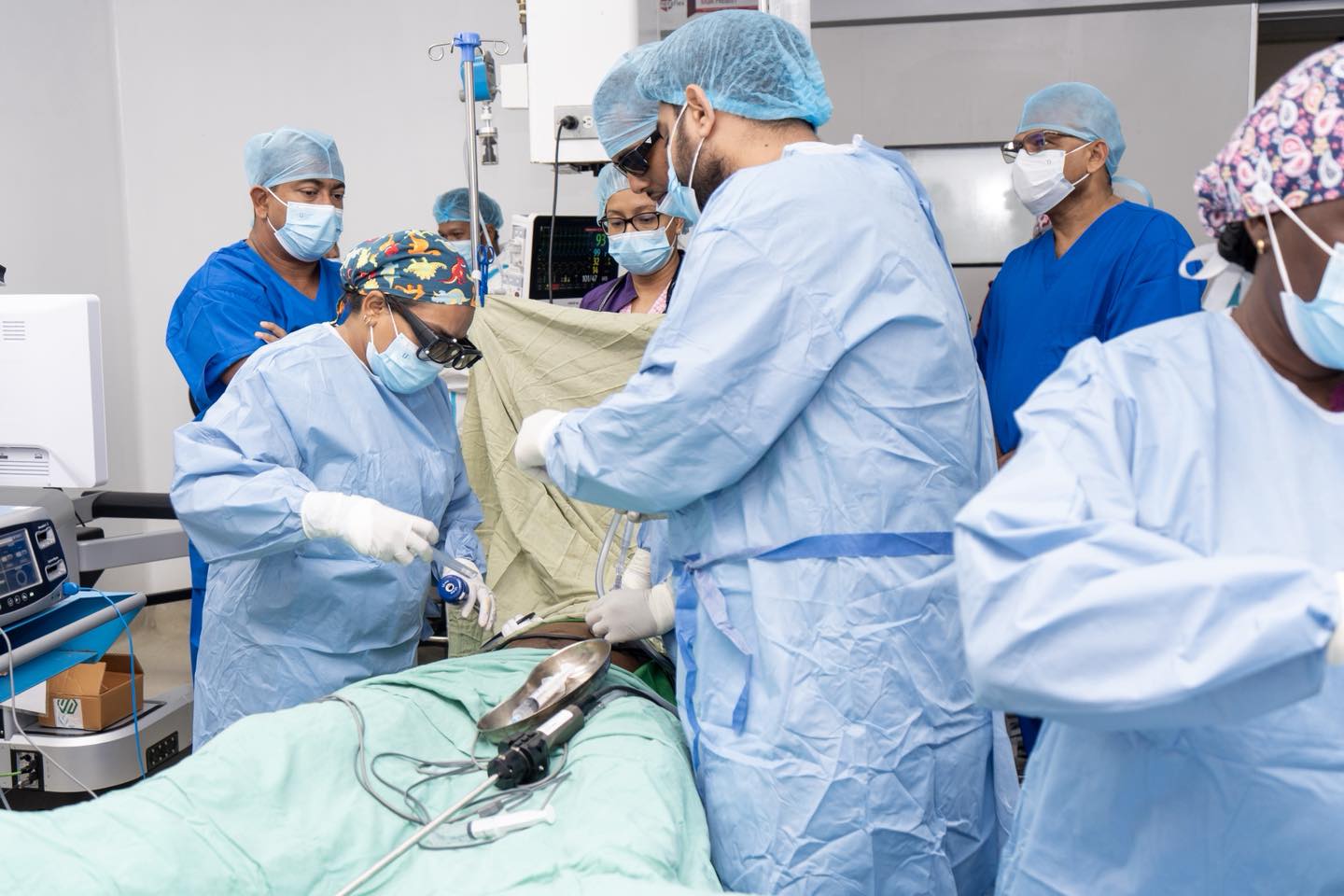
Simultaneously, the GPHC said it also achieved another historic first in local robotic surgery.
Led by Dr Hemraj Ramcharran, with support from Dr Bibi Hussain and Dr Jagnanand Ramnarine, the team successfully performed a robotic inguinal hernia repair locally.
With this achievement, the GPHC said Dr Ramcharran becomes the first Guyanese surgeon to perform robotic surgery in Guyana and the English-speaking Caribbean. “This was the first robotic surgery done physically here in Guyana and the Caribbean,” Dr Ramcharran told the news briefing.
Dr Gafoor said while robotic surgery has been around for about 20 years, SSI Mantra represents the latest generation in robotic systems, giving the surgeon an up-close, zoomed 3D magnified view of the insides of the human body such as the abdomen, chest, joints and neck surgeries. “It gives you a magnified view, not only the view, but you have extreme precision control of the tissues that you manipulate, up to a fraction of a millimeter, things that were never possible before,” he said.
“I don’t want to scare anyone, but sometimes, you’re doing surgery, open surgery, blind. You know, you’re hoping for the best but this approach truly gives you what I believe the best opportunity at getting someone home, getting them home safely, treating and curing their illness, whatever it might be, while minimizing complications like blood loss, infections, complications after surgery like clots in the veins and so on,” he said.
Dr Carpen said unlike splitting down the breastbone, also known as the sternum, to access the heart to perform the surgery, the tele-robotic surgery allows the insertion of fine tubes between the rib spaces. He said after gas is pumped into the left lung to collapse it, a spare artery already in the heart is used to conduct the bypass.
“Then the robot arms are used to detach an artery. The surgeons nicknamed the surgeon’s artery, God put it there for surgeons because they can’t figure out what it is used for normally so it is a spare artery at the back of the chest. So the robot arm then gently disengages it from the back of the chest and then makes it available to attach to the part of the heart that needs to get the bypass,” said Dr Carpen, a cardiologist, who practices in the Caribbean and North America.
The open-chest heart surgery costs US$6,000 to US$12,000 including post-operative hospital stay of at least seven days, in contrast to the robotic-assisted surgery which sees a reduction in cost by 50 percent.
The GPHC will be providing the robotic-assisted surgeries free of cost.