

Last Updated on Tuesday, 23 June 2026, 5:37 by Writer

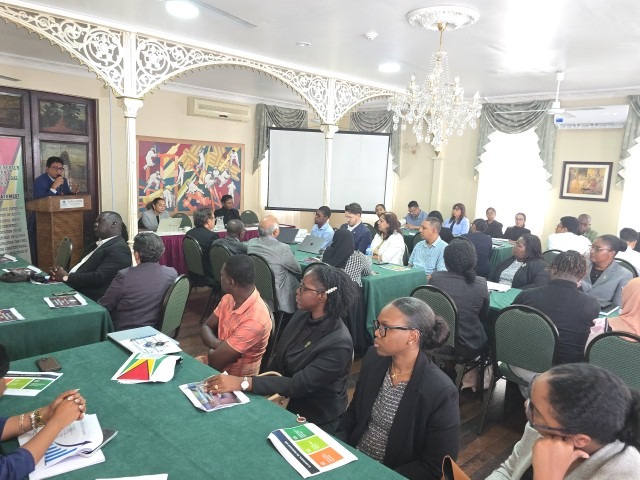
Chief Justice Navindra Singh on Monday proposed that there be parental controls on access to certain types of social media by persons below 18 years, but Caribbean Community (CARICOM) General Counsel Justice Lisa Shoman suggested that the Caribbean’s market size might not be sufficient for social media companies to comply with domestic laws.
“I would suggest strongly that it be 18, and I base that on a scientific approach,” Justice Singh told the consultation with the legal profession, organised by the Attorney General’s Chambers, on the consequential effects of social media on children.
Attorney General and Minister of Legal Affairs Anil Nandlall later remarked that, “it has to be below 18. The same rule of thumb is to regulate below 18.”
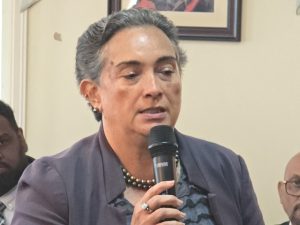
Deputy Chief Parliamentary Counsel Joann Bond told the consultation that Guyana had taken note of legislation in the United Kingdom that bans children under 16 years from using platforms such as Snapchat, TikTok, YouTube, Instagram, Facebook and X.
Similarly, she said Brazil had passed the Digital Statute for Child and Adolescent law while China’s comprehensive digital network has youth or minor modes.
Ms Bond added said underlining the consultation is the fact that children enjoy special protections under Guyana’s Constitution and the United Nations Convention on the Rights of the Child as well as Guyana’s legal framework that deals with children.
Ms Bond said those protections recognize that children are developing physically, cognitively, and emotionally, may be vulnerable to harm more than adults, require support and guidance, and have a right to develop safely and fully.
She also said there are mental health concerns, impact on cognitive development, impaired interpersonal skills, cyberbullying and harassment, online exploitation and grooming, exposure to harmful content, and addictive platform design.
Relying on writings that point to scientific approach, the Chief Justice related that the brain does not stop developing formidably until 25.
He said persons between 12 and 17 years old are in emotional puberty time when the brain develops its socio-emotional system, making the child highly sensitive and seeking rewards.
“That’s particularly one of the problems with social media and they’re more susceptible to stress and peer pressure and, so, they’re easier, it’s more likely that a child between 12 and 17 will take risks and that is what social media does a lot. It pushes these children to do nonsense.,” he said.
In addition to the age limit, Justice Singh said children should not be on social networking media such as TikTok.
Instead, he said they should on discussion platforms and communication apps with schools, parents and any learning network.
Attorney General Anil Nandlall said the proposed law that would govern access to social media by minors would not see government imposing anything or a model from another country.
He ruled out police entering homes to ensure compliance but said that would be job of parents, elders and other adult “in the best interest of your children.”
In that regard, former Chancellor of the Judiciary Carl Singh strongly recommended that adults be educated properly about parental control.
“There are platforms that can be of benefit to children, particularly educationally and there are platforms that can cause them harm by exposure to inappropriate content. One of the things I believe that is important, which we can’t legislate on, but I would respectfully urge is an aggressive education and awareness program for parents,” he said.
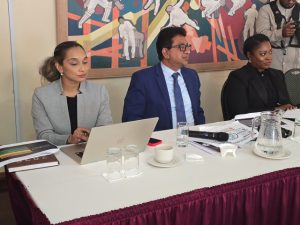
The CARICOM General Counsel urged the Guyana government representatives, who also included Deputy Solicitor General Shoshanna Lall, to include youths at the regional level.
“I urge you not to forget that this has to have the participation and the buy-in of youths. There is a Caribbean Regional Youth Council. I strongly urge that you also have them as a stakeholder, because this is critical,” she said.
Ms Shoman agreed that children and minors must be protected through a child-safe platform without taking away their need to learn and participate in this technological era.
“In terms of digital transformation and the digital economy that we must all develop, which, as you know, one of the issues about protecting our children and minors is protecting them, yes, but not at the expense of, I’m going to use the word deliberately, retarding, as in keeping back, their own development in this digital future that we are expecting them to be able to operate in,” she said.
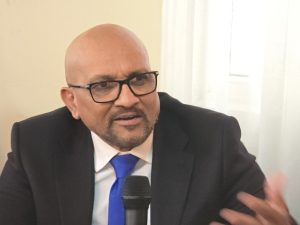
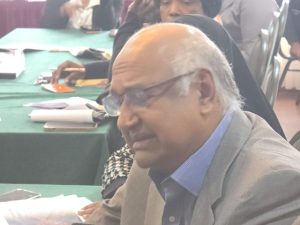
On the issue of enforcement of the proposed law, lawyer Dharshan Ramdhani, who has worked as a consultant for the Guyana government and represented the government in a number of cases, said he had seen elsewhere online cases referring to the social media platforms being required to have offices in country so that they could be served with legal papers effectively and “become amenable to the law.”
He said the next step would be enforcement of the law such as suspension from broadcasting or transmitting online or blocking them completely from transmitting.
“If the platforms are going to be responsible, then there will have to be consequences worked out for them, and those consequences must be meaningful so that we can ensure that there is compliance,” Mr Ramdhani said.
In response, the Attorney General acknowledged that that is a “very crucial issue” and would form part of the legal policy.

But Justice Shoman flagged the Caribbean’s market size as a potential drawback for enforcement and compliance by the social media giants.
At the same time, she said the region’s size could be used as leverage in its favour.
“Now, let’s be real. Australia, the U.K., the U.S., China, these are markets. We in the Caribbean, I don’t even know if we, all of us together, would give rise to a market,” she said.
“But that is no reason, AG (Attorney General) why we can’t and we shouldn’t. In fact, it’s an argument for why we should try to act in concert. Why we should find out from other countries how they are successful in navigating it,” she added.
Justice Shoman also echoed a call by well-respected copyright and intellectual property expert Teni Housty for local service providers to assist in making enforcement easier.
Mr Housty proposed that Guyana ask social media companies to block certain types of content from being available in Guyana “because you can manage the jurisdiction.”
“Sometimes, when you log on to certain services, they say this is not available in your jurisdiction. For technology, there’s a bank of IP addresses and different addresses that are allocated to jurisdictions and if the conversations start to happen with the actual content providers or the platform providers, whichever one you want to use, and you say, ‘look, this type of content will not be available in Guyana’, that’s a start,” he said.

“If you sell it to them as, ‘help us to be proud enough to say… helps to protect the young people of Guyana’, that’s where they want to be,” she said.
In that regard, Mr Nandlall said those social media content providers and the international platforms would be consulted.
The top CARICOM Secretariat legal official said there was an equal and perhaps even greater role for companies, platforms, social media and apps to have policies in place that the government could impose by law, and backed by enforcement and authority in order to protect children.
“I’m sorry to tell you that young people, who can have consensual sex at 16, are not going to just comply when you tell them that for their own protection, they’re restricted from social media until 18,” she said.
Attorney Emily Dodson recommended that the University of Guyana be asked to conduct a social survey that would assist the legal profession to determine the regulatory age and draft a law that captures the majority support of the population.
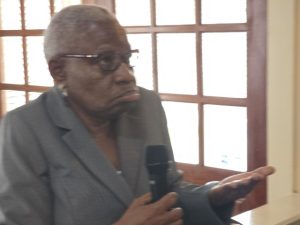
Head of the University of Guyana’s law department Retired Justice Kenneth Benjamin sought to convince the government delegation to be flexible with the age of persons who should be allowed access to social media.
“Age limits are very important because we are seeing children develop at different paces,” he said.
He advised against a “carte blanche” approach and asked that the law be drafted to provide for exceptions.
He said, for example, 16-year-old students were applying to the university and in the law programme, we’re seeing a lot of 17-year-olds with very good CAPE qualifications and university qualifications.
“When we are looking at regulating at what age we’re going to allow children to access social media, we have to take that into consideration,” he said