

Last Updated on Monday, 11 May 2026, 20:56 by Writer
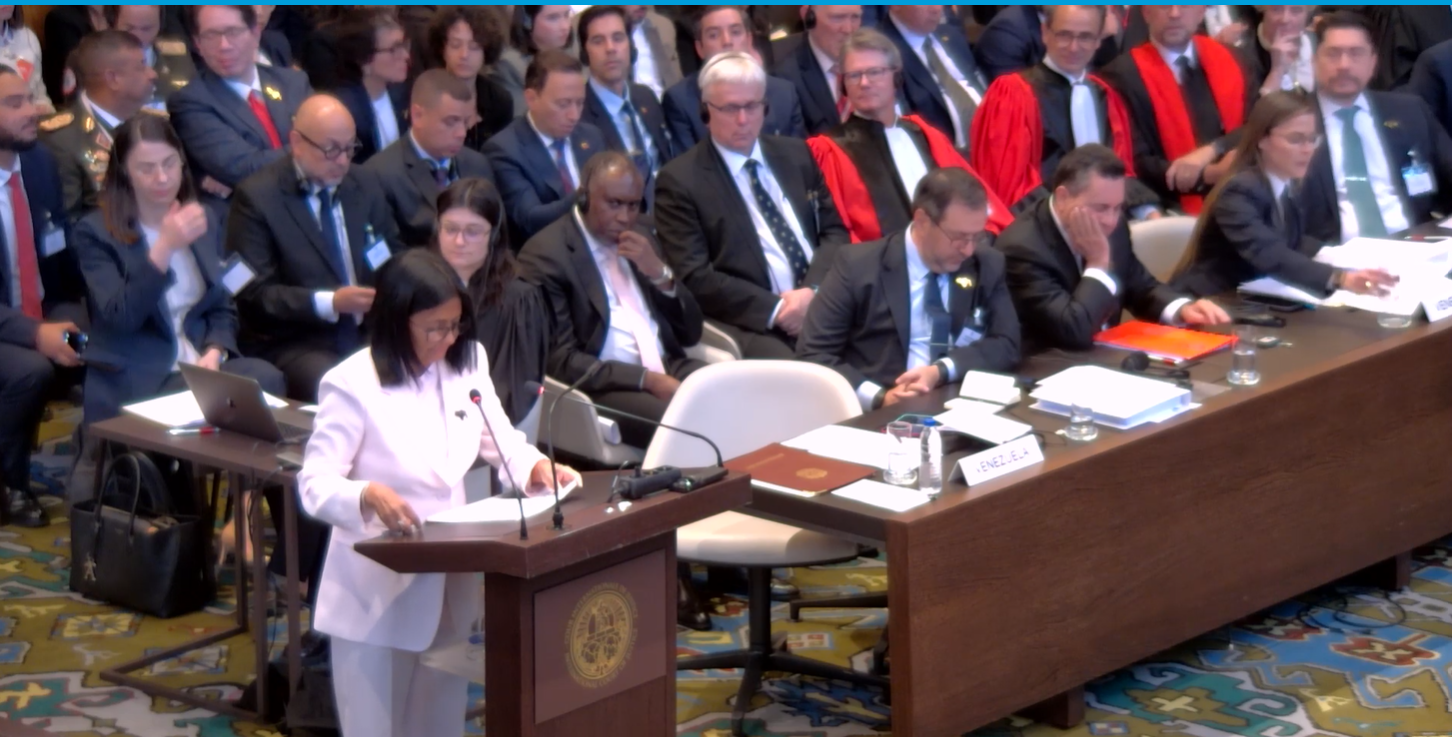
Venezuela’s interim president, Delcy Rodriguez on Monday said her country would not accept any ruling by the International Court of Justice (ICJ) that says the 1899 Arbitral Tribunal Award is valid and settled the boundary with Guyana.
“Even if the Court were to declare the award invalid, Venezuela would be unable to comply with such a ruling as it would also be nullifying the Geneva agreement and international law. It follows very clearly from this that there is no legal way of recognizing a decision resulting from this process, whatever that may be,” she said in wrapping up Venezuela’s oral arguments before that top United Nations (UN) court.
Ms Rodriguez reiterated her country’s refusal to recognise the jurisdiction of the ICJ to settle the border controversy with Guyana, insisting that the 1966 Geneva Agreement was the only “valid treaty” to do so.
“No judgment by this court on the territorial controversy will provide a definitive solution acceptable both parties. On the contrary, it will exacerbate the differences between the parties, and will lead the parties to entrench themselves in their respective positions, distancing them from the practical, satisfactory and mutually acceptable settlement to which they committed in 1966 by signing the Geneva agreement,” she said.
Instead, she recommended that in order to achieve the “noble and peaceful purpose” of the Geneva Agreement, to reach a practical, satisfactory and mutually acceptable solution there should be a high-level bilateral meeting organized by key regional stakeholders that will, without doubt, be far more productive and effective in achieving that goal.
The interim Venezuelan leader warned that any judgement in favour of Guyana would not put an end to the territorial dispute over the Essequibo Region but “at best, it would lead to a return to the same impasse that the Geneva Agreement could settle.
She accused Guyana of abandoning the Geneva accord and said that it “ceased to act in good faith”, a move she said coincided with the discovery of oil in 2015.
Instead, she said Guyana then opted to “evade compliance” with the Geneva Agreement.
Ms Rodriguez said the “evidence is irrefutable” that the Essequibo Region had been part of Venezuela’s territory since the country’s inception in 1777 when the Spanish crown created the Captaincy General of Venezuela, comprising, among others, the province of Essequibo.
She maintained that that administrative unit is the territorial origin of what later became the Republic of Venezuela, which arose from its declaration of independence it’s 1811 and since then, every Constitution of the Republic of Venezuela had reflected the fact that Guayana Esequiba is part of Venezuela’s territory.
She added that in 1825 the United Kingdom recognized Colombia as its eastern border and Guayana Esequiba in the east. “The United Kingdom never held any title to the territory of Guayana Esequiba. Its successor state did not hold it either, and nor does it hold it now, though it seeks to artificially forge such a title through this misleading proceeding, beginning in 1840 the British Crown, where then, of the immense gold reserves in the territory, designed a strategy to plunder it,” she said.
Ms Rodriguez virtually condemned Guyana’s request that the ICJ not only rules that the 1899 Arbitral Tribunal Award was valid but also order Venezuela to destroy maps, prohibit the teaching of history and eliminate symbols that would all “tear Guayana Esequiba from the hearts of Venezuelans. “The aim is to erase the memory of a people in order to nullify their future. Annihilating history will never, never legitimise dispossession,” she said.
In an effort to counter Guyana’s evidence, backed up by maps, that neither Venezuela nor Spain had ever controlled any of the Essequibo Region, Venezuela on Monday produced its maps showing that the Spanish was as far inland as Pomeroon in the Essequibo.
Guyana maintains that the Treaty that established the 1899 Tribunal Award, the tribunal itself and its award of the land boundary were all legal and valid.
Guyana also refutes Venezuela’s point that the Mallet-Prevost posthumous memorandum that there was skullduggery by the Tribunal President Friedrich Martens in playing tribunal members against one another to arrive at a decision that favoured the United Kingdom.
The Venezuelan interim president steered clear of repeating any of her often-expressed rhetoric while President Nicolás Maduro was in office, about the alleged role of the United States government, its military Southern Command and ExxonMobil as co-conspirators against her country.
Since Mr Maduro’s removal from office in a US military operation, relations between the US and Venezuela have improved under Ms Rodriguez.
Laws have been amended, sanctions have been removed on Venezuelan oil sales and American oil sector companies are returning to that country.