
Last Updated on Sunday, 3 May 2026, 15:20 by Writer
 As the Guyana government grabs yet another opportunity of World Press Freedom Day to project itself as a paragon of press freedom, the unvarnished fact of the matter is that there is tighter information control.
Consequently, there is a growing absence of public accountability. The administration has tightened the lid on almost all facets of information mechanisms that allow for openness and transparency. The State and government-controlled information ‘ecosystem’, now a favourite political jargon, no longer facilitates the unfettered constitutional right to freedom of expression by way of receiving ideas.
The State and government’s imparting of information has reached the point of an almost unbearable burden on the backs of the public. This has led to a wide array of assumptions and conclusions, some of which are fact and others left to fester to the point of being accepted as fact.
This approach to mind control and agenda setting by a sitting government in 2026 differs little from the period of the 1970s to 1992 when the then government imposed restrictions on the media by refusing to permit the importation of newspaper and printing press and refusing to liberalise the radio broadcasting spectrum. However, these restrictions were gradually dismantled as a result of the changed global political environment that paved the way for free and fair elections, market-oriented reforms and overall liberalism. At that juncture, the government, opposition, political parties, civil society and other interest groups were compelled by circumstance to face the media to communicate with the public. In so doing, their perspectives were interrogated or new information obtained.
Further technological evolution, which now allows for live or pre-recorded videos on social media by anyone in and out of officialdom, has been used by the government and to a lesser extent the opposition and non-state actors, to propagate their messages.
Though, there may or can be a larger volume of content, the technological advancement of the media landscape has now allowed the Guyana government to engineer censorship in a liberalised environment.
To counter the unfettered emergence of several sole online journalism entities or offshoots of conventional radio, television and newspapers, it is evident that the Guyana government has imposed restrictions in the manner, style and structure with which it interfaces with the public through journalists, particularly those not aligned with the ruling party or government.
One of the strong and tightly controlled screws in this regard is the refusal to hold free-flowing press conferences by the President and latterly his ministers. The environment has gotten so dismally worse that the ministers have not held year-end (2025) reviews or 2026 previews. The single-digit sit-down engagements that the President has held have been choreographed to his advantage by the sheer composition of the panel of those posing questions and the types of questions. Notably, the time consumed by the President in his opening remarks can only be seen as a means of limiting the number of questions with the excuse that he has other engagements. Then, too, there was that now infamous restriction of one question and no follow-ups pulled from that rusty ‘kit’ of PNC-era restrictions.
This approach is taking root in the modus operandi of the organised opposition whose woeful absence of a modern communication strategy is obviously transparent. As a matter of fact, the previous People’s Progressive Party Civic administration up to 2015 was comparatively transparent when it came to engagements with the public through the media. The new People’s Progressive Party Civic administration from 2020 deserves the highest commendation for perfecting the art of media restriction by A Partnership For National Unity+Alliance For Change administration whose President, David Granger, hardly held press conferences and had instead resorted to on-the-sideline interviews.
By no means a substitute, the current President and many of his ministers have resorted to Facebook Live and pre-recorded videos or text statements. That is their right to use these formats. These, however, cannot be their primary means of communication with the public if the Government and the Opposition are genuinely interested in transparency and accountability.
After the many well-founded criticisms of President Granger’s failure to hold many press conferences, one would have expected the People’s Progressive Party Civic administration to do better qualitatively with unrestricted, free-flowing press conferences.
That was not to be! After the incumbent party named Dr Irfaan Ali its presidential candidate, he (Ali) rarely engaged the media at press conferences as he was sheltered by that party’s General Secretary Bharrat Jagdeo who instead, hosted those weekly engagements. That approach was transposed to the government on the PPPC’s return to office in 2020 and continued until late 2025/early 2026. Yet another layer of official engagement with the media has been peeled off.
The fact of the matter is that the government is keen on minimising structured and formal engagements in which its policies and decisions can be subjected to questions and clarifications by the media on behalf of the public. Similarly, except perhaps for the Public Accounts Committee, the government is not interested in having sectoral committee hearings on various aspects of its operations for fear that they would find themselves in the media and otherwise on the public record.
As Guyana and the rest of the globe observes World Press Freedom Day 2026, it is not lost on the corps of reporters and journalists that the virtual absence of responses to questions by the Guyana Police Force in the Joint Services’ media WhatsApp group is by design and diktat. The President, the Minister of Home Affairs and the Attorney General are all aware of the constraints faced by the media in acquiring information from the Guyana Police Force. Unfortunately, it appears that nothing has been done to remedy this situation.
Then, again, why should there be a solution if the sole intention is for information control?
The glib excuse of accessibility to the President and ministers is nothing more than an escape route from structured information engagements. If the government, as misplaced as it does, believes that press conferences should not be one of the main mechanisms for public accountability and scrutiny, then it should advance reasons that governments in the smallest democracies around the world, including those in the Caribbean, as well as large advanced democracies in and out of the Commonwealth where there is higher Internet density, still hold press conferences, in addition to other newer means of communicating with the public. A failure to do so can only be regarded as a “misguided and reductionist” smokescreen for one-way communication to the public devoid of clarifications and questions. Simply put: take it or leave it.
Well-stated concerns about the functioning of the Access To Information mechanism cannot be divorced from the already-stated compendium of inhibitions.
This state of affairs, as outlined above and beyond, takes Guyana and Guyanese back to Article 146 of the country’s Constitution that guarantees freedom of expression inter alia “freedom to receive information and ideas without interference” and “freedom to communicate ideas and information without interference.” It should, therefore, be obvious that the government is an active participant in the State’s interference in the right of Guyanese to access information. Rather than playing a facilitating role in the structured access to public information, it has erected impervious brickwalls.
Today, the media, except the State-owned and ruling party/pro-government aligned, are kept in the dark about the majority of public ministerial and presidential engagements. No media advisories are issued. In the case of presidential assignments, most are often recorded and edited versions streamed hours later as if they are actually live. In other instances, recorded snippets are posted during the event.
Penultimately, it is not unreasonable to conclude that the business community is largely guided by governmental posture on where to spend their advertising dollars. This determines the viability of media houses.
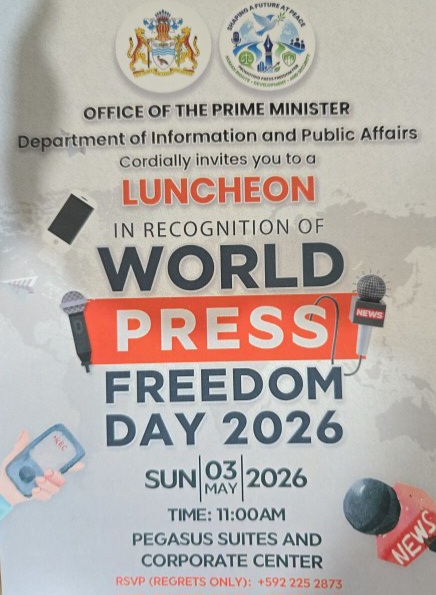
Finally, there is absolutely no justification for right-thinking members of the media to dine with the purveyors and perpetrators of information control to observe World Press Freedom Day 2026. What the government wants are pictures and videos to lend credence to claims of a free press in Guyana. At the same time, they will dish out lofty support for the principles, obviously devoid of practice.
The Guyana government is well aware of its imposed constraints and have done little to remove them, but rather to tighten and add more.
Take note, already the fabric of information has begun to unravel. The refusal to release a key report on a major incident must be leaving the government with a lot of ‘ganda’ egg on its face now that aspects of that once hidden document appear to have made its way into the media. More of this will happen as a form of resistance.
History has a way of repeating itself.
Recall after the then authorities had denied that there was a Sergeant 4141 Gregory Smith in the Guyana Defence Force (GDF) who was connected to the assassination of Walter Rodney. It was the Catholic Standard newspaper that had published a leaked picture of the officer clad in GDF uniform.
At minimum, the government must of necessity utilise Guyana’s Constitution, existing laws and international conventions to create an environment that is genuinely conducive to press freedom qualitatively. Press freedom cannot alone be measured merely by the number of journalism publications but by collective action to arrest propaganda, misinformation and disinformation.
No time to dine amidst information control on World Press Freedom Day!