

Last Updated on Friday, 27 February 2026, 22:19 by Writer
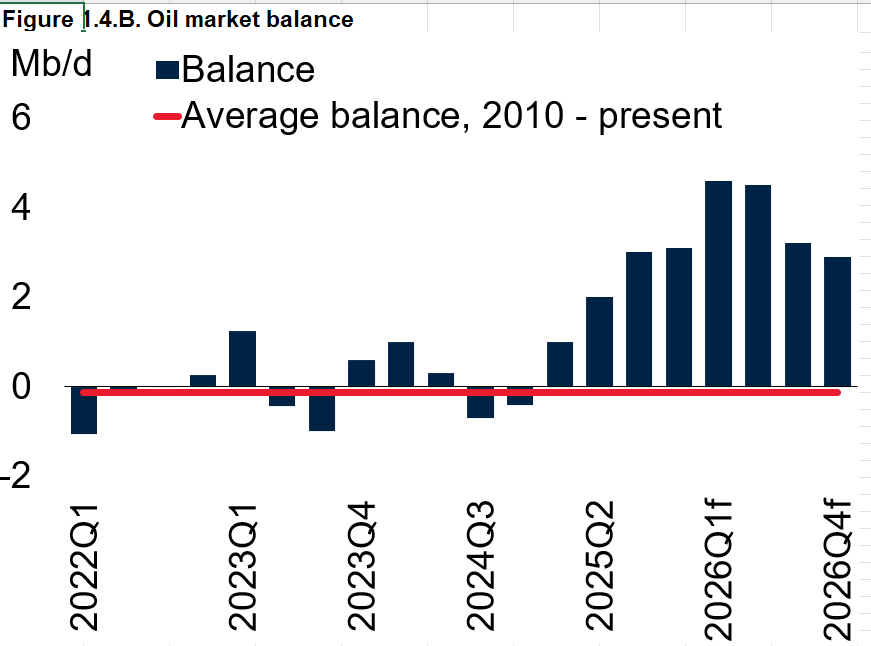
Note: f = forecast; Mb/d = million barrels a day. Data from IEA’s December 2025 edition of Oil Market Report. Data from 2025Q4 to 2026Q4 are IEA forecasts.
Guyana is forecast to lead the Caribbean’s sub-regional growth in Latin America and the Caribbean, although the price of crude is projected to decline to an average of US$60 per barrel, according to the World Bank.
The just-published flagship report titled “Global Economic Prospects” says in the Caribbean, subregional growth is set to increase to 5.2 percent in 2026 and 6.6 percent in 2027, “driven by Guyana’s ongoing oil boom.”
Excluding Guyana, the subregion is projected to grow by about 2.9 percent in 2026 and 3.7 percent in 2027, supported by tourism and related services.
Looking at oil prices, the World Bank says oil prices are expected to decline from an average of US$69 per barrel in 2025 to US$60 per barrel this year.
The Guyana government estimates the price would be US$59 per barrel, and domestically, overall growth is projected to be 16.2 percent, and growth in the non-oil economy is projected to be 10.8 percent.
The bank attributed declining oil prices to weakening of global trade and a slowdown in some major economies are also expected to weigh on demand for energy and industrial commodities. Crude oil prices, that international financial institution (IFI) says, are projected to fall as demand softens and the Organisation of the Petroleum Exporting Countries and other affiliated oil producers (OPEC+) boost crude oil supply, with oil markets envisaged to face a substantial excess of supply to outpace demand.
Meanwhile, the World Bank also says prices of industrial metals are set to be cushioned somewhat by green energy demand, partly offsetting muted growth of industrial and manufacturing activity.
The report also says global oil consumption is expected to grow by about 0.7 million barrels per day (year-on-year) in 2026—roughly the same pace as last year and about half of the pre-pandemic average.
Taken together with increased OPEC+ oil production in 2025 and United States shale, oil markets are anticipated to experience growing imbalances over 2026, with substantial excess supply.
Touching on neighbouring Venezuela, the World Bank says it is too early to assess the macroeconomic implications of recent events there.
Since the US’ military’s ousting of President Nicolás Maduro in early January, the American government has been directing much of Venezuela’s oil sales at market prices.
Relevant laws have been amended aimed at making Venezuela a friendly investment climate for major oil companies to again potentially invest billions 0f dollars in the coming years.
Earlier this week, US Secretary of State Marco Rubio told Caribbean Community (CARICOM) leaders that Venezuela was now using its oil revenues to pump into government payroll and improve health care.
Mr Rubio also envisages Venezuela playing an important role in Caribbean energy security.