

Last Updated on Tuesday, 3 February 2026, 16:05 by Writer
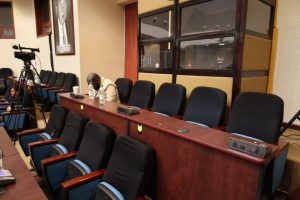
Pressure from a wide cross-section of the media on Tuesday intensified on House Speaker Manzoor Nadir’s restriction on the number of journalists allowed in the chamber to cover parliamentary sittings.
His edict that no television news camera would also not be allowed was also greeted with stiff opposition.
Commenting under a Parliament of Guyana Facebook post, several media personnel slammed the restrictions that Mr Nadir imposed at the start of Monday’s sitting.
Reacting to one of the rules that media would not be allowed to record the proceedings, media practitioner, Fareeza Haniff slammed the Parliament for giving an untruthful account of the reality. “The fact remains that the press is not permitted to record the debates; the live feed provided by the Parliament Office is of poor quality and plagued by persistent glitches and despite the completion of Day One of the Budget Debates, not a single video recording has been disseminated to the press by DPI (Department of Public Information),” she said.
She also lambasted the Parliament office for making a “deeply misleading” Facebook post late on Monday night. “Taking a photograph in the dead of night, after reporters have left to file their stories and then claiming the seats were unoccupied is plainly disingenuous,” she said.
She also said that citing an agreement the GPA entered into in 2020 under COVID restrictions and presenting it as if it were a current arrangement, is simply duplicitous.
“The Parliament Office and its PRO appear either unwilling or unable to understand how the media operates in this country,” she said.
Former President of the Guyana Press Association (GPA), Nazima Raghubir also weighed in on the issue, questioning whether Parliament had come to the point of intentionally misleading the public by the late Monday night post. “The Speaker’s behaviour towards the press should be condemned by all. #censorship,” she said.
Newsroom journalists Vishani Ragobeer and Kurt Campbell also assailed the Parliament office for making a “disingenuous post” that the private media seats remained unfilled for several hours during recent sittings.
Referring to Monday’s sitting, Ms Ragobeer said “those seats were filled by my colleagues and me yesterday.”
“I sat there with colleagues from other private media outlets, and there was a rotation of reporters covering different speakers. Posting a photo of empty seats after reporters had left to file their stories is simply dishonest.
Also, this post doesn’t address the fact that our videographers were not allowed inside to record, and the footage has not been sent out. Now, hours after the first day of the debates ended, where are the promised clips of each speaker? Are we seriously expected to download and use the low-quality livestream?” she asked.
Former GPA executive member Rawle Toney said the Parliament office engaged in “a failed attempt at damage control! smfh. Out of shame, ya’ll should delete this nonsense.”
Mr Campbell, in a separate post, said he would be among the first to publicly and unapologetically condemn what is currently unfolding in Parliament under the direction of Speaker Manzoor Nadir.
“The decision to severely and systematically restrict media access—escalating from a single sitting to a permanent, standing arrangement—is not merely ill-advised; it is profoundly regressive and democratically corrosive.
The notion that only a token number of seats are now reserved for private media, while private media houses are altogether prohibited from bringing cameras into the parliamentary dome, borders on the absurd and veers dangerously into authoritarian instinct,” he said.
He also disagrees with the “institutional farce” of expecting the media and the public to rely exclusively on the Department of Public Information for coverage. “This is the same department that, to date, has failed to provide even a basic recording of the national budget presentation delivered over a week ago. Meanwhile, the official livestream remains chronically unreliable and of demonstrably poor quality, rendering it wholly unfit as a substitute for independent journalistic access,” he said.
Former President of the GPA, Denis Chabrol added that the Parliament office’s statement defies logic. He says journalists cover sittings at peaks and troughs depending on what is newsworthy at any given time. This has always been the case for several decades.
“On the other hand, private TV news cameras stay much longer to capture video and the cameramen, with some knowledge about news value, provide guidance about cues in and out to the journalists on their return to the newsrooms or via WhatsApp. Bottom line: There is no rational reason to limit the number of journalists or cameramen. We have never ever been obstructive. We rotate and we fit in depending on what is newsworthy and requires our physical presence in the Chamber. Alternatively, we cover Online,” he said.
Insisting that there is absolutely no rational reason to limit media access to the National Assembly, Mr Chabrol argued that there is sufficient space to accommodate at least two or three privately-owned TV cameras.
The GPA on Monday registered its deep concern over the restrictions imposed on media coverage of the 2026 budget debates in the National Assembly.
The new rules are that only five reporters are being allowed into the dome at any one time, with the requirement to lodge identification before access is granted.
This represents a significant reduction from previous years, when up to 17 reporters were accommodated within Parliament Buildings to cover sessions, the Association said.
It is difficult to comprehend why, in a larger space, fewer reporters are now permitted.
Additionally, the absence of a direct feed for cameras inside the dome is unacceptable. Media houses have been told that they will be provided with a link from the Department of Public Information (DPI), which has proven unreliable, with frequent audio breaks and interruptions. An online link cannot be considered a direct feed, as it does not provide continuous, unfiltered access to parliamentary proceedings.
The GPA reminds the National Assembly that the role of the press is to ensure transparency, accountability, and accurate reporting of parliamentary business. Restricting access and failing to provide proper technical facilities undermines the public’s right to be informed, the association added.
“We strongly condemn this edict from the Speaker and view it as a direct attack on freedom of the press, a hallmark of any democratic society.
We therefore call on the Speaker of the National Assembly Mr Manzoor Nadir to urgently review these measures and restore full access for the press, in keeping with democratic norms and the principles of open governance,” the GPA said in its statement.