

Last Updated on Tuesday, 2 December 2025, 22:20 by Writer
– tables recommendations including tax incentives, improved infrastructure, virtual sport and entertainment

Former President of the Caribbean Development Bank (CDB), Professor Compton Bourne on Tuesday recommended that Caribbean Community (CARICOM) member states revive their tourism sector competitiveness because non-CARICOM states are taking away market share with better infrastructure and friendlier tax regimes.
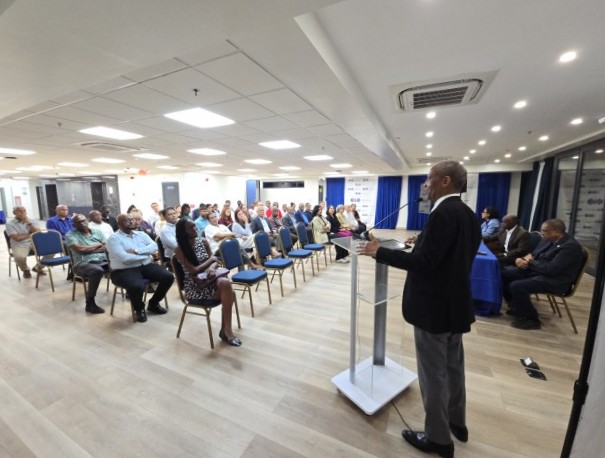
Speaking at a panel discussion to representatives of the business community, organised by the World Trade Centre Georgetown, he said several CARICOM countries have lost competitive grounds to other Caribbean countries such as the Dominican Republic and Puerto Rico that have “greatly expanded” their tourism plant, improved infrastructure and invested in modern or upgraded hotels.
Those non-CARICOM member states, except Jamaica in some regards, Dr Bourne said, have expanded their range of tourism products, focussing a lot on heritage tourism, providing better quality service in hotels, restaurants and internal transportation, and have less taxes and levies that “directly impinge” on stay-over visitors.
Touching specifically on taxes, he indicated that CARICOM governments were merely giving lip service to using taxation as an incentive. “This matter of taxes and levies that affect our tourism industry is sometimes bemoaned by our governments but often not acted upon by our governments. They are committed to the revenue intake rather than to the output expansion or business expansion aspect of it,” said Professor Bourne, a renowned economist and Guyana’s current Ambassador to Brazil.
He said intra-regional tourism was targeted by “quite significant” taxes on air travel and hotel rooms, sometimes amounting to 30 percent of the cost of the passage.
Professor Bourne recalled giving strong words to CARICOM leaders about their approach to tourism. “I’ve said and written before, even to the Heads of Government on earlier occasions, that the behaviour of governments is like if the tourism demand is not price-sensitive so that you can simply add taxes to the product and people will buy the same quantity. That is not so. They shift to other destinations and this has been particularly a retarding factor in relation to travel within the region,” he said.

Professor Bourne cautioned relatively new entrants to the tourism industry, like Guyana, to be mindful of the problems plaguing the sector and so private operators and governments should take action to address them. He further recommended that Guyana position itself as a “product innovator” on the strength of its biodiversity.
He said while, as an Amazonian country, Guyana has an extensive range and abundance of flora and fauna, efforts must be made to address the cost of that specialised tourism product. “Provision of good quality accommodation, efficient and less costly internal transportation, the availability of services such as rest stops en route to final destination and the availability of guides who are knowledgeable, articulate and competent in languages other than in English are critical requirements for sustainable growth,” he said.
He acknowledged efforts that were being made to upgrade skills and tourism plants but “we still have a long way to go in relation to that.”
Professor Bourne said the tourism sector does not need expert foreign language speakers but tourist guides who can speak about sites and exchange communication effectively. “We in this country and the English part of CARICOM have to stop being unilingual. We have to make foreign language capability part of our marketing strategy and business strategy. I think this particularly important as we seek to expand our reach into the non-Anglophone countries and regions, not least of South America and Latin America,” he said.
Professor Bourne, a former principal of the University of the West Indies’ St Augustine Campus, also recommended that CARICOM develop the potentials of entertainment and sport as “lucrative export products” by offering them online. “Virtual delivery of those export products is not similarly constrained as delivery on site but to acquire and to retain virtual buyers of export of entertainment service and sport services requires technological capacity and capabilities,” he said.
Dr Bourne said if that approach is to be successful, those services would have to be reliably delivered at scheduled times, of a high quality and contracts honoured. “If you are going to have an external market online, you have to start on time. After a while they forget about you because they lose money that way,” he said.
He said sport and entertainment are “underdeveloped products” because of the almost exclusive focus on live venue sports in which the size of the market is limited by the number of consumers due to venue capacity constraints and the cost of travel and accommodation.