


Last Updated on Friday, 11 July 2025, 22:55 by Writer
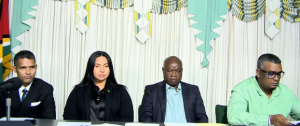
The People’s National Congress Reform (PNCR)-led A Partnership for National Unity (APNU) on Friday unveiled its proposed multi-billion dollar spending, pegging it to an average world oil price of US$50 per barrel.
APNU Finance and Economy spokesman, Elson Lowe told Demerara Waves Online News that proposed expenditures were linked to a minimum average price of oil at US$50 per barrel. “The reason we used US$50 dollars is because there are several studies that looked at $50 as the long-term average price,” he said. He also said returns on investments of some of the revenues in the Natural Resources Fund (NRF) would be used to finance some of the government’s expenditures should the price drop below the average. “We are going to ensure that the Sovereign Wealth Fund builds up as time goes on to give us, at least part of that cushion, that buffer, if the oil price should fall,” he said.
Reacting to assertions by People’s Progressive Party (PPP) General Secretary, Bharrat Jagdeo that APNU’s plans to rely on oil revenues to fulfill many of its electoral promises were unsustainable and unrealistic, APNU presidential candidate Aubrey Norton said “we do acknowledge that oil prices can go down” but the expenditures “wouldn’t be funded solely from oil resources.” Instead, Mr Norton said if he wins the September 1, 2025 general and regional elections, his administration would generate other types of economic activity, such as countrywide agricultural development, information technology services, and multiple use of natural gas.
“In our plan, cognisance is taken of the fact that oil prices can fall and that is why we said we will also increase the production in the non-oil sector as a cushion for when oil prices drop so Jagdeo is talking his usual nonsense,” Mr Norton added. The PPPC administration is also touting economic diversification to reduce dependency on oil.
The political organisation said in a statement there would be increased oil revenues as existing floating production, storage and offloading (FPSOs) are paid off and new production comes online. By 2027, three new FPSOs will kick into production, starting with the Yellowtail FPSO in late 2025. Oil productions will more than double over the next three years, adding another GY$4 billion to GY$5 billion to government revenues by 2027, APNU added.
Mr Norton also told a news conference that there would be no new taxes as his administration would also be relying on increased value added tax (VAT) revenues as a result of higher consumption. “There will be hundreds of billions of dollars of increased VAT and other tax revenues due to higher consumption and no increase in existing taxes or the addition of new taxes. Let us be clear, these increases will be based only on higher consumption and not on any increase in VAT or other rates,” he said.
Mr Norton said 30 percent or GY$400 billion of “new spending” in Guyana’s national budget would be set aside for increasing personal and household incomes. He said GY$100 billion would be spent yearly on hiking salaries.
Additionally, he said the income tax threshold would be increased from GY$130,000 per month to GY$400,000 per month for more than 200,000 public and private sector workers and self-employed persons.
APNU restated that an additional GY$53 billion would be spent on increasing old-age pension from GY$41,000 to GY$100,000 a month for 74,000 pensioners. Nine billion (Guyana) dollars would be set aside for the student stipend program for tertiary institutions and GY$25 billion for the childcare allowance program.
“Enough fiscal space therefore exists now and, in the future, to make these investments,” APNU added.
APNU said some of the money would come from GY$200 billion in savings through minimizing waste and alleged corruption by the incumbent People’s Progressive Party Civic (PPPC)-led administration, more robust auditing of oil operations to eliminate financial leakages and losses and ensure more resources are there for the benefit of the people of Guyana.
That opposition grouping said its social transfers will be a careful mix of direct cash, subsidies, and benefits, targeted and blanket programs, per household and per person programs, monthly and yearly programs, and phased and non-phased programs.