

Last Updated on Thursday, 12 December 2024, 21:24 by Writer
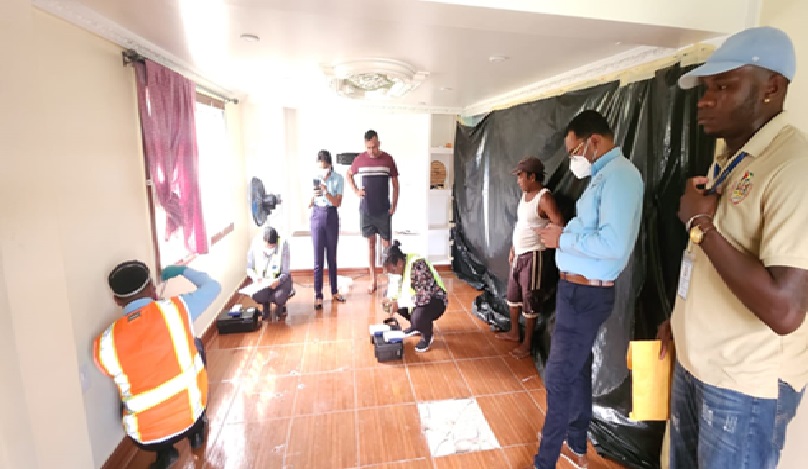
(EPA picture)
The Environmental Protection Agency (EPA) says the recent seepage of a smelly substance from the ground at several houses in Crane village, West Coast Demerara, was partly due to poor construction, had nothing to do with oil and gas and there are no risks.
“Expert advice provided to the EPA by other local agencies attributed the damages seen on the tiles to efflorescence. Efflorescence is a natural occurrence, resulting from soluble salts in construction materials rising to the surface due to moisture.
Observations also revealed that structural anomalies, including the absence of the use of damp proof membrane (DPM) or moisture proofing and substandard installation techniques, also contributed to the problem,” the EPA said in a statement. The agency said surveys of the community and homes revealed that the damage to ground tiles is not widespread. However, according to the agency, a few other households that reported seeing damaged tiles, including a temple in Crane, indicated that this seepage has been occurring several years now and prior to the COVID-19 pandemic.
While the the seepage resulted in strange odours, health-related concerns, and damaged floor tiles in several homes, the EPA said laboratory and field tests showed that there “are neither health nor environmental risks evident in the substance which was collected.” According to the agency, the tests also showed that toxic gases and radiation beyond background levels are not present in the homes where the substance was discovered, collected and tested.
The EPA has also confirmed that there have been no additional reported instances of continued odours.
Executive Director of the EPA Kemraj Parsram thanked residents for their patience and cooperation throughout the period of the investigations. As part of the process, Mr. Parsram and various teams from the EPA conducted several visits to the areas where the seepage of the substance was reported.
The EPA’s Executive Director also expressed appreciation to all Government ministries and departments, the University of Guyana (UG) and other local agencies which assisted with various aspects of the investigations.
“Our investigations, which were conducted between October 8 and November 19, 2024, involved a comprehensive scientific analysis, including laboratory testing of the substance collected from the tiles, air quality assessment, soil analysis, and surveys of the community, to determine the extent of the occurrence,” Mr Parsram was quoted as saying in an EPA statement.
Mr. Parsram said that, while the EPA’s role in this matter is now complete, he encouraged residents to contact the Agency, if necessary, as well as to take further action by engaging professional construction and engineering services for remediation. Residents are also free to pursue independent investigations, if so desired.
“We thank you for bringing this matter to our attention and remain committed to ensuring the well-being of all residents and the environment,” added Mr. Parsram.