
Last Updated on Wednesday, 6 May 2026, 9:01 by Written By Denis Chabrol
Venezuela, seeking to convince the International Court of Justice (ICJ) that the 1966 Geneva Agreement is the only means of bilaterally settling the border dispute with Guyana, on Monday told that top United Nations judicial body that in the 1970s and 1990s Guyana had offered to return parts of Essequibo to Venezuela.
The People’s National Congress (PNC) government under then Prime Minister Forbes Burnham was in office in 1977, and the People’s Progressive Party Civic administration was in office in throughout the 1990s.
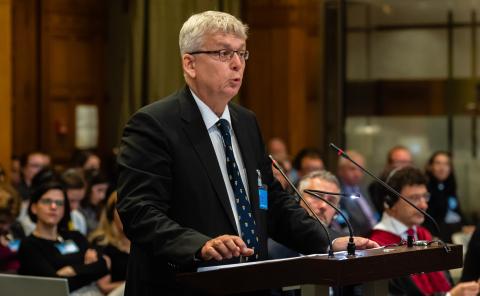
International law professor Andreas Zimmermann told the ICJ that during bilateral negotiations in 1977 the Guyanese foreign minister had proposed a correction to the last section of the border lines, specifically at Punta Playa. The lawyer said that the proposed rectification consisted of changing the northwest orientation of the current borderline and drawing it to the northeast end.
“This once again, confirms that during the bilateral negotiations undertaken within the framework of the Port of Spain protocol and the Geneva Agreement, Guyana then was ready to find creative solutions and give up de facto control over territory which the 1899 Award had purportedly allocated to British Guiana,” the law professor said.
Dr Zimmermann told the court that in line with the United Nations Secretary General’s position that the focus of his Good Officer (mediation) process was not on the nullity of the 1899 Award but on finding a mutually satisfactory settlement of the controversy through “creative options”.
He said some of those creative options that were then considered by Venezuela and Guyana in 1995 included the possibility of returning control over parts of the disputed territory to Venezuela.
He said that in that context, the parties notably also explored a possible lease back then by Venezuela in favor of Guyana of some portions of the territory.
Referring to then President Janet Jagan, Dr Zimmermann said in the same vein, he said she wrote a letter dated 18 August, 1998 reiterating that the purpose of the Good Officer Process, based on Article Four of the Geneva Agreement, was to “explore all avenues that would lead to the settlement of the border controversy.”
The lawyer for Venezuela said based on those and other actions and expressions, Guyana had regarded the Geneva Agreement as an instrument to solve the substantive boundary issue between itself and Venezuela, rather than the invalidity of the award. “They, the parties, were aiming to find a practical solution to the overall border dispute, as had already been mandated by Article four of the Geneva agreement.
He also said that between 1970 and 1975, then Venezuelan President Carlos Andrés Pérez and Prime Minister Burnham had not only discussed the border controversy at length, but also outlined possible pathways to a practical solution.
Professor Zimmermann said that culminated in a proposal in 1976 by Mr Burnham to solve the border issue through economic cooperation.
He quoted Mr Burnham as saying, “I would propose, the Guyanese Prime Minister, I would propose that there should be signed an accord which would lay at rest the border question.”
Lawyers for Guyana are yet to offer rebuttals before the ICJ which is this week and next week hearing the merits of the case on the validity of the 1899 Arbitral Tribunal Award that Guyana maintains is the full, perfect and final settlement of the land boundary with Venezuela.