


Last Updated on Friday, 31 October 2025, 23:25 by Writer
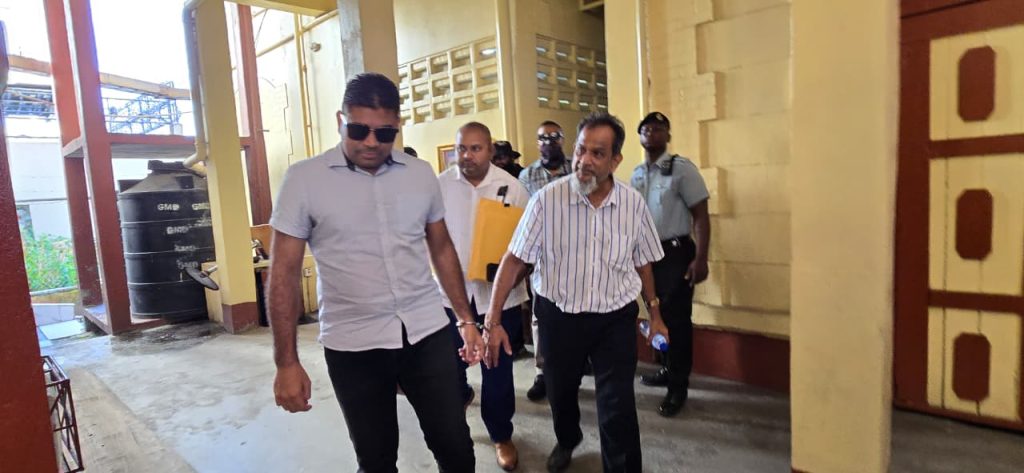
A United States (U.S.) government-hired lawyer on Friday failed in his efforts to oppose bail to Azruddin Mohamed and his father Nazar “Shell” Mohamed for whom an extradition request was made for them to face trial in a U.S. federal court for wire fraud and money laundering.
The Mohameds were earlier on Friday arrested on the basis of an extradition request that Attorney General Anil Nandlall said government received on October 30.
After they were processed at the Criminal Investigations Department’s headquarters, they were taken before Principal Magistrate Judy Latchman.
The U.S. grand jury indictment also accuse the Mohameds of gold smuggling and wire fraud connected to the payment of a U.S. company for a Lamborghini.
After hearing arguments from lawyers representing the U.S. and the Mohameds, the magistrate granted GY$150,000 bail each to the Mohameds, had them surrender their passports and report to the officer-in-charge of the Ruimveldt Police Station every Friday between 1 p.m. and 3 p.m.
They are to return to court on November 10, 2025 for continuation of the court hearing to determine whether there is sufficient evidence to support their extradition to the U.S.
The Mohameds’ defence lawyers, Nigel Hughes and Siand Dhurjon, sought a commitment from the U.S.’ legal representatives that their client would not be rendered to the U.S. as had been done to Guyanese Shaheed “Roger” Khan who was arrested in Suriname, flown to Trinidad and then handed over to U.S. Marshals who flew him to New York.
Khan was convicted for drug trafficking in a U.S. court, served time and then deported.
The majority of the reporters were locked out of the courtroom and so did not hear the proceedings from the beginning. They were only allowed in from about 2:30 p.m.
At that juncture when reporters entered the courtroom, Jamaican lawyer Terrence Williams, appearing for the U.S. government by Zoom, was opposing bail on several grounds. They included allegations that the Mohameds “engaged in an international criminal enterprise” with tentacles stretching to “high offices” in Venezuela and through the U.S. to the Middle East. He said the U.S. had information that the Mohameds had property in Brazil and were in contact with Venezuelan officials and so they could flee to Venezuela and continue their unlawful enterprise.
Mr Williams also told the court that the Mohameds allegedly supported and funded criminal and disruptive activities such as the “upheavals” associated with the death of Adrianna Younge whose body was found in a hotel pool at Tuschen. The U.S. government, through their lawyer, feared that if granted bail, the Mohameds could “tamper with justice” as there are witnesses to the crime who live in Guyana and could be dissuaded and so “interfere with the just outcome of the trial in the U.S.”
But defence lawyer Dhurjon, in his response, told the court that “these are new allegations” that he was “hearing for the first time.” He added that they were never questioned and no charge had ever been laid for any of those alleged offences. He said the only connection between the Mohameds and Venezuela were those by the Guyana government and Vice President Bharrat Jagdeo. The lawyer said those are claims by the government aimed at getting rid of an “unstoppable political movement.” The lawyer, on behalf of his client, said there was no evidence that the Mohameds had any property in Brazil. “There is nothing to suggest that these men will escape,” he said.
Referring to wire fraud and mail fraud, two of the charges that the U.S. grand jury has indicted the Mohameds for, Mr Dhurjon questioned what was the local counterpart offence in Guyana. “These offences are not extraditable offences,” he added. He indicated that the Mohameds were constitutionally entitled to have the matter referred to the constitutional court during which time they are entitled to bail.
Fellow defence lawyer, Roysdale Forde, similarly, argued in court that the alleged offences that the Mohameds committed as laid out by the U.S. government-hired lawyer had any factual basis and so any opposition to bail must be rejected. “None of this has been supported by a single piece of evidence,” he said.
Mr Forde offered a number of safeguards, in addition to cash bail, to ensure that the Mohameds do not flee the jurisdiction. They include reporting to the police several times daily, drone monitoring of their homes, bracelet monitoring, police accompanying them to hospital, and lodging of all of their property.
The Defence team has asked the lawyers representing the U.S. government to provide evidence to back up its claims.
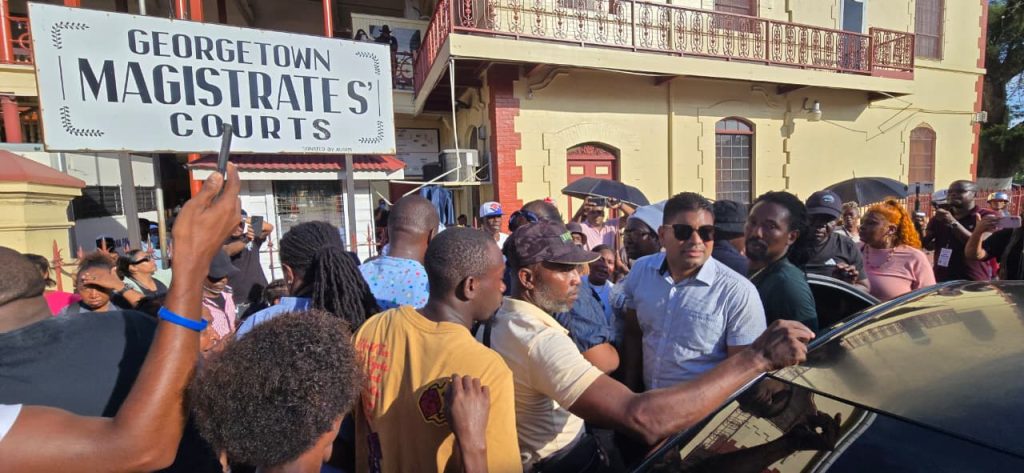
Outside the courtroom, as less than 100 persons thronged outside the Georgetown Magistrates chanting “free Mohamed”, Azruddin Mohamed categorically denied ever smuggling gold. “These charges can’t stand up. I never smuggled gold. I’m innocent,” he said.
The Mohameds were in June 2024 sanctioned by the U.S. for allegedly evading US$50 million in taxes payable to the Guyana government on the exportation of more than 10,000 kilogrammes of gold.
He said the Guyana government was soliciting support from the U.S. to ensure he did not go to Parliament on Monday to take up his position as Guyana’s Opposition Leader. “The mere fact is, they don’t want to see me in Parliament,” Mr Mohamed told reporters. His We Invest in Nationhood (WIN) political party won 16 seats to become the largest opposition party in the 65-seat National Assembly.
Mr Dhurjon did not rule out moving to the constitutional court before the conclusion of the hearing on whether there was sufficient evidence for the Mohameds to be extradited to the U.S. “So, they won’t be jumping on a plane tonight or next week or just now. There’s a process, a lengthy process that has to be completed,” he said.
Mr Forde said the extradition request raises a number of constitutional issues that were raised in court on Thursday. They include the authority to proceed as the Minister of Home Affairs, the amended Fugitive Offenders Act that prohibits an accused person from challenging the legitimacy or the unlawfulness of the process in the Magistrate’s Court. “These are a number of significant issues. We are nowhere close to even beginning to consider any process for extradition. All these issues will certainly lead to a number of significant challenges all the way to the CCJ,” he said.
Discover more from Demerara Waves Online News- Guyana
Subscribe to get the latest posts sent to your email.