

Last Updated on Thursday, 11 June 2026, 23:19 by Writer
By Ron Cheong
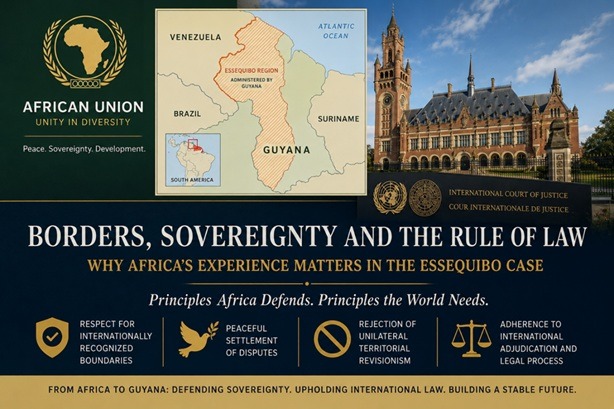 At first glance, the territorial controversy between Guyana and Venezuela may appear to be a distant South American border dispute with limited relevance to Africa. In reality, however, the case now before the International Court of Justice carries implications that reach across the entire Global South.
For reasons of both history and principle, Africa, and particularly South Africa, occupies an especially important place in understanding the broader significance of the controversy. African states emerged from colonialism confronting deeply imperfect borders, yet made the deliberate decision to preserve inherited frontiers rather than reopen territorial claims that could destabilize the continent. That historical experience now provides valuable context for understanding the stakes in the Guyana–Venezuela dispute.
At issue is Venezuela’s claim to nearly two-thirds of Guyana’s territory, including the vast resource-rich Essequibo region. But the matter has evolved into something much larger than a bilateral disagreement over borders. Increasingly, it represents a wider contest over principles central to the post-colonial international order itself: territorial integrity, the finality of established boundaries, and whether historical grievances can legitimately be used to reopen long-settled frontiers.
The Principle of Finality
At the heart of the case lies the 1899 Arbitral Award, which established the boundary between Guyana and Venezuela. Guyana maintains that the award legally and definitively settled the frontier more than a century ago and that Venezuela accepted the boundary for decades before reviving its claim in the mid-twentieth century.
This raises a foundational principle in international law: finality.
Without finality, borders are never truly settled. And where borders remain perpetually open to reinterpretation, the risk of instability becomes permanent. The modern international system depends heavily upon the understanding that even imperfect historical settlements must eventually acquire legal certainty. Otherwise, historical grievances could be invoked almost indefinitely to challenge existing states and boundaries.
Africa’s Historical Perspective
Africa understands this dilemma perhaps better than any other region.
At independence, African leaders inherited borders largely drawn during the colonial era – many of them arbitrary, artificial, and insensitive to ethnic, linguistic, or historical realities. Yet African governments recognized that attempting to redraw borders across the continent would likely trigger endless disputes and conflict.
The result was one of the most consequential diplomatic choices in post-colonial history: the collective decision to preserve inherited boundaries while pursuing peaceful coexistence and regional stability. That principle later became embedded in African diplomatic practice and international norms regarding territorial integrity.
This historical experience gives African countries a particularly important perspective on the Guyana–Venezuela controversy. It also helps explain why the case should matter across the Global South more broadly.
South Africa’s Diplomatic Relevance
South Africa occupies a distinctive position within this discussion.
Since the end of apartheid, Pretoria has consistently emphasized multilateralism, negotiated settlement of disputes, and adherence to international legal institutions. South Africa has frequently presented itself as a leading Global South voice on sovereignty, decolonization, international equity, and peaceful conflict resolution.
Those positions make the Guyana–Venezuela case especially relevant to South African diplomacy. The issues at stake – respect for established borders, peaceful adjudication, and opposition to unilateral territorial revisionism, closely mirror principles South Africa itself has long defended internationally.
Venezuela’s Expanding Diplomatic Narrative
At the same time, Venezuela’s diplomatic strategy appears to be evolving in sophisticated ways.
Recognizing the emotional and political resonance of anti-colonial narratives within the developing world, Caracas increasingly frames the controversy not primarily as a technical-legal dispute, but as a struggle against historical injustice and colonial-era manipulation. Venezuela argues that the 1899 arbitral process was unfairly influenced by the British Empire and therefore lacks legitimacy.
This narrative naturally carries appeal in parts of the Global South where memories of colonial domination remain powerful.
Yet Africa’s own historical experience complicates that argument considerably. If every border shaped by colonial-era asymmetry were reopened today, many African states themselves could become vulnerable to competing historical claims and revisionist nationalism. African stability has depended not on the perfection of inherited borders, but on the collective agreement to respect them while resolving disputes through diplomacy and law.
That reality exposes a significant weakness in Venezuela’s broader narrative. Anti-colonial rhetoric alone cannot provide a workable foundation for reopening internationally recognized frontiers generations later without risking wider instability across the post-colonial world.
Why Guyana’s Position Resonates with Small States
There is another dimension of the dispute that may resonate strongly across Africa and the wider developing world.
Guyana is itself a small post-colonial developing state of fewer than one million people confronting territorial claims advanced by a much larger neighbour. Increasingly, many observers view the controversy less as “Britain versus Venezuela” and more as a test of whether smaller states can rely upon international law and multilateral institutions for protection against revisionist pressure.
That distinction matters deeply for many African countries, which similarly depend upon international norms, legal frameworks, and collective diplomacy as safeguards against coercion by more powerful actors.
Indeed, the principles at stake in the Essequibo controversy closely parallel principles African states themselves have historically defended:
- respect for internationally recognized boundaries,
- peaceful settlement of disputes,
- rejection of unilateral territorial revisionism, and
- adherence to international adjudication and legal process.
Why African Engagement Matters
African engagement matters precisely because Africa has lived through the dangers of border instability and understands the importance of legal predictability in preserving peace.
The continent’s experience demonstrates that stability is often maintained not by perfect borders, but by collective commitment to respecting established ones while managing disputes through diplomacy, negotiation, and law rather than pressure or force.
This does not require African governments to “take sides” geopolitically. Rather, it calls for reaffirmation of principles that African diplomacy itself helped shape over decades:
- sovereign equality of states,
- territorial integrity,
- peaceful dispute resolution, and
- respect for international legal institutions.
Those principles have protected many African states from wider instability and remain essential safeguards for smaller and developing countries globally.
A Strategic Opportunity for Guyana
For Guyana, therefore, deeper diplomatic engagement with Africa represents more than symbolic outreach. It offers an opportunity to frame the dispute within a broader post-colonial context that many African states intuitively understand.
Africa’s own historical choices regarding inherited borders help illuminate why the Guyana–Venezuela controversy is not simply about colonial history, but about preserving international stability in the present. By engaging African governments, scholars, diplomatic institutions, and public opinion leaders, Guyana can strengthen international understanding of the legal and systemic implications of the case.
Such engagement could also help expose the limitations of Venezuela’s attempt to frame the controversy primarily through anti-colonial rhetoric. Africa’s experience demonstrates that post-colonial solidarity and respect for settled boundaries are not contradictory principles; in fact, they have often been mutually reinforcing foundations of stability.
A Wider Global South Test
Ultimately, the Guyana-Venezuela controversy is becoming a broader test for the Global South itself.
Can post-colonial solidarity coexist with respect for settled international boundaries? Can historical grievances be acknowledged without undermining modern international stability? And can smaller states continue to rely upon international law as their primary shield in an increasingly uncertain world?
These questions extend far beyond South America. They carry particular relevance for Africa, and especially South Africa, whose diplomatic identity has long been tied to the defense of international legality, negotiated settlement, and principled multilateralism.
In that sense, the Essequibo case is no longer merely a regional territorial dispute. It has become part of a much wider conversation about sovereignty, stability, and the future of international order across the post-colonial world.
Ron Cheong is a frequent political commentator and columnist whose recent work focuses on international relations, economic resilience, and Caribbean-American affairs. He is a community activist and dedicated volunteer with extensive international banking experience. Now residing in Toronto, Canada, he is a fellow of the Institute of Canadian Bankers and holds a Bachelor of Science degree from the University of Toronto.