
Last Updated on Friday, 8 May 2026, 19:01 by Writer
Guyana on Friday provided fresh evidence to the International Court of Justice (ICJ) showing that Spain never occupied the Essequibo Region.
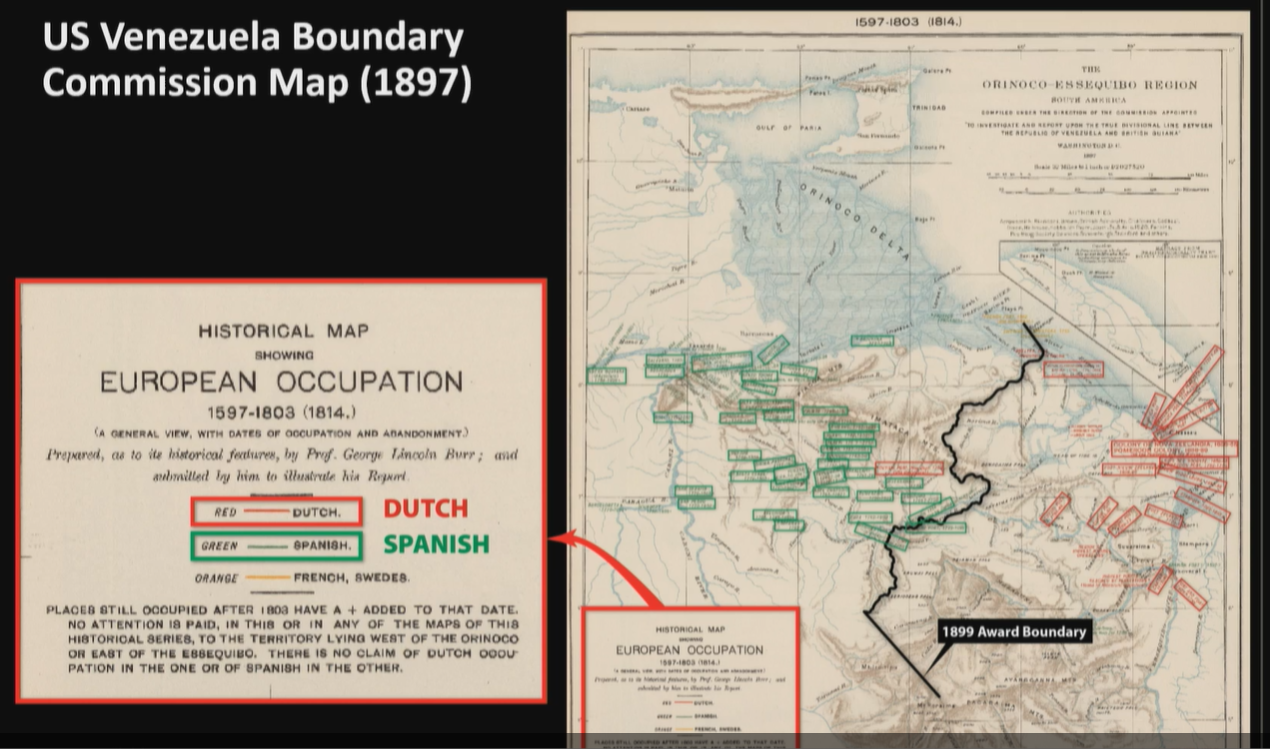
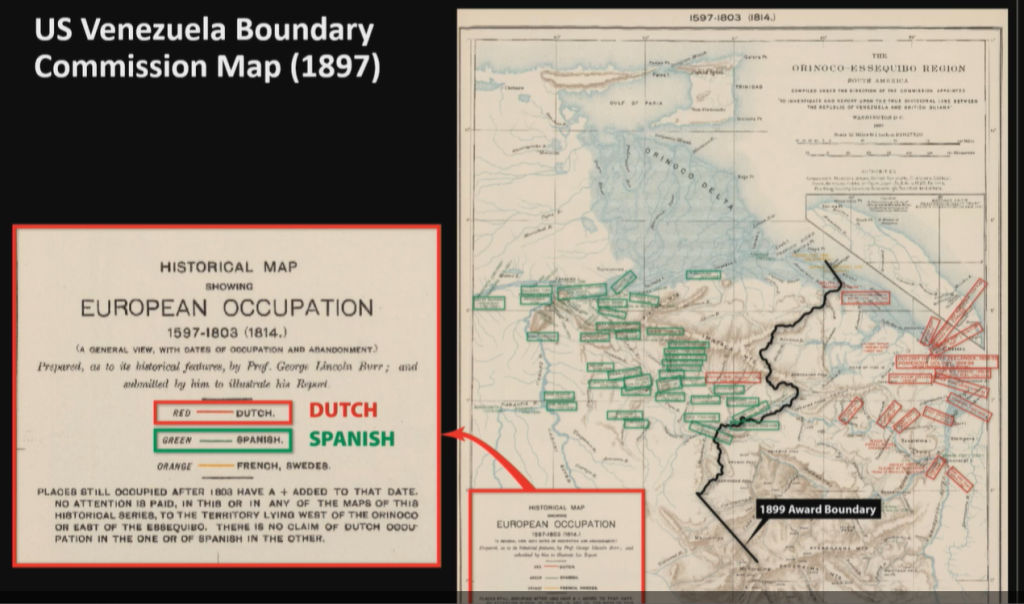
Lawyer for Guyana Paul Reichler presented maps of the area one of which included the boundary that was demarcated after the 1899 Arbitral Tribunal Award.
“They (Venezuela) knew that it was no injustice to the arbitral tribunal in 1899 to award the territory east of the agreed boundary line to the British,” he said.
He explained that according to the United States (US)-Venezuela Boundary Commission, there was no Spanish occupation east of this boundary line, adding that the map was published by the Boundary Commission in February 1897, the same month in which the 1897 treaty was signed.
Guyana had already argued before the court that the Dutch rather than the Spanish had occupied the area which until today still has more than 30 Dutch names.
The lawyer said the transcript of proceedings of the US-Venezuela Boundary Commission and the 1899 Arbitral Tribunal stated that Venezuela or Spain never occupied any part of the area.
“Venezuela has presented none in this case; likewise, Venezuela presented No evidence in the 1899 arbitration that it or Spain, ever actually occupied any of the territory that was ultimately awarded to Great Britain,” he stated.
Mr Reichler urged the ICJ judges to read the transcripts of those proceedings.
Mr Reichler noted that the question before the court concerns the legal validity of the 1899 Award rather than whether the tribunal got the boundary right.
He said the ICJ would only address the accuracy of the boundary line if, according to its 2020 judgement, that court determines that the award is invalid.
Venezuela had already told the ICJ in its oral arguments that Britain had frequently engaged in aggression against the Spanish in that area.
While Venezuela says the 1966 Geneva Agreement replaced the 1899 Arbitral Tribunal as the means by which the border controversy should be settled, Mr Reichler presented segments of that agreement which state that “In order to facilitate the greatest possible measure of cooperation and mutual understanding, nothing contained in this Agreement shall be interpreted as a renunciation or diminution by the United Kingdom, British Guiana or Venezuela of any basis of claim to territorial Sovereignty in the territories of Venezuela or British Guiana, or of any previously asserted rights of or claims to such territorial sovereignty, or as prejudicing their position as regards their recognition or non-recognition of a right of, claim or basis of claim by any of them to such territorial sovereignty.
No acts or activities taking place while this Agreement is in force shall constitute a basis for asserting, supporting or denying a claim to territorial sovereignty in the territories of Venezuela or British Guiana or create any rights of sovereignty in those territories, except in so far as such acts or activities result from any agreement reached by the Mixed Commission and accepted in writing by the Government of Guyana and the Government of Venezuela,” he said.
Mr Reichler also added that the text of the Geneva agreement, as understood and explained by the court, could not be reconciled with Venezuela’s novel reinterpretation of the agreement as a novation dispensing with the 1899 arbitral award.
“Venezuela’s argument that the 1966 (Geneva) agreement somehow set aside and replaced the 1899 award cannot be reckoned reconciled with the text of that agreement,” he also said.
For his part, professor Pierre d’Argent said the Geneva Agreement empowered the United Nations Secretary General to decide that the court would be the next step in finally settling the controversy, after 60 years of discussions.