


Last Updated on Friday, 3 April 2026, 15:20 by Written By Denis Chabrol

The Georgetown City Council is preparing to move against delinquent ratepayers with legal action to recoup some of the billions of dollars owed to the municipal government, at a time when A Partnership for National Unity (APNU), which controls the 30-member council is accusing the People’s Progressive Party Civic (PPPC)-led central government of starving City Hall of monies.
“We intend to take people to court. We’ll take them to court. It will be harsh but we’ll take them to court. Let the court decide how they will pay us,” Chairman of the Council’s Finance Committee, Lelon Saul told Demerara Waves Online News.
He said that, unlike decisions by previous councils to go after defaulters, lawyers would be filing legal action against property owners.
Asked how soon legal action would be taken, he said lawyers would be consulted with a view to hauling the first set of persons before the court in 30 days. “We have identified some lawyers to do it and we will take some people to court,” he added.
Mr Saul estimates that commercial and residential property owners owe the City Council an estimated GY$400 billion in principal and interest.
In a number of cases, he said the demand and interest exceed the value of properties. “You can’t want benefit from service and you’re not paying. Ideally, you should pay and some of them are wicked,” he said.
Several residential properties in prime areas of Georgetown pay as low as GY$10,000 (about US$45) annually.
In an effort to tackle long-overdue rates and taxes, Mr Saul said his request to the local government minister, Priya Manickchand, for a “blanket amnesty” with the aim of incentivising ratepayers to pay off their principal debts “was granted”.
City Hall’s meagre rates and taxes are based on a 1997 valuation, but the Finance Committee chairman says central government continues to resist requests for a revaluation of properties in Georgetown to allow for more revenue. “So when the government says ‘oh you don’t do anything’, they know that we don’t get money,” he said.
Potentially, Mr Saul is wary that central government’s takeover of responsibility for 22 roads in Georgetown can further deprive the city council of much-needed cash in the forms of street vending cleansing fees, traffic management, shipping container and billboard fees.
Saying the Council was unsure whether vending fees can still be charged, he vowed that City Hall would put that threat to democratic governance to the test. “Some of the very streets that are now designated public roads, we will not be able to do that and it’s the way how it was done; there was no consultation,” he said. The finance committee has not yet calculated how much money the council will lose.
He also said plans were afoot to take the government to court to challenge its assumption of responsibility for those roads.
Mr Saul said a team of lawyers was examining the law before filing a lawsuit because they want to be confident that they could demonstrate to the judge that the streets should be under the control of the city or whether the Road Act allows the minister to declare those thoroughfares public roads because the central government maintains them. He said the lawyers were examining precedents and global practice.
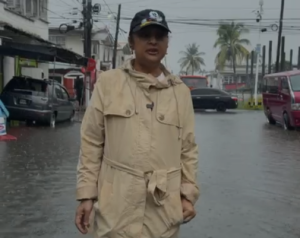
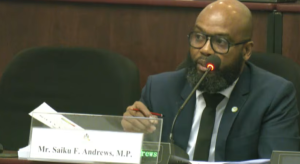
The local government minister on Tuesday shrugged off accusations by APNU parliamentarian Saiku Andrews that central government was engaged in double standards when it comes to managing the affairs of the capital city. “One cannot claim to invest in a city while dismantling its ability to sustain itself,” Mr Andrews said in a statement.
Mr Andrews blamed the Irfaan Ali-led administration of choking the city administration by providing an inadequate subvention that is no different from smaller towns and disproportionate to even much smaller neighbourhood councils; refusing to approve property revaluation though the cost of services continue to spiral, and removing key income-generating assets, including streets inclusive of sidewalks and parapets, and the City Constabulary training complex on Water Street.
“This effectively strips the council of income derived from vending during Mashramani and other national events, from advertising placements, and from utility-related rentals,” said Mr Andrews, who is also a city businessman.
He said the “seizure” of the Constabulary Training Complex removes a valuable piece of real estate property with strong commercial potential.
Ms Manickchand had said records show that complex, which has been unoccupied and unused for many years, is State property dating back to colonial times.
However, she declined to respond to APNU’s specific criticisms of central government. “Not engaging APNU on their incompetence. It is a colossal waste of my time which could better be spent on making sure people receive service. Everytime APNU engages overtly or covertly on denying that the City council fails to function they are denying people who rely on that body for service, a better life. And that is a sin. I want no part of it,” she told Demerara Waves Online News.
Instead, Ms Manickchand questioned whether City Hall had suffered from a shortage of money when the APNU+Alliance For Change coalition was in office from 2015 to 2020.
She also wanted to know what the City does with the money that it now collects.
Many drains in Georgetown are clogged with solid waste, silt and vegetation, an indication that they have not been cleaned for a very long time or rarely. Garbage bins are overflowing and in other instances street dwellers rummage them, leaving litter strewn on sidewalks. There are also piles of uncollected garbage in several areas of Georgetown.
The Chairman of the City Council’s finance committee said that while City Hall earns GY$2 billion from general rates and taxes, container, cleansing fees from vendors, market fees, managing all of Georgetown’s operations would require at least GY$30 billion annually.
Rates and taxes alone, he says, generate GY$1.6 billion annually.
He noted that revenues from the municipal markets are insufficient for physical maintenance of those facilities. If the city were to get in the vicinity of GY$30 billion yearly, he says the municipality can benefit from services such as road maintenance, waste disposal, drainage, and the maintenance of parapets, parks, public open spaces, gardens and street lights.
He said of the GY$2 billion in revenues, 50 percent is for wages and salaries.
On the GY$50 billion annual subvention to the city council, he says that money cannot be spent without central government’s approval for specific purposes.