

Last Updated on Tuesday, 17 February 2026, 22:01 by Writer
ExxonMobil on Tuesday said its investment in the development of gas offshore Guyana depends on the rate at which the country’s bureaucracy works and a rules-based system, even as the government said it was ready to produce gas jointly with neighbouring Suriname.
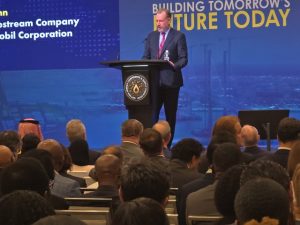
President of ExxonMobil Upstream Company and Vice President of ExxonMobil Corporation, Dan Ammann said Guyana needs to take the same approach as it did for the development of the oil reserves.
“The same alignment that enabled Guyana’s oil success, clear roles, shared standards, transparency and disciplined execution will be even more important for natural gas,” he told the 2026 Guyana Energy Conference.
With natual gas development being more complex than oil and requiring different infrastructure such as processing, compression pipelines and power systems, Ammann said gas would succeed when the entire upstream, midstream and downstream value chain comes together in the right sequence.
Ammann promised that ExxonMobil would match the pace of its partners in gas development which involves more players, utilities, industrial users, financiers and regulators.
He said ExxonMobil was committed to developing Guyana’s gas and maximising its value and impact for the country through rapid, safe and smart monetisation.
“When government advances, permitting approvals and market frameworks, we will advance engineering, execution and investment in lockstep. When government accelerates, we accelerate. Because the pace of gas development is not set by any one company. It is set by the readiness of the full system. That means regulatory approvals, environmental reviews, (14:10) land and marine use decisions, downstream infrastructure and, critically, market demand. Our message is simple,” he said.
The top ExxonMobil official said the development of the $6.8 billion Hammerhead project, which could produce up to 95 billion cubic feet of gas per day, would be the “first starboard project” that from the outset incorporates a plan to send gas to shore via pipeline.
He said a small portion of the gas would be used to run the floating production, storage and offloading vessel (FPSO) and the remainder to support the gas-to-energy project, future domestic industry or re-injection for optimised recovery. “That flexibility matters because the smartest development plan is one that maximises value across oil and gas altogether,” he said.
Ammann also said Hammerhead could also serve as a practical bridge to phase two of the gas-to-energy project when Guyana chooses to advance it. “More broadly, we see significant recoverable
gas resources particularly in the southeast part of the Stabroek Block. We believe that opportunity is compelling,” he said.
For his part, Guyana’s President Irfaan Ali said his country was keen on joint development of gas in the same area that Ammann referred to as part of plans to develop a second gas-to-energy project at Berbice.
He said discussions between Guyana and Suriname to get that project off the ground were “on target” and he hoped that could be done soon because “our investors are waiting for those decisions.”
“We want to do this with our friends in Suriname and we are hoping that our friends in Suriname can make a decision to join us by bringing their gas with our gas so we can move from a medium-sized project to a larger-scale project for both of our countries and for the region,” Ali said.