


Last Updated on Monday, 15 December 2025, 20:37 by Writer
Guyana will shortly begin training its own pilots when a local aviation school is established, according to President Irfaan Ali.
He said in collaboration with the private sector, government would be establishing a premier aviation school in Guyana to train and certify Guyanese talent across all areas of aviation.
They include, he said, air traffic controllers, engineers, policymakers and pilots.
“This school will have the capability to train and certify our pilots domestically. Our aspiring pilots will earn their wings right here in Guyana,” he said.
All of Guyana’s pilots are trained overseas at a cost of US$140,000 per pilot.
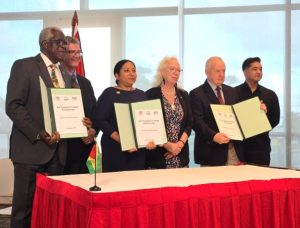
Ahead of the establishment of an aviation school, stakeholders recently launched the Guyana’s Next Generation of Aviation Professionals Programme.
A number of cadets have already enrolled to tap into that initiative which is a partnership of the Guyana Civil Aviation Authority (GCAA), the United Kingdom’s International Air Cadets Training (I.ACT) of Guyana, and the University of Guyana.
Dr Ali said each of them has brought its expertise, vision and commitment.
“Our domestic aviation network is expanding and it will expand further…because our government’s economic philosophy is built on the principle of inclusive development,” he said.
i.ACT said in a statement that the memorandum of understanding will see Guyana becoming one of the first states to implement i.ACT’s fully integrated next generation aviation operatives, technicians & professionals (NGAP+) programme, aligned with ICAO’s Next Generation of Aviation Professionals (NGAP) initiative and related Assembly resolutions and working papers.
The NGAP+ partnership directly supports the Government of Guyana’s goal of training 1,500 internationally qualified aviation personnel by the end of 2028 and creating a first-class regional aviation training hub.
Under the new framework, Guyanese youth and adults aged 16 and above – known as air transport cadets – will gain access to internationally benchmarked aviation education, technical training, and industry-focused life skills, with a pre-vocational “Air Cadets” track for youth aged 12–16, i.ACT also said.
The NGAP+ programme has been developed by i.ACT in collaboration with leading global partners including the International Space University, IATA Training, Airports Council International – Global (ACI-G) and CANSO, bringing world-class civil aviation and space-related training concepts into a single integrated framework.
i.ACT said a forthcoming technical support agreement between GCAA and i.ACT will enable international subject-matter experts to work alongside GCAA, ACG and UG to adapt NGAP+ curricula to Guyana’s regulatory and education systems, train local instructors and build institutional capacity, and develop a national NGAP+ implementation plan and ICAO-aligned reporting.
“The programme will roll out over an initial three-year period as a “living” national framework, with phased expansion across disciplines such as airport operations, air navigation services, airline operations, safety management, and emerging aerospace technologies,” i.ACT added.
“This is about giving Guyanese young people a direct pathway to jobs and careers in the aerospace sectors at home and across the region,” said Malcolm G. Evans, CEO of i.ACT in a statement.
“NGAP+ is designed as a transformational pipeline – from classroom and community air cadet activities, right through to internationally recognised qualifications enabling young people to apply for aviation related jobs, trades, and professions.”
Evans added: “Guyana is sending a clear signal that aviation is a strategic national economic asset and that of investing in young people.”
Head of Air Cadets of Guyana, Captain Gerry Gouveia Jr said getting into aviation is “quite expensive” but there are options such as taking a bank loan, join (sic) the military, and now through the cadet scheme.
“What we are also trying to do with Air Cadets of Guyana is that we are trying to connect another pathway of people to get into aviation-young people 11, 12 years old who look up in the sky and they see the aircraft flying through the air and they want to connect the dots of how do I move from here to there and that is part of the goal,” he said.
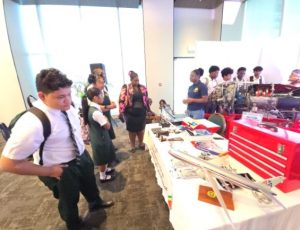
Mr Gouveia said the Air Cadets of Guyana would be teaching students leadership, communication, organisational management that are also key skills so that students can become competitive in the oil and gas sector.
He said the Guyana’s Next Generation of Aviation Professionals Programme would over the next five months attract youths in Georgetown who are interested in aviation to join the cadet programme before targeting other areas of Guyana.
UG Vice Chancellor, Professor Paloma Mohammed said that publicly-funded tertiary institution “stands ready and willing and we’re supplying some of the space, the expertise and the technical support to the programme.”
GCAA Director-General Retired Lt. Col, Field urged the numerous secondary school students to grasp the opportunity of getting into the field of aviation. “Children, youths. You have an opportunity. There has never been an opportunity like this in Guyana,” he said.
Among the attendees was David Hackett who welcomed the aviation cadet scheme. “I would say innovative and it’s on the new edge to see what is going on just in Guyana but also in the region,” said the budding pilot.
He also plans to evolve into management and focus on aviation law and its relationship with safety.