

Last Updated on Sunday, 7 December 2025, 22:27 by Writer

President of the Caribbean Manufacturers’ Association (CMA), Ramsay Ali has expressed concern about several lingering stumbling blocks to regional trade such as the absence of harmonised food import rules and the apparent selfish blocking of requests for waivers of the 40-percent common external tariff (CET) despite the obvious inability to supply certain products.
He said when objections to companies importing raw materials from extra-regional suppliers are filed to CARICOM’s ministerial Council for Trade and Economic Development (COTED) on the grounds that there are companies in specified member states that can supply the products, that process is usually time-consuming and expensive.
“At the end of the day, sometimes you’re out of raw materials and it’s a whole long issues and back and forth simply because you can object based on who you are here,” said Mr Ali, a former President of the Guyana Manufacturing and Services Association (GMSA). He appealed for action to be taken.
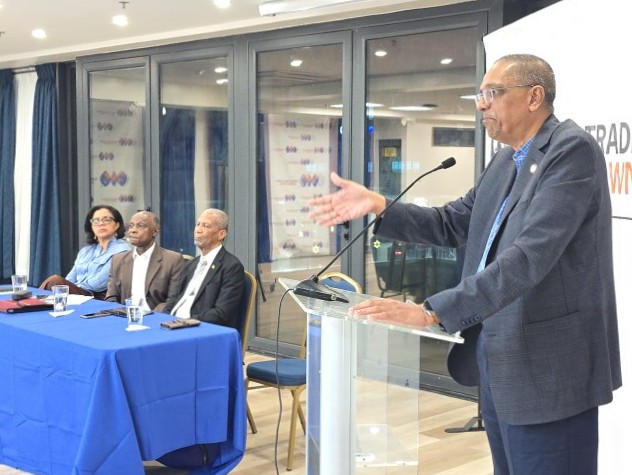
Citing the export of a food product as an example, he told a recent forum organised by the World Trade Centre Georgetown (WTCG) that the “distinct different” requirements, including the need for inspectors from the intended buying countries, point to the absence of a common set of rules. He said that type of non-tariff barrier (NTB) has been in place for many years with no apparent success in fixing that problem. “The frustration I have and some of us in the Caribbean and Guyana is we have been trying to fix this for years,” he said.
Mr Ramsey believed he knew the reason but declined to provide details. He hoped that the issue could be addressed because some of the smaller companies could not afford to pay for teams of experts to go to countries to validate the process.
The CMA President also criticised a number of CARICOM governments for violating the CET by allowing imports from extra-regional sources without payment of the tariff that is aimed at protecting local companies that have invested millions of dollars to produce the identical finished product. “There is no progress that is being made and I don’t know what can be done,” he said.
Mr Ali said there were hundreds of pending court cases about that violation across the region. “The governments of countries flagrantly break the laws of COTED and allow supermarket chains, private businesses, hotels, whatever, to import finished products from outside the region without paying the CET,” he said. Mr Ali, who is the Chief Executive Officer of Sterling Products Limited, said his company has 10 pending cases on that topic in the Caribbean.
Economist and global trade expert, Carl Greenidge defended CARICOM’s decision-making, saying that was not as a result of malicious or incompetent technical staff. Instead, he blamed governments at the regional level of decision-making. “COTED is a collection of government ministers. It’s probably the least effective of all the ministerial bodies, the committees of CARICOM,” said Mr Greenidge, a former Guyana foreign affairs and foreign trade minister.
He blamed several of the CET court actions on “breaches” and waivers on decisions taken by the regional trade ministerial council. Mr Greenidge diagnosed that part of the problem of market protection had to do with individual member states breaking the COTED rules on the basis of sovereignty. “You cannot pursue a collective course if each member state exercises that right to break the rules that they have collectively made,” he said. He urged the private sector to take advantage of the opportunity in CARICOM’s decision-making mechanism on trade.
However, CARICOM Single Market expert Neville Bissember said the COTED mechanism provides space for negotiating medium- to long-term exemptions. “The thing is working,” said Mr Bissember, a former assistant general counsel at the CARICOM headquarters.
Reflecting on the Caribbean Court of Justice’s (CCJ) decision in Trinidad Cement Limited’s case against Guyana’s unilateral CET waiver on extra-regionally produced cement, Mr Bissember said the regional court pointed out that there were rules to be followed. He said the two key questions are whether a country can supply the quantity and quality of the product in question.
Belize’s High Commissioner to Guyana, Gale Miller-Garnett, in her presentation, said Belizean manufacturers value the CET as means of protecting their industries.
She said maintaining the regional tariff also strengthens CARICOM’s negotiating leverage with external partners. “Belizean stakeholders regard the common external tariff (CET) as a crucial tool to support domestic industry and prevent market flooding by cheaper external imports,” she said.