

Last Updated on Tuesday, 20 May 2025, 19:59 by Writer
by Ivan Cairo
As Suriname prepares to head to the polls on May 25th, the nation stands at a critical juncture, grappling with significant economic challenges and looking towards its next political leadership. Beyond the immediate domestic concerns, this election also holds potential regional significance, possibly adding a third female head of government to the ranks of the Caribbean Community (CARICOM), a body where male leadership currently predominates, with notable exceptions being Mia Mottley of Barbados and the recently elected Kamla Persad-Bissessar in Trinidad and Tobago.
The Surinamese political landscape is dominated by two major parties, the National Democratic Party (NDP) and the VHP (Vooruitstrevende Hervormings Partij or Progressive Reform Party), both expected to secure the largest shares of the vote. However, recent polling suggests neither will achieve the outright majority required to form a government independently. This sets the stage for complex coalition negotiations following the election results, where the choice of president will be a central bargaining chip. Suriname’s presidential election process is indirect. The president is initially elected by the 51-member National Assembly, requiring a two-thirds majority vote. If this is not achieved after two rounds, the process moves to the much larger United People’s Assembly (VVV), comprising over 900 members, where a simple majority suffices. Traditionally, the leader of the party successfully forming or leading a governing coalition is nominated as the presidential candidate.
Against this political backdrop, conscious efforts are being made to enhance women’s participation and leadership. In June 2024, the Ministry of Home Affairs, with financial backing from the United Nations Development Programme (UNDP), initiated a campaign specifically designed to increase the involvement of women in these elections. A key component of this initiative, known as the ‘Excellence, Women First’ program and promoted with the hashtag ‘May 25, the president is female’, is public awareness aimed at paving the way for Suriname’s first female president after May 25.
Karin Refos, the lead consultant for communication on the project, expressed satisfaction with the progress made since the program’s launch a year ago. “It is high time for a female president for Suriname,” stated Refos, while maintaining neutrality on specific candidates. Refos has a history of conducting successful campaigns around the 2010 and 2015 elections that contributed to increasing the number of women in both parliament and government. However, 2020 saw a significant step backward in the representation of women within the government’s ranks. Recognizing the need to reverse this trend, the ‘Excellence, Women First’ campaign was established. Its 2024 launch specifically targeted political parties, urging them to place women in electable positions and appoint them to responsible roles within the country’s political administration. Looking at the current elections, Refos notes that over 40 percent of all candidates are women. Furthermore, she observes that within the top five positions on the lists of major parties, there are at least two female candidates in potentially winnable spots. Refos articulated her criteria for satisfaction, stating she would be pleased if, after May 25, the new government comprises at least 45 percent women. Ideally, she hopes to see a woman elected as president, vice president, or Speaker of Parliament.
Within this framework of promoting female leadership, two prominent women have indeed emerged as potential presidential candidates, presenting differing paths to the nation’s highest office.
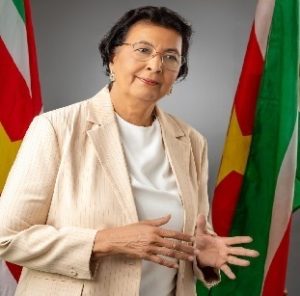
Leading the NDP is Jennifer Geerlings-Simons, a figure with a substantial political track record. Having entered politics in 2000, she has been elected as a Member of Parliament in five consecutive elections. Notably, Geerlings-Simons served as the Speaker of the National Assembly from 2010 to 2020, holding a key constitutional position. Given the strong tradition within Surinamese political parties to put forward their chairperson as the presidential candidate upon securing a leading role in government formation, Geerlings-Simons is considered to have a significant chance if the NDP can successfully build a coalition. Geerlings-Simons has articulated a vision for a fundamental revision of the Surinamese economy. She emphasizes that the economy should serve the people, not the other way around. Her platform stresses the need to create a stable economic situation that fosters well-being for all citizens, explicitly rejecting a model where wealth is concentrated in the hands of a few, leaving large segments of the population in poverty. Her stated priorities for investment include education, healthcare, production, infrastructure, and tourism – areas critical for sustainable growth and improving living standards.
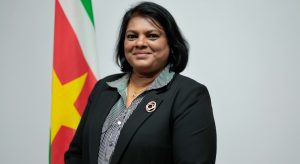
Contrasting with Geerlings-Simons’ established path is Krishna Mathoera of the VHP. A former police commissioner, Mathoera’s political career is relatively shorter, spanning about 10 years. She served as a Member of Parliament from 2015 to 2020 and subsequently became the Minister of Defense in the current VHP-led government after their victory in 2020. Mathoera recently announced her ambition for the presidency, directly challenging her party leader and current President, Chan Santokhi, who seeks re-election. Mathoera’s path to a potential presidential nomination is therefore more complex than Geerlings-Simons’. She would first need to win an internal party contest against the incumbent president to become the VHP’s presidential candidate. Her public messaging tends to focus on the importance of honest and integral governance. However, this stance faces challenges given the significant criticism leveled against the current government, of which she is a part, regarding issues of integrity and economic management. Furthermore, operating within the shadow of the party leader and president means her specific policy stances, beyond the general call for good governance, are not as clearly defined or widely publicized compared to Geerlings-Simons.
While Geerlings-Simons benefits from her position as NDP chair and the party tradition, and possesses a longer history in legislative leadership, Mathoera brings executive experience as a minister and a background in law enforcement. However, the ultimate determinant of which woman, if either, could become president rests heavily on the post-election coalition negotiations. Whichever party successfully cobbles together the necessary majority in the National Assembly (and potentially the United People’s Assembly or VVV) will be in a position to nominate their leader or chosen candidate for the presidency.
Suriname’s election on May 25th is a pivotal moment for the nation’s future governance and economic direction. It also presents a compelling possibility for Suriname to elect a female head of state for the first time in history, adding a significant voice to female leadership within the CARICOM region. While Jennifer Geerlings-Simons, as leader of the NDP, currently appears to have a more direct route to nomination should her party be in a position to form a government, Krishna Mathoera’s announced ambition within the VHP adds another layer to this narrative of potential female leadership, a narrative actively supported by campaigns like ‘Excellence, Women First’. The coming weeks will reveal not only the composition of the new National Assembly but also the intricate dynamics of coalition building that will ultimately determine who is best placed to lead Suriname forward. It is highly likely that if the NDP takes the lead in the upcoming coalition government, their presidential candidate will be none other than the party leader herself, Jennifer Geerlings-Simons.