
Last Updated on Wednesday, 8 July 2026, 22:44 by Writer
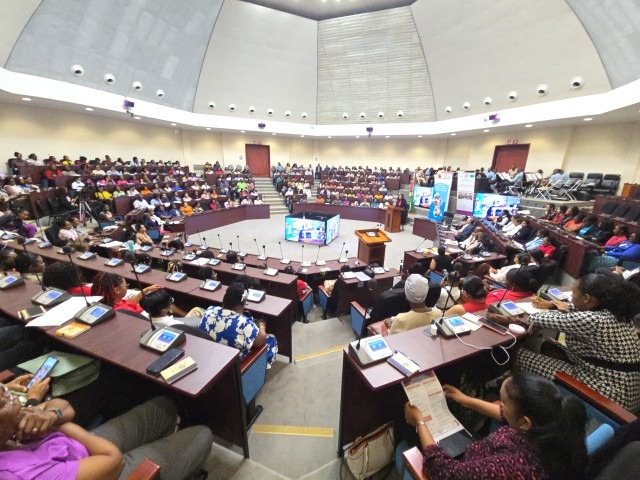
Children 0 to 2 years old must not be allowed to use digital devices such as phones and tablets because of the impact it can have on their mental health, Minister of Human Services and Social Security Dr Vindhya Persaud said on Wednesday.
“Think about what you do with your child when your child is active and anxious. You give them the phone and you give them the tablet, and let me remind you that children below the age of two should have no screen time,” she told the opening of her ministry’s Early Childhood Development Conference that was hosted by the Childcare and Protection Agency (CPA) in partnership with the United Nations Children’s Fund (UNICEF) and the Canadian government.
Dr Persaud cautioned against giving such young children those devices because at that time they are having important brain development. “You have to be conscious of what is going into that child’s brain. Should not be a phone and tablet. If you’re doing it, stop,” she added.
The minister also advised that as the children get older, they can be given such devices two hours per week.
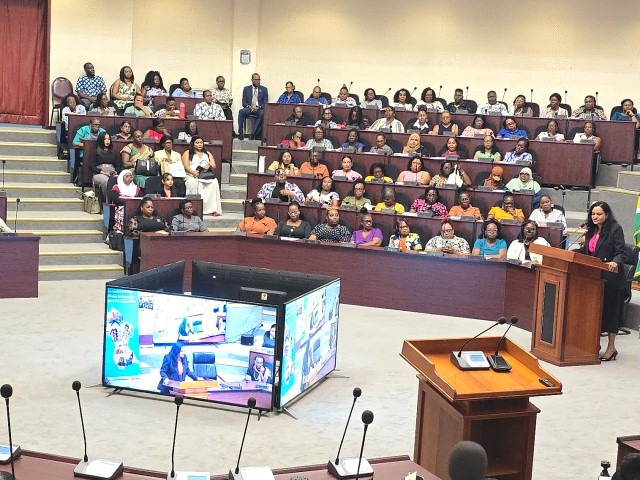
The conference aims to bring together key stakeholders to highlight Guyana’s continued efforts to strengthen early childhood development, promote the safety and well-being of children, and improve the quality of services provided to young children nationwide.
Dr Persaud encouraged community-based care centre owners across Guyana to access financing from the GY$1.2 billion co-invest initiative to purchase furniture, access technical expertise to start, sustain and expand their operations.
Already 700 persons have registered, and she said the money would be allocated to centres to ensure there are safe and child-friendly spaces in which they can learn, grow and play.
She said the aim is to ensure parents can afford to pay for use of the care centres.
“I say affordable care because the one request the government has is when we co-invest with you, your service should be accessible to all. It is in the heart of the community so parents know the persons who will be caring for the children. It is in the heart of the community so transportation would not be an issue,” she added.
The minister said so far 352 care centres have been licensed and 376 registered. There are also 25 centres of excellence that include specially trained staff.
She said the 100 owners of the care centres have been provided with the equivalent of GY$10 million to support their transformation to centres of excellence.
Dr Persaud said, too, that 460 parents have received GY$25 million in three-month contributions for their children who are placed in registered and licensed care centres. “It is making sure that children are placed in safe environments.,” she said.
Director of Children Services Levine Gouveia said the pillars of Guyana’s National Integrated Early Childhood Development Policy includes cross-sectoral collaboration and coordination, safety and security, access, quality, and inclusion in early childhood development services.
She said the policy also focuses on children’s health and nutrition, parenting and family support, research and infrastructure.
“All of these areas work together to ensure that we have a robust child protection service, as it regards our children, zero to three, or what we say, pre-nursery years,” she said.
Charge D’Affaires of Canada’s High Commission Adam Loyer, whose country supported the development of the National Integrated Early Childhood Development Policy, said together they had supported the expansion of quality early childhood development services to more than 48,000 children and over 35,000 parents and caregivers across Guyana.
Mr Loyer said they had also seen ECD programming reach 156 communities, surpassing the original target.
He said one of the most significant achievements has been the launch of Guyana’s National Integrated Early Childhood Development Policy.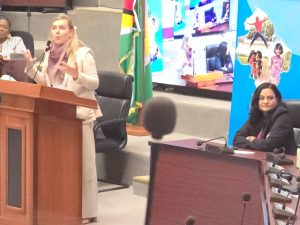
UNICEF Representative for Guyana and Suriname Anna Azaryeva Valente emphasised the need for greater awareness about the pillars of the ECD policy.
She highlighted the importance of inter-sectoral coordination in executing the policy.
Acknowledging that Guyana had made strides in fighting a number of social ills, Ms Valente said there was still much more work to be done.
“We know that while we have moved further ahead in Guyana, there are still communities that are vulnerable. There are still services where quality can be improved, so there are still milestones to be achieved, promoting children’s health, nutrition, and protection, empowering parents and caregivers with information with access to support, not just responsibility, but also accompaniment in this important task, using evidence to guide our action, and finally securing sustainable investment in early childhood services with policy and guidelines,” she said.
The UNICEF Representative charged participants — who included experts, caregivers, parents and guardians, and early childhood service providers — to learn, understand, ask difficult questions, critique and identify gaps and challenges, seek clarifications and suggest new areas of effort.
“Please take this opportunity to be active, to go back to your knowledge, share it with each other, share it with us, help us collectively to understand what we should prioritize, where we still have difficulties, and how we need to move forward,” she said.
Discover more from Demerara Waves Online News- Guyana
Subscribe to get the latest posts sent to your email.