

Last Updated on Saturday, 20 June 2026, 9:28 by Writer
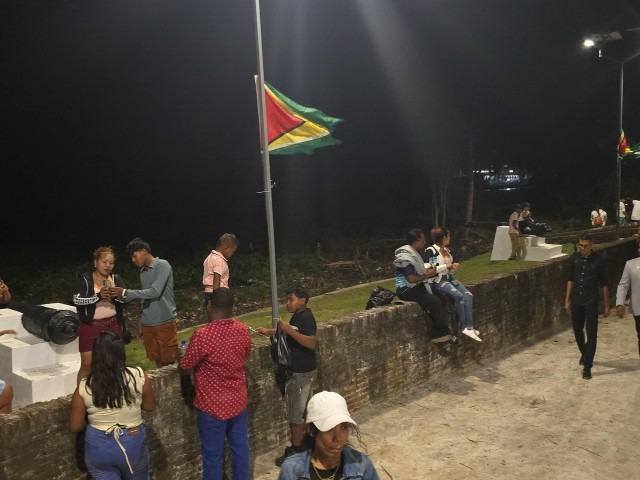
 The almost 300-year-old fragile brick fort on Fort Island was at grave risk of being badly affected by the impact of last month’s 60th independence anniversary flag raising ceremony on that Essequibo River island, a city and regional planning expert said.
In addition to the removal of top soil by the grading of several areas on Fort Island near one of the Fort Zeelandia structures, mangroves, a natural habitat for birds and marine species, were bulldozed.
During the evening of the flag raising ceremony, no one was seen at the time enforcing the National Trust’s rules around the fort.
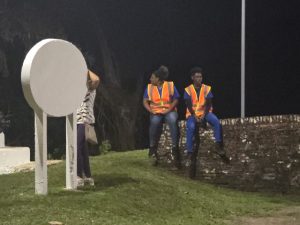
Persons were seen climbing, sitting, walking and jumping on various parts of the structure that was already under visible stress from weathering.
Ceremonially-dressed members of the Disciplined Services were also seen standing in the upper flat of the fort.
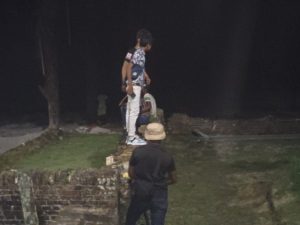
United States-trained city and regional planner Dr Allyson Stoll told Demerara Waves Online News that such actions, such as people sitting on the brick revetments of a section of Fort Zeelandia’s ramparts (defensive perimeter of the fort), and walking around on top of the earth-filled ramparts should not be allowed at any time.
She said there was a grave risk of further damage and destruction to the fort whose construction was completed in 1749.
“The entire section can collapse inward, or outward especially with the removal of the vegetation surrounding the outer revetment, bricks can be dislodged either singly or in sections. Much loose brick has already been removed and used by island residents to build their house foundations etc.,” she said.
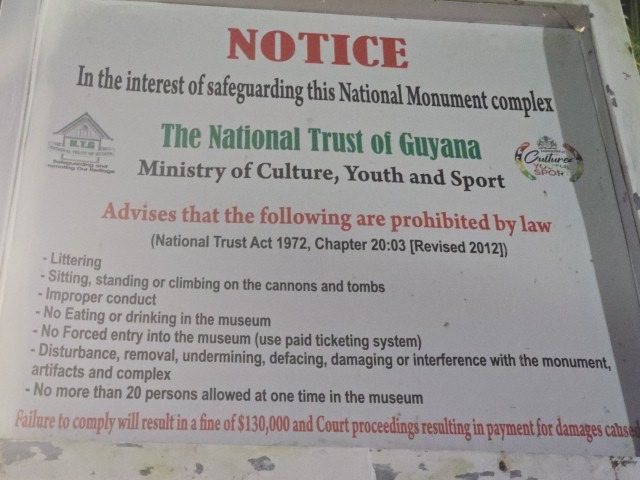
The National Trust has a sign erected nearby the fort, warning persons that they would be fined GY$130,000 and taken to court for an order to pay for repairs to the site.
Specifically, the National Trust Act states that, “Any person who disturbs, removes, undermines, defaces or in any manner damages or interferes with any national monument or anything therein or thereupon otherwise than in accordance with the written permission of the National Trust is liable on summary conviction to a fine of one hundred and thirty thousand dollars, and in those proceedings the court may, in addition, order him to pay such sum as the court thinks just for the purpose of repairing or restoring the monument”
With no scientific studies or analyses done, Dr Stoll said no one knows the condition of the site including whether the walls are stable, have animals dug holes under, and the condition of the iron braces holding the walls emplaced there in the 1740s.
She said river sand was taken to the fort, dumped and compacted by bulldozers.
“Absolute madness to even conceive such an operation that introduces untested materials into a site that has not been studied. Any decent structural engineer should have said ‘no’ to dumping tons of sand on an earthen Fort site hundreds of years old. Above all, for no justifiable reason,” she said.