
Last Updated on Friday, 5 June 2026, 22:11 by Writer
As the Guyana government continues to boast that the increasing number of vehicles is a sign of wealth, the Caribbean Development Bank (CDB) says more roads alone will not alone solve the problem of congestion across the region but the focus must be on mobility, inter-agency planning and technologically-driven coordination.
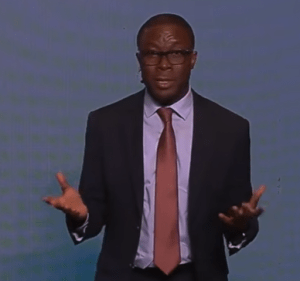
“A key point, as we said, is moving away from the idea that congestion can be solved by expanding roads alone. Instead, the focus is on integrating urban mobility. That means looking at the system as a whole,” CDB Acting Division Chief, Economic Infrastructure Division in the Projects Department, William Ashby on Friday told a bank forum titled “Edge X by CDB: Unlocked – Stuck in Traffic: What Congestion Is Costing the Caribbean?”
Among the areas he identified that requires close attention are public transportation, land use, demand management and the role of technology.
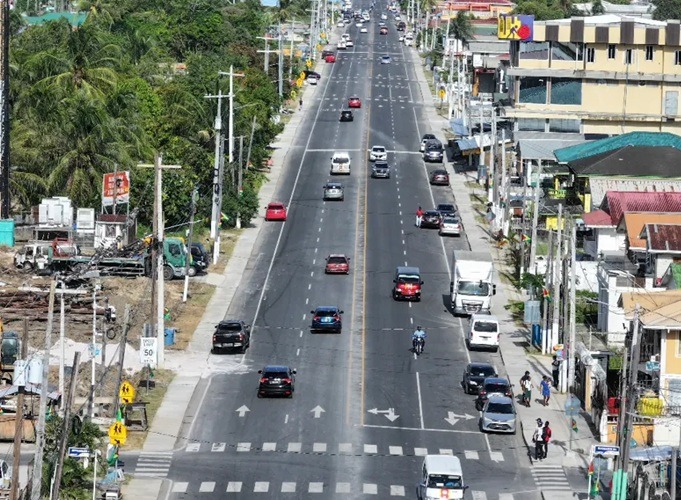
In Guyana, the government has narrowed several trenches and widened parallel roads to facilitate the ever increasing number of vehicles.
A number of new highways have also been constructed in West Demerara and East Demerara.
He says congestion, a cross-cutting urban development and a macro-economic issue, is a “regional problem” that impacts on productivity, costs and growth.
Mr Ashby explained that road congestion has implications for health, climate resilience, labour markets and housing.
The CDB official recommended an “analytical foundation” to understand the problem through mobility plans, congestion studies and feasibility studies.
He said the Barbados-headquartered development bank could support that work through technical assistance, project preparation, policy-based operations and other instruments.
In the area of investments, he said that financial institution could provide loans, grants and concessional resources for public transport, walking and cycling infrastructure and traffic management “as part of one coherent approach.”
Mr Ashby discouraged planners from “reacting project-by-project” and instead make evidence-based and coordinated decisions.
He cautioned that infrastructure and planning would not be enough to solve the road traffic congestion problem, and so should be supported with clear roles, coordination and stronger institutional measures.
“In many cases, congestion is made worse by how responsibilities are distributed across the system with infrastructure, transport planning, policing – responsibility for these decisions sitting in different places, often without sufficient coordination,” he said.
At the same time, the CDB economist said Caribbean countries need to build capacity in traffic engineering, transport modeling and mobility planning so that solutions could be designed, implemented and sustained.
He also said policies were needed to “actively manage demand such as flexible or staggered working hours, parking policies and pricing and incentives of car-pooling and ride-sharing. “These kinds of measures can have a very direct impact on reducing pressure on the transport system,” he said.
Mr Ashby also made out a strong case for accessing and using real-time data from sensors and GPS (global positioning system) tracking, traffic control centres and digital dashboards to make resolving congestion a priority. “With that kind of information, the approach shifts from reacting after problems occur to anticipating and responding in real time,” he said.
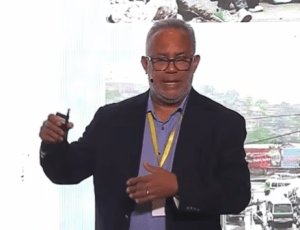
Mr Ashby also floated the idea of small pilot projects such as adaptive traffic signals, smart parking systems or bus priority measures in high congestion areas. Such an approach, he said, would allow the testing of options before scaling.
“Congestion in the Caribbean is solvable but only if we treat it as the real development issue that it is,” he added.
Dr Rae Julien Furlonge, Managing Director of LF System, a regional traffic and transportation consultancy, told the forum that the importation of cheap vehicles into the Caribbean over the past 30 years was seen by governments as an opportunity to earn revenue from taxes, and the establishment of businesses.
On the downside, he said, the “wicked cycle” had seen countries spending more foreign exchange on fuel imports and bitumen to repair roads, compounded by insufficient and unreliable public transportation system.
He noted that more than 60 percent of the users of public transportation were women and children.
Dr Furlonge said hidden costs of road traffic congestion include lost productivity, wasted fuel, delays, lost time, stress and fatigue, pollution, missed opportunities and stunted economies.
But the transportation consultant said he gleaned from business owners that they preferred vehicles to slow down so that commuters could see their businesses.
Dr Furlonge strongly recommended that Caribbean people “rethink mobility” by removing vehicles from the road, rather than divert them to another road. “Take them off during the peak periods because that’s when you have the congestion,” he said, adding that the aim was to reduce vehicle kilometre usage.
He said developed nations had achieved a 30 percent reduction.
He said despite the high number of cars, Caribbean peoples do not have access to good public transport and the commuters are inconvenienced by the owners of private vehicles during periods of congestion.
Another option, he said, is to pay-as-you-drive, a premium fee based on historic use of the car.
Rather than tolls and other types of payments, he also recommended an income tax rebate for employers and employees.
In the area of parking management, Dr Furlonge said short-term techniques could include parking management, park-and-ride, roundabout metering, intersection improvements, double-lane roundabouts, improving the entry angle to clear roundabouts and improving signal timings, and eliminating arbitrary stopping of buses.
Discover more from Demerara Waves Online News- Guyana
Subscribe to get the latest posts sent to your email.