
Last Updated on Saturday, 23 May 2026, 7:56 by Written By Denis Chabrol
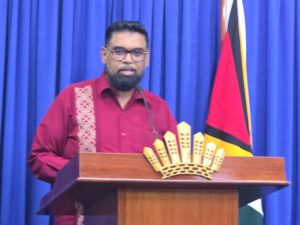
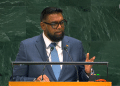
Amid lingering concerns about weak copyright and other types of intellectual property (IP) rights legislation, President Irfaan Ali on Friday said his government would shortly hold consultations.
“On the issue of copyright, we have to have some consultation as to what form it will take,” he said in response to a question from Demerara Waves Online News.
Dr Ali said he was keen on hearing soon the perspectives of the artistic community on those rights.
He suggested that the first line of consultations could be held on social media. “Maybe, we should move this up on the agenda and start the consultation on that,” he said.
The President’s desire for consultations on copyright and other types of IP came one day after Government Efficiency Minister Zulfikar Ally listed creative and digital industries among the “key sectors” that would attract financing from the soon-to-be-established Guyana Development Bank.
However, during question time after his presentation to the Guyana Manufacturing and Services Association (GMSA) business luncheon earlier in the week, he could not provide details on plans to tackle rights protection of creative works. “That’s a whole new sector that we are currently looking at,” he said.
Guyana is yet to replace the 1956 British Copyright Act after it gained independence from Britain in 1966.
Efforts in the early to mid-2000s to enact modern copyright and IP legislation were stymied by a lack of political will.
The People’s Progressive Party Civic last year promised legislative reform as part of its election campaign promise but so far there has been no movement.
The National Assembly is yet to consider a motion by the opposition A Partnership for National Unity (APNU) calling for a bipartisan select committee and clear timeframe for the presentation of those laws to the House for debate and passage.
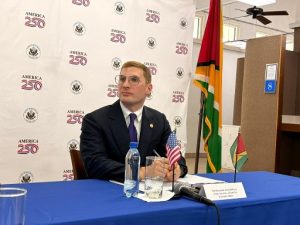
US Under Secretary of State for Economic Affairs Jacob Helberg, during his visit to Guyana on May 13, highlighted the importance of respecting private property, including IP.
Asked specifically whether intellectual property and copyright legislation were raised specifically with President Ali and whether he had secured a commitment from him, the top American policymaker said that was a crucial element to accelerate private investment and realise Guyana’s potential as one of the most prosperous economies in the Western Hemisphere.
“In order to do that, certain conditions have to be met, including the right to private property, including respecting intellectual property, including different kinds of principles of governance that the private sector necessarily needs in order to have the confidence, the predictability, and the certainty to deploy and invest a lot of money. And so we focused on the goal. We agreed on the goal,” he said.
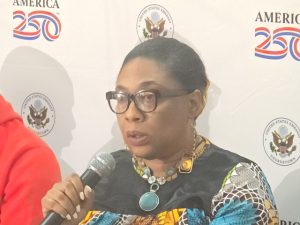
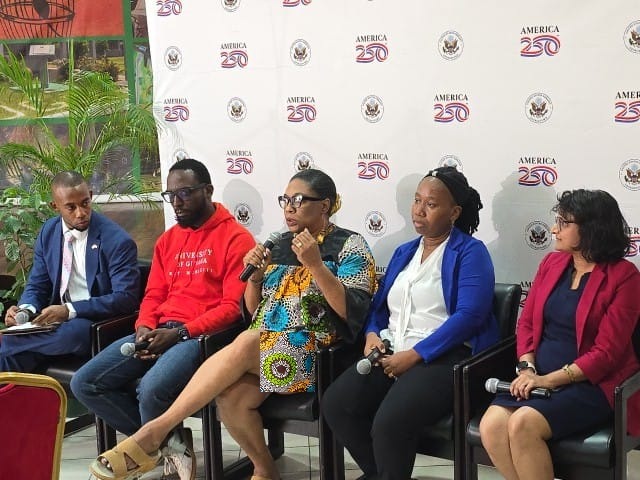
The issue of weak intellectual property protection was also raised by Founder and Executive Director of STEM Guyana, Dr Karen Abrams during a panel discussion organised by the US Embassy in Georgetown to discuss STEM (science, technology, engineering and mathematics) education and innovation.
She painted a bleak picture of the country, calling it a “shallow market” made up of a small population, significant poverty, and a lot of competition in a small marketplace where there is no protection for literary and artistic works, inventions and creations.
“For innovators, the minute you throw out an innovation, there’s no protection, no IP protection. It’s co-opted by the powerful entities,” she told the well-attended event held at the University of Guyana.
While Dr Abrams reasoned that the structure of the environment was responsible for that situation, she also indicated the need for a national science foundation.
Such an entity, she said, could provide funding to university professors and students to conduct research rather than doing it on their own without IP protection.
She also recommended that Guyanese protect their intellectual property overseas.
“If you want to do something big and technical, you should be thinking globally. You should protect your ideas. So there’s not a whole lot of protection for ideas in Guyana but wherever you look overseas, those markets do offer protection for your ideas,” she said.
Dr Abrams urged that attention be paid to the “beginning of the pipeline” where half of Guyana’s children were struggling with math and literacy, and then 50 percent drop out around the ninth grade.
“You can’t develop an innovative ecosystem if you lose half of your children in a tiny country where you need them to not only develop the oil industry, you need them to be thinking in 2046, what are those industries?
Earlier this year, APNU parliamentarian Nima Flue-Bess filed a motion calling for the establishment of a special select committee to review the existing copyright laws and identify specific gaps concerning digital rights and enforcement.
APNU also wants consultation with the relevant stakeholders across the creative industry to ensure that their needs are reflected in a new legal framework.
After that is done, Ms Flue-Bess said a draft modern copyright bill should be presented to the 65-seat National Assembly for consideration within six months.
Discover more from Demerara Waves Online News- Guyana
Subscribe to get the latest posts sent to your email.