
Last Updated on Wednesday, 25 March 2026, 21:57 by Writer
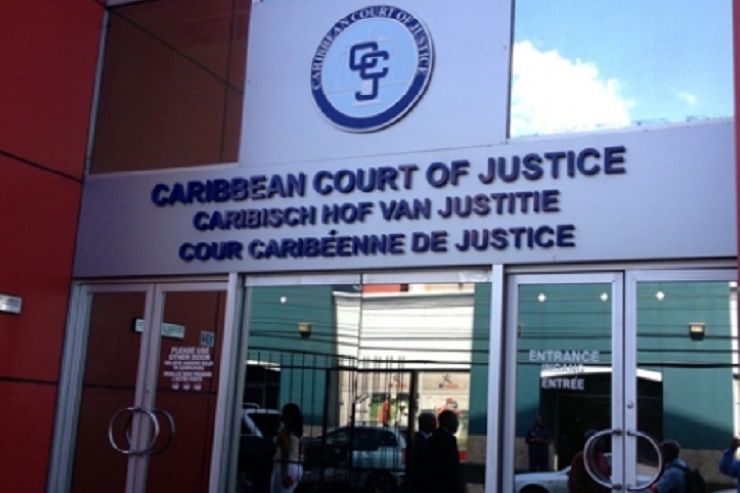
The Caribbean Court of Justice (CCJ) on Wednesday granted an interim stay of the extradition commital proceedings involving city businessmen Azruddin Mohamed and his father Nazar “Shell” Mohamed pending the hearing and determination of their appeal.
“An interim stay of the proceedings for the extradition of the Applicants/Intended Appellants before the court of committal presided over by the Third Respondent is granted until the determination of the special leave application and/or the substantive appeal and/or until further order of this Court,” states one of the orders.
CCJ President, Winston Anderson said the stay was being granted “in the interest of justice.”
He acknowledged the need for extradition cases to be addressed “expeditiously”.
He hoped that the Court could make a decision on April 21 or “soon after.”
The CCJ set April 21 to hear an application by the Mohameds to appeal a decision by the Guyana Court of Appeal that hinges on the issue of political bias in their extradition case.
They are challenging the Guyana Court of Appeal’s decision that the home affairs minister Oneidge Walrond performed an administrative function in issuing an Authority To Proceed (ATP) to a magistrate to go ahead with requests by the United States (US) for them to be extradited to face trial for alleged financial crimes.
The Trinindad-based regional court granted the application for permission to appeal the Guyana Court of Appeal decision as the substantive appeal.
Meanwhile, extradition committal proceedings had been scheduled to resume from April 7 to 10 because the younger Mohamed is suffering from dengue, according to a diagnosis and lab test results submitted to Principal Magistrate Judy Latchman on Tuesday.
Neither the High Court nor the Guyana Court of Appeal had granted a stay of the committal proceedings pending their hearings and decisions.
The CCJ directed that the Respondents file affidavits in opposition on or before 2 April 2026.
The parties are to file written submissions, in relation to the application for special leave on or before 10 April 2026, and any written submissions in reply, on or before 15 April 2026.
The application for special leave is scheduled to be heard via video conference on 21 April 2026 at 9:00 a.m. (AST).
The CCJ panel comprised Justice Anderson, and Mme Justice
The Appellants were represented by Fyard Hosein, SC; Roysdale A Forde, SC; Siand A Dhurjon; Damien Da Silva, and Aadam Hosein.
The First Respondent was represented by Douglas L Mendes, SC and Clay J Hackett.
The Second Respondent was represented by Mohabir Anil Nandlall, SC, Attorney General; Nigel O. Hawke, Solicitor General; Shoshanna V Lall, Deputy Solicitor General; and Dishon Persaud.
The Third Respondent was represented by Arudranauth Gossai.
The ATP paved the way for Ms Latchman to issue arrest warrants for the Mohameds and subsequent committal proceedings.
But the Mohameds are maintaining that Ms. Walrond’s decision was “infected” by political bias due to the utterances against primarily Azruddin Mohamed, amounting to political persecution by his opponents – Bharrat Jagdeo, Anil Nandlall and Irfaan Ali.
“The Court of Appeal erred in law and in fact when it failed to give due weight to the sheer prejudicial nature of the accepted evidence of innumerable statements uttered by the minister’s political leaders to whom she was answerable namely the President, Vice-President and the Attorney General who for several consecutive months prior to the issuance of the Minister’s ATP constantly advanced their views and acted as a pressure group in labelling the Mohameds as ‘criminals’, ‘tax frauds’, ‘dishonest’, ‘robbers’, etc and ‘guilty’ of the very offences which formed the subject of the ATP,” the grounds for the appeal to the CCJ also state.
The Mohameds are asking the CCJ to find that the Guyana Court of Appeal erred in law when it found that the Minister’s issuance of the ATP setting in motion the extradition committal proceedings was merely an “administrative act incapable of attracting any actual, perceived or notional bias’ impermissibly immunising the Minister’s ATP decision from being susceptible to judicial review for bias and so carved out in law a category of decisions which is immunity from bias.
In their appeal, the Mohameds said the Guyana Court of Appeal failed to consider that the minister and her association, her government and its leaders, directly stood to benefit politically from the extradition of her and her association’s main political rival and his father and as such would justify the prejudicial statements made by her political leaders prior to the issuance of her ATP and suppress the Applicants’ political views adverse to her and her association, and otherwise.
The CCJ is also being asked to find that the Court of Appeal was wrong in law when it found that the Attorney General was not infected with bias, presumed and apparent, due to the prejudicial statements made by him against Mr Azruddin Mohamed in evidence which were unaddressed.
They said the Court of Appeal failed to consider that the minister, if the magistrate ordered the committal of the Applicants, was obligated under the Fugitive Offenders Act to make the final decision as to whether or not to issue an order extraditing them and so the minister’s impartiality was indispensable to their right to receive a fair hearing from an unbiased tribunal/decisionmaker.
Also cited as grounds for appeal was the Guyana Court of Appeal holding that the ATP decision of the minister and any role of the Attorney General in facilitating and/or advising on the ATP could not be delegated to a person unaffected by presumed or apparent bias under section 27 of the Interpretation and General Clauses Act, Cap. 2:01, and/or the Carltona principle.
The appellants also contend that the Court of Appeal erred in law in failing to give due consideration to the fact that the ATP decision substantially encroaches upon the fundamental rights of persons as it confers and empowers jurisdiction to the court of committal and triggers the local extradition process, without which no arrest, committal or extradition may occur.
The Mohameds also said the Guyana Court of Appeal made a mistake by relying on subsequent judicial safeguards such as committal proceedings and habeas corpus to find that bias was incapable of arising in the initiation stage or the ATP decision.
Further, the appellants say the Court of Appeal failed to consider the duty of fairness owed by the Minister to the Applicants/Intended Appellants considering the substantial adverse impacts it would cause on the lives of the Applicants/Intended Appellants.
According to the appeal that was filed with the CCJ, the local Court of Appeal erred in law and misapplied the pertinent principles emanating from the House of Lords decision stating that the Mohameds needed to establish that the Minister had ‘a direct and personal interest, that is, proprietary, pecuniary, or, equivalently close in the outcome of the proceedings’ when in fact under the said authority, a direct interest in the proceedings that was political or associative was sufficient to automatically disqualify one for presumed bias.
They also say the Court failed to draw appropriate adverse inferences from the Attorney General’s breach of the duty of candour and lack of disclosure before the High Court where he failed to disclose what role he played or did not play in the issuance of the ATP and was silent on said matters.