

Last Updated on Thursday, 19 March 2026, 22:41 by Writer
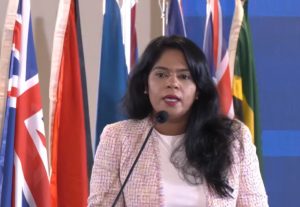
Guyana is this year introducing Grade Two and Grade Four literacy assessments in schools in an effort to produce more literate persons, education minister Sonia Parag told a meeting of Caribbean education ministers in Jamaica on Wednesday.
She also told the commencement ceremony of the 2026 CXC® Ministerial Forum and the closing of the CXC Regional Education Conference that those assessments are aimed at ensuring that students can read by the time they get to Grade Four “so they are exiting the primary schools literate.”
Ms Parag said she agreed with a top CARICOM official that the region was “producing functionally (sic) illiterates.”
Another aspect of the plan to improve reading, she said, is the establishment of literacy tents in communities for parents to assist their children with their homework. “We want them to be actively involved in their children’s development from the point of view of the academics so making them literate is not only for the students and their children but it is also for their own development,” said Ms Parag who is also Chairman of the Caribbean Community (CARICOM) Council for Human and Social Development (COHSOD) – Education.
The education minister said next year Guyana would be introducing the numeracy assessment in schools.
She also told the forum, which was held at the Jamaica Pegasus from March 16–18, 2026 under the theme “Navigating the Digital Age: Rethinking Teaching, Learning and Assessment”, that the Caribbean must embrace artificial intelligence (AI) as a tool for the education sector to develop lessons, personalised learning, provide immediate feedback, and improved learning for children with special education needs.
However, in light of the creation of false images, manipulation of images and messages, plagiarism, increased physical and virtual bullying, data privacy and uncritical acceptance of information, she recommended that tough measures be put in place.
The Minister of Education charged her colleagues and educators from across the Caribbean to introduce AI into the school systems in a way that is responsible, structured and grounded in clear ethical standards.
She said the time had come for the Caribbean to develop “clear frameworks” for AI integration into education.
“We’ve seen this before when cellular phones first entered our schools; there was widespread concern about distraction and misuse. Over time, we recognised that the solution was not prohibition but integration with clear boundaries and purpose. The same principle must now guide us,” she said.
While students would be expected to produce authentic work and be responsible in using powerful technology, she said a Caribbean-wide framework on AI in education must focus on ethics, data protection, academic integrity and child safety without impeding innovation and growth. “It is a matter of safeguarding our students, preserving the integrity of our systems and ensuring the use of these tools aligns with the values that we hold as Caribbean societies.”
Chair of the Conference Committee, Nicole Manning, in a summary of the “rich” CXC Regional Education Conference concluded with the need for assessment that prioritises fairness authenticity and competence at all levels, sustained investment in teachers’ accessibility and digital infrastructure , strong regional collaboration and shared ownership of reform, and building inclusive, resilient, ethically grounded and future-ready education systems in the face of technological change. “Overall, the conference affirmed the Caribbean’s determination to move from rhetoric to action,” she said.
Ms Manning said including voices of students and parents in a “great way” was also a key outcome of the conference.
CXC Chairman, Sir Hilary Beckles, who authored the history syllabii for CXC and CAPE, noted that 50 years ago history was a compulsory subject unlike today. He said the “consequences” of persons not knowing their history was obvious today, and despite a recommendation to return to mandatory teaching of the subject nothing has happened.
Sir Hilary said on the other hand CXC had introduced a “suite of remarkable future generational” curriculum in areas of technology science.
Though they were celebrated in conception, he said there was extreme difficulty in implementation due to a shortage of teachers, laboratories or technology to participate in contemporary, highly needed programmes in most schools.
In light of those circumstances, the official welcomed the CXC Regional Education Conference as a means of bringing all stakeholders together to talk about the issues and find scarce financial resources rather than engage in public squabbles. “They will be divisive, there will be differences but we will internalise these conversations and find solutions that are acceptable to our community,” he said.
Caribbean Community (CARICOM) Assistant Secretary General for Human and Social Development, Alison Drayton appealed to participants to act with “urgency and purpose” in this digital age which is already reshaping the region’s societies and economies. “My first charge is to act with urgency. We cannot afford incremental adjustments. The pace of technological change demands bold, systemic transformation,” she said.
The regional official cautioned that every delay risks widening inequities and leaving segments of populations behind combined with the impacts of COVID-19 and yearly hurricane disasters.
For her part, the education minister of Guyana challenged the CXC body, policymakers and regional leaders to rethink education for the digital age in a phased manner.
She said that could not be done in a “sudden, heavy-handed manner that leaves students and teachers feeling pressured, unprepared or excluded. “Reform that is not understood will be resisted, Reform that is not grounded in consultation will struggle to take root and reform that does not account for the realities of a region may very well deepen the very inequalities we claim to be addressing,” she said.
Ms Parag further recommended that there be groundwork and consultation, and a “genuine meeting of minds” by all stakeholders, especially educators, to ensure there is not only compliance but buy-in, adjustment and appreciation.
Ms Drayton charged the gathering to reimagine teaching by shifting from the rooted content delivery approach and focus on critical thinking, creativity and problem solving.
At the same time, she agreed that numerate and literate students must be graduated to teach themselves.
She said through a renewed commitment to teacher development, teachers must be supported to become facilitators, innovators and leaders in the digital classroom.
The CARICOM official said learning must be transformed into something flexible, inclusive and responsive to the diverse realities of Caribbean learners.
While the region must take full advantage of technology in teaching and learning, she said the Caribbean must be vigilant against losing its identity. “At the same time, we must ensure that digital transformation strengthens rather than erode Caribbean identity and our values or our cultural grounding,” she said.
Ms Drayton said there must be regional unity across the ministries of education, CXC, teacher education institutions, private sector and development partners.
“We must act collectively as a Caribbean community. No single country, institution or agency can undertake the transformation alone,” Ms Drayton also said.