

Last Updated on Thursday, 12 March 2026, 18:10 by Writer
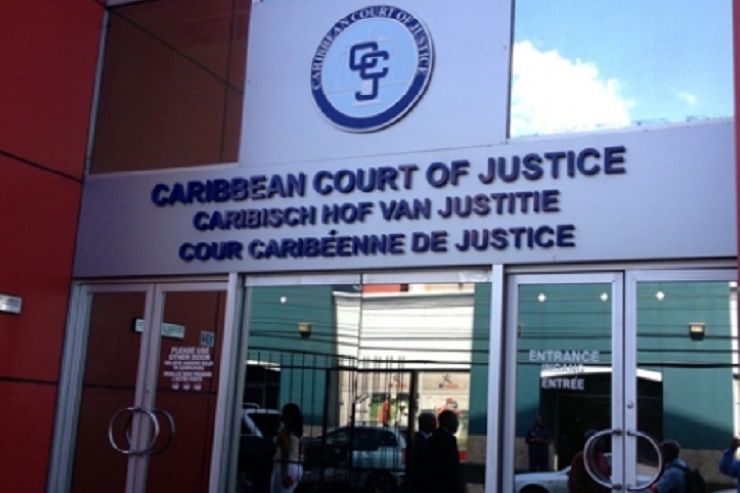
The Caribbean Court of Justice (CCJ) has dismissed an appeal by the Guyana government over an arbitration award to Azad Meerza, trading as Falcon Transportation and Construction Services, paving the way for the business to be paid GY$179,946,850 for road works.
The CCJ on Wednesday dismissed the appeal in the case of the Attorney General versus Falcon of Lot 108 Meten-Meer-Zorg, West Coast Demerara, marking what appears to be the end of a 15-year dispute.
“Based on the evidence before the Court, the appellant was fully aware and had been represented at various stages of the court proceedings, which was supported by the exchange of correspondence between the parties. In the circumstances, the CCJ said it dismissed the appeal, holding that the appellant effectively waived its right to object and upholding the decision of the Court of Appeal of Guyana that the award be enforced,” according to a summary of the decision.
The genesis of the dispute lies in a contract between the parties in 2009 for certain road works pursuant to the Agricultural Export Diversification Programme’s Canal Polder Control Structures and Access Road.
The case, centered around alleged changes to the scope of the work, spawned a disagreement in 2011, which the parties have been trying to resolve over the intervening 15 years through adjudication, arbitration and now litigation.
In the proceedings, the CCJ said the government objected to the enforcement of an arbitral award made in favour of the respondent regarding a contractual dispute between the parties for road works.
The Attorney General argued that one of the arbitrators, Mr Edward Gonsalves, was biased because he had sat on a previous tribunal
The CCJ says it rejected the claim of apparent bias and held further that the government had lost the right to object because it failed to do so in a timely manner.
The Court held that the mere fact of having sat on a previous panel adjudicating
Moreover, since an exhaustive list of situations giving rise to the potential of bias could not be laid down in advance, each case fails to be determined on its own merits.
On the issue of waiver, the CCJ noted that the rules of international arbitration, by which the parties agreed to be bound, dictate a 15-day window to raise any questions regarding an
Lastly, while the Court accepted that each arbitrator has a duty to disclose any fact or circumstance that leads to a real possibility of bias, there was no such duty arising in these circumstances, given that both parties were fully aware of the arbitrator’s involvement in the first tribunal.
The appeal was heard by the CCJ President Adrian Saunders and Justices Jacqueline Rajnauth-Lee, Winston Anderson, Peter Jamadar, Chibuzo Ononaiwu, and Andrew Burgess Bulkan.
Mr Nigel Hawke, Ms Raeanna Clarke, Ms Mohanie Sudama, and Ms Shania Persaud represented the appellant and Mr K. A. Juman-Yassin, SC
The CCJ’s summary of the case states that the High Court did not enforce the first award made in March 2015 because the panel was found to be improperly constituted.
Following the non-enforcement of the first award, the respondent filed an originating summons under the Arbitration Act to nominate appointees to form a new panel, to which, at the direction of the High Court (Persaud J), Mr Gonsalves was nominated again by the respondent with no objection from the appellant.
The process of nominating the rest of the panel took place over the months following intermittent participation by the appellant.
Thereafter, the reconstituted panel conducted the arbitration proceedings and again made an award in favour of the respondent in the sum of GYD179,946,850.
The appellant did not participate in the arbitration proceedings despite being notified on several occasions.
The respondent once again returned to the High Court for an Order enforcing the second award.
At first instance, the application was refused on the basis that the second tribunal was improperly formed, the court reasoning that the Order of Justice Holder in the first enforcement proceedings brought the tribunal’s tenure to an end.
The court added that there was no evidence that the parties had consented to designating the High Court as an appointing authority to constitute the second tribunal.
The Court of Appeal of Guyana reversed this decision, holding that the appellant was estopped from objecting to the composition of the second panel since its objection was outside the 15-day window prescribed by the United Nations Commission on International Trade Law (UNCITRAL) Arbitration Rules, by which the parties were bound.
By a majority, the Court of Appeal ordered that the award of the reconstituted panel be enforced.
The appellant appealed this order, repeating before the CCJ its contention of apparent bias on the part of the reconstituted panel and arguing that Mr Gonsalves erred by failing to disclose that he had served on the first arbitral panel.
The Court affirmed the principles of disclosure and their importance in maintaining the impartiality of an arbitrator and the integrity of arbitral proceedings, but found that the fact of Mr Gonsalves’ prior involvement as an arbitrator was no secret, and in those circumstances, he did not violate any duty to disclose what was already known.
On the issue of apparent bias, the CCJ applied the common law test of ‘whether a fair-minded and informed observer, having considered the facts, would conclude that there was a real possibility that the judge was biased.’
Based on the authorities considered, the Court agreed that the mere fact of having sat on a panel that previously adjudicated on the same dispute between the parties does not automatically give rise to a presumption of apparent bias, but rather something additional of substance is required for such a finding.
The Court discussed a plethora of reasons in support of this position, including the fact that arbitrators and judges are trained to be fair and open-minded, while other factors such as judicial economy and efficiency are relevant in determining whether the same judge or panel should sit again in the same dispute.
Ultimately, this Court determined that the there is no exhaustive list of situations that automatically suggest apparent bias by an arbitrator, with each case having to be evaluated on the basis of its specific facts and circumstances from the perspective of the ‘fair-minded observer.’
On the facts before the Court, there was no evidence to support a finding of apparent bias on the part of Mr Gonsalves.
On the issue of waiver, the Court found that the appellant had waited more than seven months to object to the constitution of the panel, when the UNCITRAL Arbitration Rules only allow for a 15-day window to do so.
The rules also caution that a lack of promptitude in objecting to an issue by any party results in that party waiving its right to object.
The Court noted the case law in international arbitration frowns upon the strategy of a party waiting to raise an objection at the end of arbitral proceedings only if the result is unfavourable to it, especially where the issue could have been remedied at an earlier stage.
The CCJ maintained that this results not only in a waste of time and resources but is also fundamentally unfair to the other party who may have diligently participated in the process.