

Last Updated on Monday, 23 February 2026, 17:01 by Writer

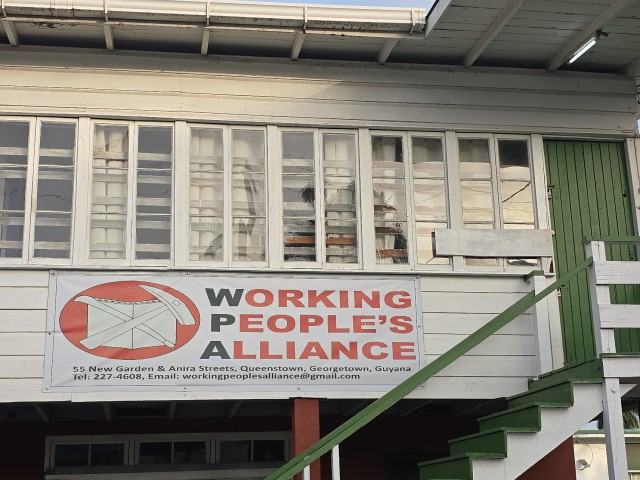
Firebrand Guyanese politician Dr Rupert Roopnaraine died early on Monday morning at the Georgetown Hospital after a prolonged period of illness, co-leader of the Working People’s Alliance (WPA) Dr David Hinds said.
Dr Roopnaraine was 83 years.
Dr Hinds credited Dr Roopnarine with quelling decades of animosity with the People’s National Congress (PNC) and helping to co-found the coalition A Partnership for National Unity (APNU) in mid-2011 with the WPA’s Dr Clive Thomas and the PNC-Reform leader Robert Corbin.
After APNU+Alliance For Change had won the 2015 elections, Dr Roopnaraine was appointed Minister of Education.
The WPA had always cited the PNC for being responsible for the bomb-blast assassination of its leader, Walter Rodney, on June 13, 1980 at a time when that small party had vowed to remove the Forbes Burnham-led dictatorship by any means necessary.
Though a Commission of Inquiry had blamed the then government of the day for Rodney’s assassination, Dr Roopnaraine was one of the WPA leaders who was always looking for ways to mend fences, and so many in the WPA had a lot of soul-searching, given the history between the two parties. “I saw that Rupert engaged in soul-searching too, but he, I would say, was the leading member of the party who pushed us in the direction of making peace with the PNC in the national interest. So his capacity for reaching across the aisle is another of his legacies. He, along with Clive Thomas, were instrumental in the formation of the APNU. I think it was Rupert who coined the coalition, A Partnership for National Unity, and he, Clive Thomas and Robert Corbin brought the APNU into formation. So I would say the APNU is Rupert’s baby. He worked in the early days to make the coalition a reality,” Dr Hinds said.
Current PNCR Leader and APNU Chairman, Aubrey Norton said Dr Roopnaraine applied the WPA’s principle of co-leadership in his relations with other political parties. “He came from a WPA background where he was part of co-leadership, and that in itself suggests that he had an interest in accommodating others’ views, and in that regard, that would have been significant in terms of impacting the WPA and the APNU. As I understand it, Rupert was very significant in the APNU and in the political landscape, especially as it relates to ideas about inclusion and moving forward,” he said.
Mr Norton said Dr Roopnaraine could not be easily replaced. “Politically, one-time opponent, one-time friend, but generally a good human being, and so the society would have lost one of the best patriots we have ever had,” he added.
Dr Roopnaraine was also hailed by the WPA co-leader as one of the best Guyanese orators, but also as an Indo-Guyanese who transcended race in his general interaction and political mobilisation. He said he marveled as a young man watching Dr Roopnaraine work his way among African Guyanese. “Everyone knows that we are still a divided society in many ways, and lots of times we talk about Walter Rodney’s ability to speak across ethnicity, but Rupert had that too. As I said, he was an Indian, but I think it would be hard-pressed to find a Guyanese who would refer to Rupert Roopnaraine as an Indian,” Dr Hinds added.
Long-serving People’s Progressive Party (PPP) executive member, Clement Rohee remembered Dr Roopnaraine who, along with Dr Rodney, attracted large numbers of people to their political meetings especially in Georgetown and spoke eloquently and eruditely in explaining the political situation in Guyana. “This is what I would call a new era that they opened up in the politics of our country. A Black and an Indian young, young men, historians in their own right; one well schooled in literature and was able to speak in such a way to influence more and more people to come to listen to them.”
Mr Rohee said he was happy that Dr Roopnaraine was not killed with Dr Rodney but lived to facilitate the downfall of the dictatorship and to facilitate what was known then as the chant People’s Power, No Dictator,” he said.
Mr Rohee said when Dr Roopnaraine became a member of parliament he made a lasting impression on his colleagues and others. “Rupert made some solid contributions in the parliament. When he spoke everyone listened because he was able to fall back on his training and his ability to interpret a wealth of literary work and to blend those literary works with his political speeches which made a big impression on parliamentarians and the public at large,” he said.
Dr Roopnaraine was also a film-maker, author and cricketer.