

Last Updated on Friday, 20 February 2026, 22:48 by Writer
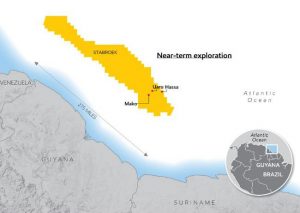
Guyana has resisted against ExxonMobil’s desire to begin exploring for oil in the north-western area of the Stabroek Block nearer Venezuela pending an International Court of Justice (ICJ) decision on the validity of the 1899 Arbitral Tribunal Award, natural resources minister Vickram Bharrat said on Friday.
“Exxon wanted to go and drill but we said ‘no, let’s wait on the International Court of Justice because we don’t want to aggravate a situation or it leads to aggression or anything untoward,” he told reporters on the sidelines of the Youth Forum of the Guyana Energy Conference.
The ICJ could hand down its decision by yearend in Guyana’s case that seeks a confirmation of the validity of the 1899 Arbitral Tribunal Award that settled the land boundary with Venezuela.
Denying reports quoting Chartered Accountant and Attorney-at-Law Christopher Ram that there was a second force majeure in favour of the American supermajor, Mr Bharrat explained that there was only one such activation of that clause in the agreement. He said other international oil companies with concessions in the disputed area had also invoked force majeure in their agreements.
The minister said ExxonMobil about two years ago dispatched a note to the Guyana government through the Ministry of Foreign Affairs requesting permission to explore for hydrocarbons in that area of the prolific Stabroek Block that has so far yielded more than 50 discoveries.
However, the Guyana government told that international oil company that it would not green light such a request because that could trigger tensions with Venezuela. “They can’t do exploration and we took the decision because we didn’t want to aggravate the situation with Venezuela because rightfully, it’s our territory and we could say to Exxon ‘go and drill’,” he said.
Last year, a Venezuelan military patrol vessel entered Guyana’s waters and informed vessels contracted by ExxonMobil that they should leave the Stabroek Block because they were in disputed Venezuelan waters that were yet to be delimited with Guyana.
Looking ahead, ExxonMobil’s Chief Executive Officer, Darren Woods on January 30 described the eventual ICJ ruling as a “critical milestone” for deciding on the company’s future work in the Stabroek Block.
“The portion of the block that’s under force majeure as a result of the border dispute remains there, and I think, from my perspective, one of the unlocks with respect to that region will be the ruling that comes out of the International Court of Justice, that’s the process that Guyana has been going through with Venezuela to align on the border, to resolve the border dispute,” he said.
The Venezuelan navy had over the years chased out two seismic research vessels from Atlantic waters off the Essequibo Region.
The first occurred in 2013 when the MV Teknik Perdana was detained while doing work in the Roraima Block for the United States-based Anadarko Petroleum. This was followed by a similar incident in 2018 involving the MV Ramform Tethys vessel, which belongs to Norwegian company Petroleum Geo-Services (PGS), that was doing work for ExxonMobil.