

Last Updated on Thursday, 4 December 2025, 22:08 by Writer

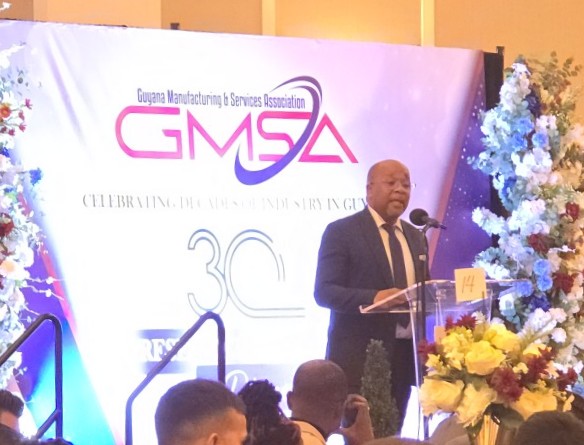
Finance minister Dr Ashni Singh on Wednesday said the amount of ‘oil money’ saved in the Natural Resources Fund (NRF) exceeds Guyana’s external debt, but at the same time government would continue to make “hard choices” to position the economy firmly for long term sustainability.
“You would see in our fiscal priorities, a very significant reorientation of the budget away from government consumption and towards investment in economic infrastructure that is critical to competitiveness” he said.
Dr Singh recalled that when the People’s Progressive Party Civic (PPPC) returned to office in 2020, after being in the opposition from 2015, the public investment component of the 2019 budget was less than 25 percent of the total budget, but by 2024 it grew to more than 50 percent.
In his address to the Guyana Manufacturing and Services Association’s (GMSA) annual awards ceremony, he said that decision was grounded in a deliberate policy position not to engage in inefficient government consumption but focus on long-term economic growth, prosperity and competitiveness. “There are some hard choices that are involved in these decisions because investing in the things that matter for the long term are not necessarily the things that are most popular in the short term,” he said.
His comments come as Guyanese wait to see if the Irfaan Ali administration would announce another universal cash grant.
The President’s election campaign hint of a payout before Christmas was further backed up by Vice President Bharrat Jagdeo’s reassurances that the government would stick to its promises.
The People’s National Congress Reform-led A Partnership for National Unity (APNU) and the main opposition We Invest in Nationhood (WIN) have been intensifying calls for the president to keep his campaign promise.
Dr Singh ruled out the government allowing the economy to tank for the sake of delivering merely on short term gains.
Instead, he told the business community that the focus is balancing the short term and long term goals of fiscal sustainability such as prudent debt management. “We recognise, of course, the importance of meeting immediate term, near term needs but we will not compromise the long term well-being, long term health and well-being and prosperity of our country,” he said.
Earlier this month, Dr Singh declined to say whether the government will cut its expenditure in the 2026 national budget due to declining oil prices. The 2025 mid-year economic report states that “crude oil prices are anticipated to come in 15.7 percent below the 2024 level, to average US$68 per barrel in 2025, lower than the US$71.9 per barrel projected at the time of preparing budget 2025.”
In tracing back Guyana’s recent economic history, the finance minister said the debt to GDP (gross domestic product) ratio has moved from more than 600 percent in 1990 to 38 percent in 2020 before oil was produced and 24.3 percent last year.
As a result, he said Guyana was now one of the least indebted countries globally.
Dr Singh added that Guyana is one of very few countries globally that has saved sufficient money in its sovereign wealth fund to pay off its external debt and “still have cash remaining.”
Latest official Bank of Guyana figures show that the Natural Resources Fund has US$3,635,067,908.12.
The finance ministry says Guyana’s total external debt up to the end of 2024 was US$2,239 billion and is projected to be US3,773 billion at the end of 2025.
“That’s a very, very rare circumstance to be in that notwithstanding that we are utilising revenues generated by the oil and gas sector to implement an accelerated public investment programme, that we have still managed to accumulate enough savings to exceed our country’s external debt,” he said.