

Last Updated on Sunday, 9 November 2025, 23:16 by Writer
The ministries of education, human services, and home affairs at the weekend agreed to a multi-pronged strategy to tackle bullying in schools.
Minister of Education, Sonia Parag said the three ministries would be signing a memorandum of understanding to address bullying.
She also announced that the trio, along with the Minister of Legal Affairs, would be establishing a task force “to ensure there is a structured approach.”
Ms Parag said the time had come for “frank conversation” on the issue of bullying that could lead to law reforms, even as she noted that the Juvenile Justice Act 2018 makes persons 14 years and older liable for crimes. “But bullying doesn’t have an age at just 14,” she said.
She also indicated that transferring bullies to other schools amounted to transferring the problem, a situation that points to the need to fix the problem.
As means of preparing rounded citizens, Ms Parag said the curricula for moral and civic education would be included in school timetables within the next few weeks. Moral education, she said, would help to combat bullying and create kind citizens.
The Ministry of Education also launched a secured online platform that allows students, parents and staff to report confidentially incidents of bullying or harassment without fear of retaliation. The minister said the platform would streamline communication between schools and the Ministry of Education, enabling timely investigations and appropriate interventions while maintaining the privacy of all individuals involved. “Its goal is to promote accountability, encourage a culture of respect and strengthen the overall well-being of students,” she said.
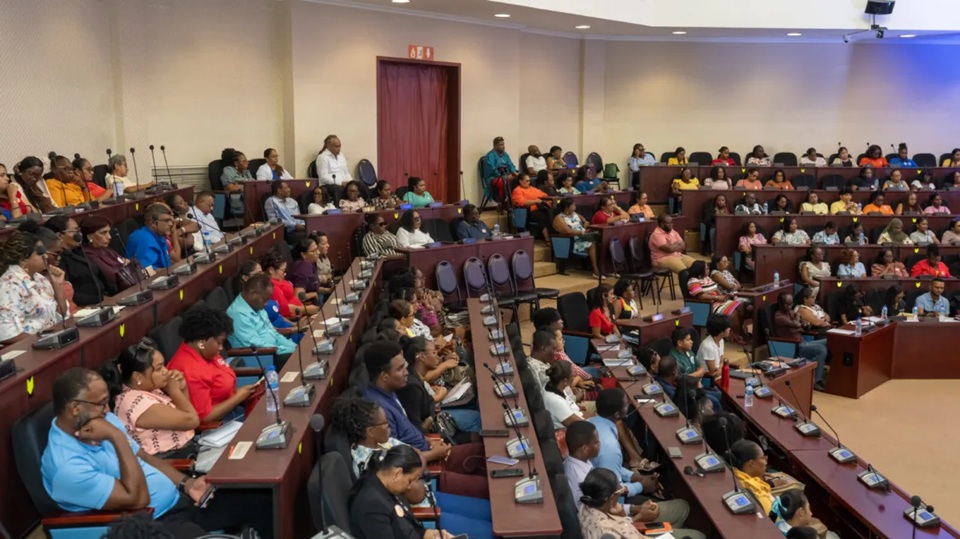
Human services minister Dr Vindhya Persaud handed over copies of her ministry’s national anti-bullying policy to Minister of Education Sonia Parag and Minister of Home Affairs Oneidge Walrond at a national consultation on bullying held on Saturday at the Arthur Chung Conference Centre, Liliendaal, Greater Georgetown. “This could be used to create a larger, more comprehensive approach that is structured so that we can really respond to the cries of young people out there,” she said. Ms Walrond said “we can build on” that policy.
Dr Persaud reported to the forum that her ministry has been tackling bullying through the Child Care and Protection Agency, Sexual Offences Domestic Violence Unit and Family Enhancement Services Unit. She said those entities have been working with students and teachers by examining behaviours and trying to understand their reasons. As an offshoot, Dr Persaud said a ‘Young Influencers’ programme has been developed and has been addressing bullying in schools.
The human services minister said bullying could stem from domestic violence. She hoped that educators, community and religious leaders and others could aid in combatting bullying in and out of schools through positive behaviour and mentorship.
Deputy Chief Education Officer (School Support Services), Fazia Baksh said bullying, which is a sustained pattern of harm, includes verbal bullying, teasing, name calling, inappropriate sexual comments or taunting, spreading rumours, purposeful exclusion or public embarrassment, cyber-bullying, threats and humiliation. Bullying, she said, could lead to anxiety, depression, low self-esteem, physical health complaints, decline in academic performance, school avoidance, self-harm and suicide ideation.
The home affairs minister recommended that an anti-bullying and cyber-bullying leaders be appointed in every school to coordinate with the Guyana Police Force and its Cyber-Crime Unit for “quick, informed responses.” She said the aim should be to report all such occurrences of “serious harm or threats” within 24 hours. She also recommended a “clear partnership” and memorandum of understanding to guide the types of incidents that would be managed internally and how others should be escalated with timelines and protocols. “Not every altercation you need to call the police for and so we can discuss what sort of incidents…The idea is that we don’t want our minors and juveniles to have unnecessary contact or conflict with the law because it often times criminalises them” she said.
The home affairs minister said there must be “fast, secured and confidential” communication among schools, parents and police for fast action and status updates. Parents and teachers, she said, must be oriented to spot bullying to seek assistance. She warned that decisive action would be taken against violence, threats, exploitation or persistent harassment in schools, rather than mere childhood misbehaviour.
Ms Walrond lamented the impact and extent of cyber-bullying beyond school hours. “Harm can follow a child home on a phone, on a tablet or the computer,” she remarked. She said group chats, non-consensual image sharing and the use of artificial intelligence to manipulate pictures are “real threats to our children’s dignity and their mental well-being.” She said the response must be aimed at protecting their dignity, privacy and mental health while holding perpetrators accountable in ways that are proportionate and educational especially when they are minors.
Ms Walrond noted that the Guyana Police Force’s Cyber-Crime Unit is staffed with officers who are trained in “digital forensics, holds student and parent awareness sessions several times annually on cyber-bullying, privacy and how to report online harm. That unit preserves digital evidence, guides victims on how to document evidence and works with international partners and social media companies t0 remove harmful content swiftly.
Discover more from Demerara Waves Online News- Guyana
Subscribe to get the latest posts sent to your email.