
Last Updated on Thursday, 9 October 2025, 22:24 by Writer
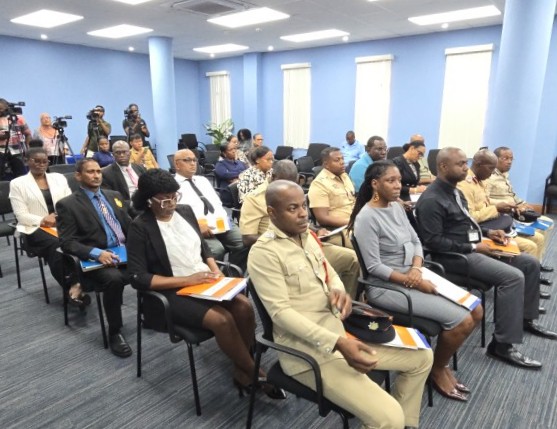
Guyana on Thursday launched its early warning system (EWS) to intercept and reduce the use of new psychoactive substances (NPSs), becoming the seventh country in the Caribbean to do so.
The early warning system represents a major step forward, It connects our law enforcement, health and forensic sectors in real time allowing us to detect emerging drug threats, share information quickly and take preventative action before they spread or claim lives,” said EWS head Curt Richards, also a technical officer at the Customs Anti-Narcotics Unit (CANU).
NPSs are synthetic drugs that are designed to mimic well-known illicit narcotics such as marijuana, cocaine and ecstasy but are not listed under the 1961 Single Convention on Narcotic Drugs and allow manufacturers to escape the grasp of the law. “There are new psychoactive substances that mimic traditional drugs but it often evades detection, legal classification and treatment protocols,” CANU director, James Singh said at the launch of the EWS known locally as the Guyana Drug Information Network (GUYDIN).
He said the system would not react after harm has been done but would anticipate and prevent it.
Mr Richards said the EWS would strengthen the mission of law enforcement agencies and Guyana’s public health and national security framework and collaboration amongst the Ministry of Home Affairs, Guyana Forensic Sciences Laboratory, Ministry of Health and regional and international allies such as the Organisation of American States’ Inter-American Drug Abuse Control Commission (CICAD) and Italy.
Mr Singh said the EWS, which was developed in keeping with international best practices is designed to detect, assess, and respond to new and emerging drug threats, particularly NPSs. He said the EWS would capture, verify and translate information about a new dangerous substance on the streets, lab report or a hospital into “actionable intelligence” for all relevant stakeholders.
He said some of the NPSs are disguised as herbal mixtures, candy and vaping products. “The Early Warning System is basically our line of defence against this evolving threat,” he said. “We are not waiting until there is a problem. We are proactive.”
CICAD Specialist Pernell Clarke said the Caribbean drug trade and consumption continue to evolve bringing new NPSs and synthetic drugs such as fentanyl that are often mixed with cocaine and cannabis and other substances to increase their toxicity and health risk, “often without the user being aware of what they are actually consuming.”
Mr Clarke said that as a result, overdose, toxic events and deaths reached epidemic levels in the United States and had caused significant problems in Canada. “This reality serves as a stark warning for Latin America and the Caribbean countries of the potential impact of these emerging threats,” he said.
For instance, he said CICAD, about two years ago, received information about the first clandestine laboratory in Trinidad and Tobago where methamphetamine pills were being produced “from scratch”. Across in Barbados, that island’s EWS issued two warnings in early 2023 about methamphetamine and synthetic cannabinoids in its drug market.
Mr Clarke said last week Barbados seized a quantity of gummies and other products that contained semi-synthetic cannabinoid hexahydrocannabinol (HHC) because they are technically legal.
“The traffickers are smart. They have chemists just like the lab and they know what they can do to circumvent laws. These are the people that they’re working against,” he said.
Two years ago, more than 60 students in Jamaica received emergency medical care after they had consumed tetrahydrocannabinol (THC)-laced candy sold by a vendor outside a primary school. “These examples are remarkably close to home for Guyana and they are proof that no country is immune to the dangers posed by emerging drugs,” he said.
Mr Clarke said that with the launch of its EWS after “months of hard work and dedication” by Guyanese officials, Guyana is now the seventh country to have done so in the Caribbean sub-region. The others are Antigua and Barbuda, Barbados, Jamaica, St Lucia, Suriname, and Trinidad and Tobago.
Permanent Secretary of the Ministry of Home Affairs, Andre Ally said the EWS represents a “whole of government approach” in tackling NPS as part of a unified Caribbean that strengthens long-term collective security. “The government of Guyana remains fully committed to sustaining and strengthening the Early Warning System, not as a one-time project but as a permanent instrument of national safety and regional cooperation,” he said.
The Ministry of Health’s Chief Medical Officer Dr Narine Singh said the health sector is aware of how infectious disease-related EWSs work and so would be able to adapt to this one on NPSs. “This is another system of surveillance that we will fully participate (sic),” he also said.