

Last Updated on Wednesday, 22 April 2026, 22:11 by Writer
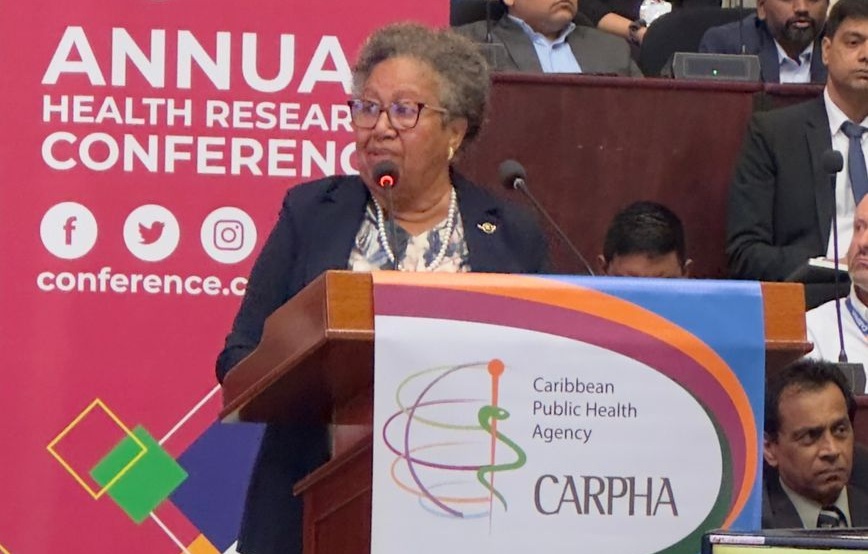
Secretary General of the Caribbean Community (CARICOM), Dr Carla Barnett on Wednesday cited the need for data sovereignty at a time of technologically-driven solutions in the health sector.
“Our goal must be a model of health innovation that is sovereign, fair and rooted in trust,” she said.
Addressing the opening of the 70th Annual Public Health Research Conference of the Caribbean Public Health Agency (CARPHA) in Guyana, she said the era of artificial intelligence (AI), genomics and digital health platforms are offering pathways to leapfrog historical barriers.
Possibilities include genomic research to tailor non-communicable disease (NCD) treatments to their complex genetic heritage and AI surveillance prediction of pandemics weeks ahead. “These are the game-changing possibilities to safeguard the health and resilience of the people of the region,” she added.
Against that backdrop, she said innovation must be anchored on answers to questions about the ownership of data generated, ensuring Caribbean citizens are not just data points for external extraction but are the primary beneficiaries of breakthroughs, and building a bio-bank that protects their biological assets while advancing global science.
Dr Barnett, an economist and Belizean politician, identified the need for CARICOM professionals to have “new instruments in their toolkit” so that they could be prepared for the new era, and more researchers who understand public policy, data analytics and ethical governance.
At the heart of much-needed paradigm shift, she singled out the need for public trust at the community level. “If our people do not trust innovation, they will not adopt it. Our research must stay relevant, speak to the needs of the mothers in a rural or remote village and as clearly as it does to a scientist in a laboratory,” she said.
Guyana’s health minister Dr Frank Anthony, a medical doctor and public health specialist, said CARPHA’s annual conference was one of the most important spaces for sharing, challenging and strengthening Caribbean science. He said if the region did not generate its own data, “others will define our realities for us; if we do not publish our findings, our stories remain untold.”
He said research must be published in order for it to be fully realised by informing policy, guiding clinical practice and contributing to global knowledge.
He said that should be done by shifting from laboratories and conferences to peer-reviewed journals, policy briefs and implementation frameworks as well as mentor young researchers to investigate, write, publish and lead. “It places Caribbean knowledge on the world stage and it allows our voices and our evidence to shape the international discourse,” he said.
Similarly, he advised that emphasis must be placed on innovation by using and applying modern tools such as telemedicine and integration of digital health tools.
Meanwhile, President Irfaan Ali challenged delegates to craft a document for CARICOM leaders on the gaps that must be filled to enable the region’s population as a whole to be used to conduct research.
He told delegates and other invitees at the opening of the conference that the Caribbean has an in-built advantage of having an entire population as a “pilot” for research and development, new technology and part of a global system of advanced medicine.
However, he said, the region did not have the infrastructure, laws and regulations to allow Caribbean societies to be used as pilots. “We have an ethnic mix that is essential for pilots, yet how many pilots are conducted in this region?” asked Dr Ali, an urban planner.
The Guyanese leader also offered Guyana’s telemedicine capacity to become a hub for the rest of the region.
He envisaged the hub being used for clinical care, research and educational purposes.