


Last Updated on Tuesday, 22 April 2025, 23:55 by Writer
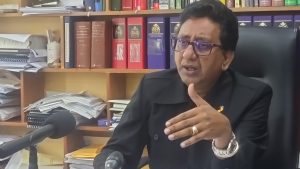
Attorney General and Minister of Legal Affairs, Anil Nandlall, on Tuesday assailed the United States for issuing its 2025 International Narcotics Control Strategy Report (INCSR), saying that many of its claims of financial crimes by public officials were not backed by evidence and contradict assessments by the Caribbean Financial Action Task Force (CFATF).
“Any statement linking money laundering to corruption amongst public officials must be substantiated by empirical/anecdotal evidence,” he said in a statement.
“For the report to attempt to link ML (money laundering) to holders of public offices and corruption without citing the cases which have led to this conclusion, is simply speculative,” he added.
He chided the US government for failing to obtain guidance from the CFATF, but instead resorted to publishing a report that lacks any supporting facts.
He said Guyana fared better than most of its Caribbean counterparts.
“Significantly, this positive appraisal comes from the appropriate and authorised global regulator for this hemisphere, and therefore, in my respectful view, constitutes the authoritative and conclusive diagnosis of Guyana’s AML/CFT credentials,” he added.
The INCS Report, he said, should have taken guidance from CFATF’s mutual assessment of Guyana, which is publicly available on CFATF’s website.
CFATF’s assessment of Guyana received the approbation of the Financial Action Task Force – the global regulator of this sector.
He also said Guyana’s efforts to counter corruption had also been recognised by the 2024 Sixth Round of Review of the Mechanism for Follow-up on the Implementation of the Inter-American Convention against Corruption (MESICIC) and the International Monetary Fund’s Article IV Consultation.
Mr Nandlall added that the Integrity Act would be amended and the government would be implementing the beneficial ownership recommendations by the 2024 Extractive Industries Transparency Initiative (EITI).
The Attorney General suggested strongly that government could not take blame for few successful prosecutions in court, saying that there is no Financial Action Task Force or any known Anti-Money Laundering/Countering of Financing Terrorism (AML/CFT) yardstick that states that few convictions in a country means there are weak institutions and a framework for those financial crimes.
“As a matter of fact, it may very well indicate that the rule of law and order is working in that particular jurisdiction,” he said. Instead, he said the AML/CFT structure can ensure that the matters are investigated, charges are filed and evidence presented.
He said government had no control over the determination of these matters.
Since coming to office in 2020, Mr Nandlall said the volume of investigations and charges have greatly increased.
He said there are currently 298 money laundering charges, with one conviction, while in other instances, persons have been convicted of other offences, such as obtaining by false pretense.
Additionally, given that money laundering matters are complex and usually involve detailed financial analysis and reporting, he said it is not unusual for cases to take some time to be completed.
The Attorney General said in addition, there are instances where international protocols, laws and bilateral arrangements to share information are not always as swift as intended and that these existential yet extraneous factors must be taken into account when concluding how delays in disposing of matters, which are exclusively domestic and those which are hybrid in nature and involves the necessary input of our foreign partners in progressing and concluding cases forensically.
Mr Nandlall said he was disappointed at the contents of the INCSR because none of the information that had been provided to the US was used in the document that was released.
“I recall a questionnaire was circulated from the publishers of this report, and large volumes of critical information were supplied, but were unfortunately omitted in the report,” he said.
He said Guyana’s AML/CFT credentials were “scrupulously” examined over a period of 18 months, from September 2022 to June 2024, in a mutual evaluation exercise conducted by CFATF.
He said in that process, every aspect of Guyana’s AML/CFT framework was critically scrutinized, including the country’s legislative framework, administrative processes, investigative capabilities, and law enforcement and prosecutorial capacities.
Additionally, various critical sectors were interrogated, including the mining, banking and real estate sectors, revenue collection, gaming authorities, and the Commercial and Deeds Registries.
He said Guyana has bolstered its Beneficial Ownership Legislative provisions by requiring covered entities to identify and verify beneficial ownership information for legal persons and legal arrangements.
The Commercial Registry has exercised various powers, primarily, the right of refusal and the power of issuing warnings, and ultimately striking companies from the register for failure to provide basic and beneficial ownership information, which has resulted in significant improvement of compliance by companies, with over 2000 companies filing Beneficial Ownership information from 2023 to present, he added.
Even Guyana’s inter-agency as well as inter-country cooperation mechanisms were examined. Issues such as beneficial ownership were specifically evaluated. In the end, Guyana was given a clean bill of health.
He said the Caribbean Regional Security System was engaged with the Guyana Police Force’s Special Organised Crime Unit and the Financial Intelligence Unit in addressing financial and other related crimes.