

Last Updated on Saturday, 13 June 2026, 12:55 by Writer
By Ron Cheong
First published on caribbeannewsglobal.com.
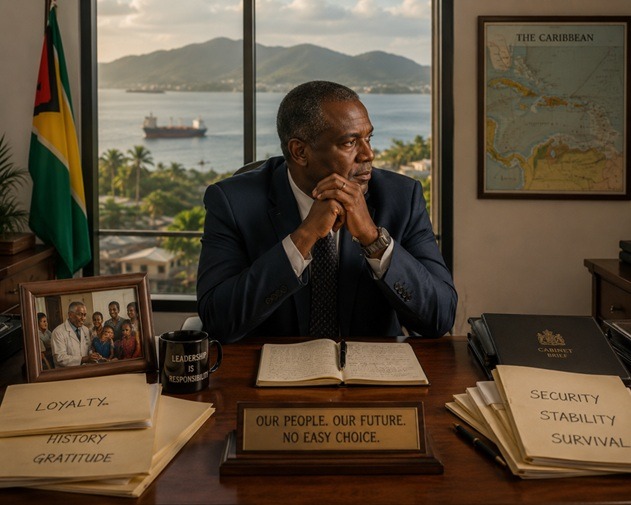
 For much of the modern postcolonial era, the Caribbean has lived inside a permanent contradiction.
Its small states speak the language of sovereignty, solidarity, anti-imperialism, and regional fraternity. Yet they survive in a world dominated by overwhelming asymmetries of power – economic, military, and political. No contradiction illustrates this more painfully than the Caribbean’s present dilemma regarding Cuba, Venezuela, and the United States.
At one level, the issue appears binary: remain loyal to Cuba, the region’s long-time friend and benefactor, or align more closely with the United States, the hemisphere’s dominant superpower. But the reality is far more complicated because Venezuela sits at the center of the equation – economically, ideologically, geographically, and militarily.
The Caribbean today is caught between gratitude, fear, morality, and survival.
Cuba: The loyal friend
For decades, Cuba did what few larger nations ever bothered to do for the Caribbean.
Cuban doctors staffed rural clinics across the region. Cuban medical brigades appeared after hurricanes, epidemics, and disasters. Thousands of Caribbean students received scholarships to study medicine in Havana when Western education was financially unreachable. In many islands, healthcare systems became deeply dependent on Cuban personnel.
Cuba’s relationship with the Caribbean was never merely transactional. It was rooted in a shared history of colonialism, race, vulnerability, and resistance to external domination.
And nations, like people, remember loyalty.
The relationship deepened further through Venezuela’s PetroCaribe initiative. Cheap Venezuelan oil purchased on concessionary terms provided fragile Caribbean economies with breathing room during periods of debt, energy shocks, and fiscal crisis. PetroCaribe was not simply economics; it was oil diplomacy – the conversion of energy wealth into political influence and regional solidarity.
At the center of this arrangement stood the close political partnership between Cuba and Venezuela. Caracas supplied subsidized oil. Havana supplied expertise, intelligence, and legitimacy. Caribbean states benefited from both.
For many governments, this was not ideology. It was survival.
When survival changes shape
But survival has changed shape.
As Venezuela descended into economic collapse, political authoritarianism, and increasingly aggressive regional behavior, the moral equation shifted dramatically, especially for Guyana and Trinidad and Tobago.
Guyana now faces an existential territorial threat through the Essequibo dispute with Venezuela. Trinidad, sitting only miles from the Venezuelan coast, confronts the dangers of instability spilling across its borders: migration pressures, organized crime, and strategic vulnerability.
This transforms the Caribbean dilemma entirely.
The region is no longer simply choosing between friendship and power. It is choosing between historical loyalty and physical security.
And in moments of danger, moral philosophy itself becomes uncomfortable.
The Archbishop and the Chambermaid
The dilemma resembles William Godwin’s famous thought experiment from An Enquiry Concerning Political Justice: “The Archbishop and the Chambermaid.”
Godwin asked whom one should save from a burning building – a brilliant archbishop whose survival benefits humanity, or a chambermaid whose death affects far fewer people. His answer was coldly utilitarian: morality requires saving the person of greater social value.
But critics raised the devastating counter-question: What if the chambermaid is your mother? Your wife? Your lifelong benefactor?
That is the Caribbean’s Cuba problem.
Pure strategic logic may point toward alignment with the United States. Whatever the inconsistencies or moral contradictions of American foreign policy, only the United States possesses the military and economic power capable of deterring Venezuelan aggression against Guyana or wider regional instability.
But Cuba is not an abstract geopolitical actor to the Caribbean. Cuba is the friend who came when others did not.
To abandon Cuba under pressure from Washington feels, to many, less like diplomacy than betrayal.
“One Thought Too Many”
The philosopher Bernard Williams sharpened the dilemma even further when he argued that if a man pauses to calculate whether morality permits him to save his own wife first, he has already had “one thought too many.”
His point was that human beings cannot live morally while treating loved ones as morally interchangeable with strangers. Loyalty itself is part of what gives life meaning.
Yet governments are not private individuals.
States carry obligations not merely to friendship or historical gratitude, but to the survival of their citizens. In moments of crisis, nations often behave according to a brutal form of triage: preserving what has the greatest chance of survival, even when the choice feels morally wounding.
This is why the Caribbean’s predicament cannot be resolved through abstract moral rules alone. Immanuel Kant’s ideal that we should act only according to principles we would wish universally applied becomes difficult to sustain when the very existence of small states may be at stake.
Absolute loyalty can become national suicide.
But pure self-interest destroys the trust and solidarity upon which small nations themselves depend.
America: Protector and problem
The final irony is perhaps the cruelest.
The United States itself often behaves in ways that undermine the moral clarity of its demands. Its history in Latin America and the Caribbean includes interventions, embargoes, covert operations, and deeply inconsistent commitments to democracy and sovereignty.
And yet Caribbean states understand an uncomfortable truth:
If Venezuela truly threatens Guyana’s territorial integrity or wider regional stability, only the United States possesses the credible power to deter it.
Not Cuba.
Not CARICOM.
Not international law alone.
This is the tragedy of power politics. Moral discomfort does not eliminate strategic dependence.
The Caribbean’s burden
Large powers often speak in the language of principle because they possess the luxury of abstraction.
Small states rarely do.
For the Caribbean, every diplomatic choice carries existential consequences. To choose Cuba may jeopardize security and economic access. To choose America may feel like abandoning a loyal friend. To oppose Venezuela risks retaliation. To accommodate Venezuela risks future coercion.
There is no morally clean path because the Caribbean does not control the structure within which these choices are made.
And perhaps that is the deepest lesson of all: Ethical theories are easiest to defend when one’s survival is not at stake.
For small nations living beside great powers and unstable neighbors, morality is never abstract. It is lived under pressure, memory, fear, necessity, and the constant calculation of survival.
Ron Cheong is a frequent political commentator and columnist whose recent work focuses on international relations, economic resilience, and Caribbean-American affairs. He is a community activist and dedicated volunteer with extensive international banking experience. Residing in Toronto, Canada, Ron is a fellow of the Institute of Canadian Bankers and holds a Bachelor of Science degree from the University of Toronto.