

Last Updated on Monday, 1 June 2026, 21:30 by Writer
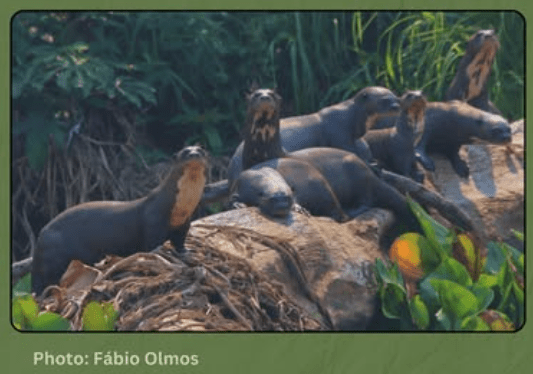
 Progress is being made in parts of the Rupununi in southern Guyana to protect the endangered giant river otters, according to the EMC Foundation.
“In key conservation landscapes such as the Kanuku Mountains Protected Area and Karanambu, joint monitoring initiatives have helped establish robust population baselines, with observations confirming stable groups of otters in multiple river systems,” that organisation said in a statement about a panel discussion that was held on Friday, May 29, in observance of World Otter Day.
The foundation, in collaboration with the Protected Areas Trust (PAT), hosted the discussion.
The foundation also said trained community rangers and citizen scientists also play an active role in mapping otter distribution and identifying threats such as illegal gold mining and mercury pollution, which impact freshwater food chains.
According to the EMC Foundation, classified as endangered, the giant river otter is recognised as a key indicator of healthy freshwater ecosystems and plays an important ecological role as a top predator within river and wetland systems across the Amazon and Guiana Shield.
Guyana is considered one of the species’ remaining strongholds due to its extensive intact forests, wetlands, and river networks.
Commissioner of the Guyana Wildlife Conservation and Management Commission (GWCMC), Alona Sankar emphasised the importance of strengthening wildlife conservation policies, legal protections, monitoring, and enforcement mechanisms to ensure the long-term survival of Guyana’s giant otter populations and other wildlife resources.
“What we need to strengthen is our monitoring and enforcement capability to ensure that persons are actually abiding by what the law requires. Now we want to increase our giant otter populations, so if you’re affecting the viability of the species, that is very negative,” she was quoted as saying at the panel discussion.
Managing Director of Karanambu Lodge, Melanie McTurk highlighted the significance of long-term conservation efforts and research in protecting the giant river otter and its habitat.
“Many people don’t realise that giant otters are one of the most understudied species, to the point where we don’t even know if they exist in some areas. That gives us an opportunity to start looking at the varying populations and how those individual populations are impacted by human activity. There is an opportunity for researchers and young scientists in the room to start understanding the DNA.”
Community-Based Natural Resource Management Specialist Dr. Deirdre Jafferally emphasised the importance of integrating community engagement and local knowledge into conservation initiatives to support long-term environmental stewardship.
“Community efforts to care for abandoned and injured giant river otter pups have been impactful, helping to support the species’ recovery and contributing to their return in areas where they were once rarely seen. Citizen science is an important part of that, as well as education and awareness. Educating people is important, getting them involved, not just those who already know and see and want to be involved in established forums,” she was quoted as saying in the EMC statement.
EMC also said conservation efforts for the giant river otter are increasingly shaped by a coordinated approach
involving Indigenous and local communities, government agencies, conservation organisations, researchers, and private sector partners. This collaboration has produced tangible results, including strengthened community-led governance through localised biodiversity monitoring systems and fishing management plans informed by otter presence and fish population recovery.
Sarah Singh highlighted the Foundation’s ongoing Giant River Otter Education and Conservation Programme in the Mahaica Watershed and the importance of combining research and education initiatives to improve understanding and protection of the species.
“We started this Giant River Otter Education and Conservation Programme in October 2025. It comprises of two components: Research and Monitoring and Education and Awareness. Under our Education and Awareness component, we have environmental clubs that we work with along the Mahaica River, and we are also working on communication tools and capitalising on social media audience to share key messages.”
EMC Foundation was established by Shyam Nokta, winner of the 2022 Anthony N. Sabga Award for Entrepreneurship.
The foundation works to support environmental awareness and education in Guyana by promoting activities that encourage a greater understanding of the environment, creating a network to connect like-minded people, and providing opportunities to experience Guyana’s rich natural environment.
The Protected Areas Trust was established to provide sustainable financial support for the effective management, conservation, and protection of Guyana’s protected areas.
The Trust works to strengthen biodiversity conservation, safeguard critical ecosystems and wildlife, support research and monitoring initiatives, and promote community involvement in the sustainable use and stewardship of natural resources.
Through strategic funding and partnerships, the Trust contributes to the long-term conservation of Guyana’s rich natural heritage for present and future generations.