
Last Updated on Thursday, 14 May 2026, 22:35 by Writer
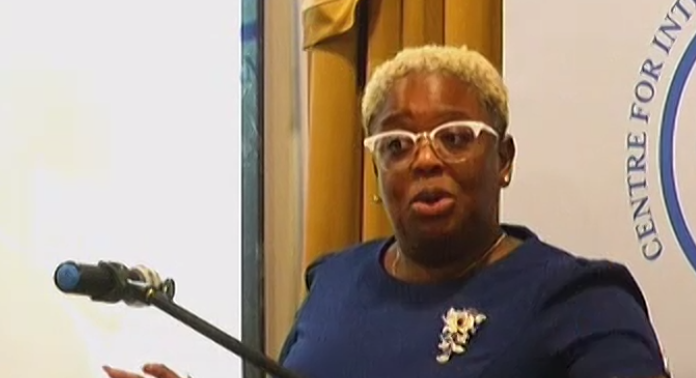
Even as Trinidad and Tobago vows not to recognise Dr Carla Barnett as Secretary General of the Caribbean Community (CARICOM) when the Belizean economist’s current five-year term ends in July, a University of the West Indies (UWI) international relations expert, Dr. Kai-Ann Skeete believes that her re-appointment should have been by consensus and based on her first term’s performance.
“I do think that we should revisit it and do it in a timely manner so that we can move on from this because there are larger issues that we must and we will be grappling with at the end of this year,” Dr Skeete told a conference organised by the Centre for International and Border Studies under the theme “Navigating The Future: Guyana, the Caribbean and Latin America in a Changing Global Environment”.
She expressed regret that since Dr Barnett was appointed in 2021, her tenure has been marred by a failure to narrow the divide between the more developed countries (MDCs) and least developed countries (LDCs) in the 15-nation CARICOM “that often fragments even more.”
Dr Skeete said she had hoped that, as a female and a former employee of the CARICOM Secretariat and Vice President of the Barbados-based Caribbean Development Bank (CDB) who understood the “tensions”, Dr Barnett would have been able to mobilise regional decision-makers.
“I was also hopeful that she would be able to rally the troops and explain to them the need to be pragmatic and focus on regional goals and visions,” she said, attributing the CARICOM Secretary General’s performance to the political environment.
“Alas, politics stepped in and Dr Barnett stayed in her lane,” said Dr Skeete, Trade Research Fellow at the Shridath Ramphal Center for International Trade, Law, Policy and Services at the UWI, Cave Hill Campus in Barbados
Arguing that the Caribbean needs to be led based on visions and plans in a regional grouping of sovereign member states, the UWI international relations expert believes that CARICOM leaders should decide who should be the secretary general based on performance. That approach, she said, should weigh heavier rather than haggling over procedures or allowing Dr Barnett another opportunity.
“For me, I argue regional integration is a must. Can you do the job of uniting this region, deepening regional integration as well as advancing our goals. If not, give somebody else a turn,” she said.
She disagreed with CARICOM Chairman, St Kitts and Nevis Prime Minister Dr Terrance Drew’s announcement on March 25 that Dr Barnett was reappointed for a second five-year term from August, 2026 by the “required majority” of CARICOM leaders at their February 24-27 summit.
For her part, she said such a decision must be made by consensus. “It means that we all have to agree. There are no winners and losers. If you go by majority rule, somebody is going to say ‘I lost” and that does not bode well for our regional integration,” she said.
Trinidad and Tobago has objected to the reappointment of Dr Barnett, saying that it was excluded from the heads of government forum that arrived at that decision.
Since then, Antigua and Barbuda, Jamaica, and the Premier of Nevis believe that the issue should be revisited, while Guyana, Belize and Dominica have openly backed Dr Barnett’s reappointment process.
Article 24 of the Revised Treaty of Chaguaramas, which governs CARICOM’s operations, states that the Secretary-General shall be appointed by the Conference, on the recommendation of the Community Council, for a term not exceeding five years and may be reappointed by the Conference.