

Last Updated on Thursday, 29 January 2026, 20:27 by Writer
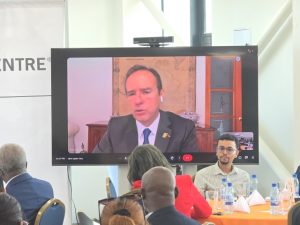
Former president of Bolivia Jorge Quiroga and United States (US) Secretary of State Marco Rubio are placing different emphases on what is required for oil sector investors to return to Venezuela, with Mr Rubio saying that if there is no legal security there they would shift to Guyana and elsewhere.
Mr Rubio said companies would only invest if they would be allowed to make a profit, their land would not be taken away and if they are moves to do so the court would enforce contracts.
“That’s the level of certainty that we’re talking in terms of security,” he said. “That’s part of this recovery process is to normalize their industry. Because if not, they’ll just invest the money in Guyana or they’ll just invest the money in some other part of the world that has oil,” Mr Rubio said.
Guyana’s prolific Stabroek Block is already supplying almost 1 million barrels per day, and several leading oil companies such as Petronas and TotalEnergies have inked exploration and production agreements with Guyana.
Within two and a half weeks of Maduro’s removal, Mr Rubio said the Venezuelan government passed reforms to the hydrocarbon laws that roll back many of the Chavez-era restrictions on private ownership and investment in their country. “It doesn’t go far enough. It probably needs to do more but that’s extraordinary. That never would have happened two or three weeks ago. It certainly wouldn’t have happened if Maduro was still there,” he said.
The US Secretary of State said in the end the US government wants to see Venezuela transition to a friendly, stable, prosperous and democratic country run by free and fair elections.
Chairman of the US Senate Foreign Relations Committee, Republican Jim Risch, in his opening remarks said US oversight might be required for Venezuela to have free and fair elections.
With President Donald Trump already saying that it would be tough for Venezuelan Opposition Leader Maria Corina Machado, Mr Rubio elaborated to the Senate on Wednesday that the American leader acknowledged that the administration of Delcy Rodriguez was still in place but the aim is to have “stabilization, recovery, and transition to something where Maria Carina and others can be a part of.”
“What the President is acknowledging is that today, as it stands, whether we like it or not, the elements of control in that country, the people with the guns, the people that control the guns and the institutions of government there, are in the hands of this regime,” Mr Rubio said.
Speaking at Wednesday’s World Trade Centre Guyana forum titled “Perspectives on Global Trade”, the former Bolivian President stressed the vital importance of urgently restoring democracy in Venezuela before attempting to get oil companies to return and invest in the once rich, prosperous and democratic country.
The right-wing former Bolivian leader openly disagreed with the US approach to normalising the situation in Venezuela. Instead, he said oil sector investors require judicial security with laws, a legislature and a respected government that respects the will of the people. He said stabilisation would require dismantling all the criminal elements that were still running around in Venezuela, a democratic transition.
“I personally think that the order that the U.S. government is talking about doing things is not quite the right order…I sincerely doubt that the oil companies will consign agreements with an interim government that is the remnants of a criminal group that was running the country, and they will do so because there’s an armada of US boats floating in the Caribbean,” Mr Quiroga said.
The former Bolivian President recommended that, rather than depend on actions by the US, “big brothers in the region” such as Brazil, Mexico and Colombia could dispatch a delegation of foreign ministers t0 Venezuela to ask that political prisoners be released.
He hoped that when Venezuela returns to the democratic fold of nations within the Inter-American system, Latin America and the Caribbean would be able to hammer out coordinated foreign policies. “As that fades out, as Venezuela regains democracy, I think that would allow us a great opportunity to engage and work between Caribbean countries and Latin American countries on a common economic agenda, and having common and joint positions in many developing issues,” he said.
Mr Quiroga said the Hugo Chavez and Nicolás Maduro-led governments of Venezuela had used high oil prices US$140 to US$150 per barrel with an output of 3.5 million barrels per day to “buy loyalties” in the Organisation of American States and the Caribbean through the Bolivarian Alliance for the Peoples of Our America (ALBA), the concessionary oil pricing mechanism PetroCaribe and the Union of South American Nations (UNASUR). “He (Chavez) used that money to ingratiate himself and he dished it out, and then Maduro kept that up for a while, to be able to build a majority in the OAS,” he said.
Guyana was at one time a beneficiary of PetroCaribe and a member of UNASUR.
Having had support from 22 out of the 34 OAS members, Mr Quiroga said Venezuela was able to “get away” with shutting down TV stations, persecuting people, holding elections, without the international community or the election observation system of the OAS saying much about what they were doing.
He said that kind of situation had affected the relationship between Latin America and the Caribbean because for a while Venezuela, apparently, had influence in a lot of countries such as Ecuador, Bolivia, Nicaragua, and many Caribbean countries to ensure abuses of the regime were never raised in international fora like the OAS.
“Now, if the Venezuela issue gets fixed, I think there’s an opportunity to re-engage between the Caribbean and Latin American countries without the toxic influence that we have all lived under everywhere,” he added.