


Last Updated on Monday, 5 January 2026, 21:51 by Writer
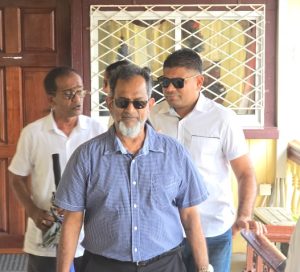
This week’s scheduled extradition hearing before a magistrate face a potential delay as billionaire gold dealers – Azruddin Mohamed and his father Nazar “Shell” Mohamed – are set to appeal Monday’s High Court decision that those proceedings could go ahead pending the hearing of two High Court cases.
While Attorney General Anil Nandlall welcomed Chief Justice Navindra Singh’s decision that the committal proceedings could go ahead as slated for January 6 and 8, 2026, the Mohameds’ lawyer, Roysdale Forde, told reporters that he would be lodging an appeal to the Full Court of the High Court.
“We disagree with the decision respectfully and we will be filing an appeal to the Full Court and we will be seeking a stay of the proceedings at the level of the Full Court,” he told reporters.
Though the appeal does not amount to a stay, he explained that judicial officers are expected to “stay their hands” while proceedings are pending in superior courts.
Mr Forde said usually the effect of such a move is that the planned proceedings that are the subject of an appeal are pushed back.
The Chief Justice said in assessing the balance of convenience, it seems that a stay of proceedings is a drastic remedy in the circumstances presented to the Court, where the constitutional issue(s) can be determined without halting the extradition process, and no immediate and irreversible harm has been demonstrated,
Mr Singh set January 14 to begin hearings into two High Court cases brought by the Mohameds to challenge the extradition proceedings: one the constitutionality of several provisions of the Fugitive Offenders Act and another that the Authority To Proceed granted by Minister of Affairs Oneidge Walrond has been infected by explicit political bias against Mr Azruddin, opposition leader of the We Invest in Nationhood (WIN).
Mr Forde disagreed with the Attorney General that the legal challenges were unnecessary and that the law provides for them to be filed after rather than before the decision by Principal Magistrate, Judy Latchman.
He said the case raises “thorny issues” emerging from conflicting decisions by different courts at different levels. “I’ve long said to you and members of the media and to our clients that this will be a long, arduous process. It cannot result in any sort of quick fix,” he said, adding that the High Court decisions in the substantive cases would be taken to the Caribbean Court of Justice (CCJ).
Mr Nandlall said if the magistrate rules against the Mohameds, who are each on GY$150,000 bail, they would be immediately taken into custody pending any further legal challenges. The US has requested their extradition to face trial in a Florida federal court for alleged mail fraud, wire fraud and money laundering associated with their gold trading business that led to the evasion of millions of dollars in taxes.
The Attorney General said courts around the world have rejected any type of intervention that seeks to stay, stop or delay the committal hearing from taking place because after they are held “there is an elaborate regime of challenges that the law provides for any party who is aggrieved by the committal hearing ruling.” He said that “in-built regime” stays the extradition process while those challenges are exercised.
But Mr Forde, in reaction, said it would make no sense to expose a defendant at the outset to a process based on a flawed system.
He expressed disappointment in the Chief Justice not agreeing with him and other members of his legal team that a stay was warranted until the substantive High Court matters are heard and decided.
While the Chief Justice did not grant the stay, Mr Forde said “other strategic moves” were planned for Tuesday to “bring these proceedings to some degree of halt” to make way for the issues to be determined. “There are a number of proceedings which we intend to file,” he added.
In his decision, Chief Justice Singh addressed the element of public interest. He said the Mohameds have not established that allowing the committal proceedings to continue will cause irreparable harm. “No surrender order is presently imminent.”
He reasoned that the Magistrate’s proceedings are preliminary in nature and may result in discharge and even if committal occurs, the applicants retain the right to challenge any surrender order before execution of that order.
He said further, the risk of onward extradition to a third state remains hypothetical at this stage and is not sufficient to justify halting statutory proceedings.
On the point of whether the balance of convenience between the applicants’ interest and the public interest favours intervention, the judge said the court must balance their interests with respect to liberty pending determination of the proceedings and meaningful access to constitutional justice against a substantial Public Interest in honouring Guyana’s international extradition obligations, maintaining confidence in the administration of justice and preventing the use of constitutional litigation as a device for delay.
“The public interest would be undermined if extradition proceedings could be routinely stayed by the filing of constitutional motions raising issues capable of later resolution,” he said.