

Last Updated on Saturday, 8 November 2025, 11:01 by Writer
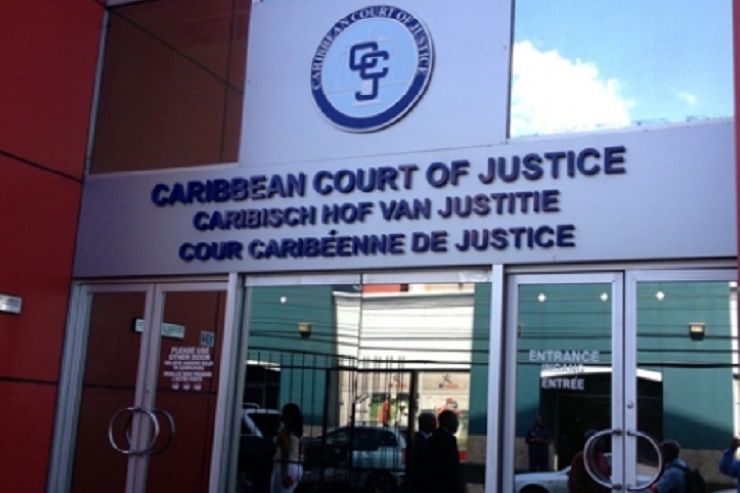
Then Opposition Leader Aubrey Norton on Friday said the President of the Caribbean Court of Justice (CCJ) Winston Anderson “engaged” him about the stalemate over the substantive appointment of a chancellor of the judiciary.
“All I would say to you is that I was engaged by him. I gave him my views about the situation and outside of that I know of no other role he would have played,” Mr Norton told a news conference in response to a question by Demerara Waves Online News. Pressed on whether himself or Justice Anderson solicited his input, Mr Norton said “he engaged me”.
Past serving and former CCJ presidents had publicly expressed concern about Guyana’s protracted delay in the substantive appointments of a chancellor and chief justice.
Mr Norton refused to say what Justice Anderson proposed or did not. “He engaged me. I stated the position and when I thought this wasn’t in the interest of Guyana, I discontinued to engage.”
He said also present at that meeting were the leaders of the Forward Guyana Movement (FGM) and We Invest in Nationhood (WIN).
The People’s National Congress Reform (PNCR) leader said “I would be hard-pressed to say I know” whether the CCJ President reached out to him at the request of President Irfaan Ali “but it will be reasonable to say I suspect so.”
Mr Norton said the PNCR was in the forefront pushing for the CCJ but actions like the most recent one and others that occurred during the elections raise “questions about the credibility of the CCJ in terms of dealing with Guyana in a fair way without political acts and involvement.”
He said unlike the rest of the region, there is a “kind of an authoritarian government” that does not subscribe to Westminster conventions, leading to questionable CCJ decisions. “I would say to you this last set of engagement raises serious concerns about the impartiality of the Caribbean Court of Justice. I will never see them in the same light that I saw them at the inception of its establishment,” he said.
Asked why he did not turn down the CCJ President immediately rather than continue the engagement, Mr Norton said he told the meeting that he was not in favour of superseding of the then acting Chancellor of the Judiciary, Yonette Cummings. “I made it very clear in that meeting that I am opposed to supersession of any kind including superceding Cummings and when I started to talk to him, I made the assumption that he knows my position on supersession and, therefore, he was engaging in that context. Unfortunately, it wasn’t and I ended it,” he said.
President Ali later announced that Justice Cummings had decided to go into early retirement and proceeded on pre-retirement leave from October 27. As a result, Acting Chief Justice Roxane George-Wiltshire would continue to act as Chancellor of the Judiciary and Justice Navindra Singh would continue to act as Chief Justice.
Mr Norton indicated that he considered the CCJ President’s engagement improper, adding that it called into question the independence of the Trinidad-headquartered regional court.
Meanwhile, Chairman of the Vigilant Political Action Committee (VPAC), Dorwain Bess on October 28 last formally requested an inquiry into alleged interactions between the CCJ and Guyana on Ms Cummings’ exit from the post of Chancellor of the Judiciary and a retirement package.
Mr Bess said if there was such an out-of-court exercise, that could impact on the image of the court as an independent body and so undermine public confidence in its impartiality.
Mr Bess on Friday November 7 said he received reply from the Regional Judicial and Legal Services Commission (RJLSC) but the Guyana Bar Association did not acknowledge receipt. The RJLSC told Mr Bess that his letter “will be forwarded to the appropriate department for further attention.”
Mr Bess said such an RJLSC inquiry should ascertain the nature and extent of any discussion or negotiation between the CCJ President and the Guyana government or any of its agents relating to the retirement or removal of the Acting Chancellor of the Judiciary, the appointment or promotion of senior judicial office-holders, or the participation of the CCJ President in shuttle diplomacy on behalf of the Guyanese Government.
Further, the VPAC Leader is asking the Commission to assess whether those interactions, once verified, constitute a conflict of interest, or give rise to a perception of lack of impartiality in respect of future or current CCJ matters involving the Government of Guyana.
He is also asking the RJLSC to recommend any remedial steps to preserve or restore the independence, impartiality and public confidence in the CCJ, including mechanism for recusal, if required, or other transparency safeguards.