

Last Updated on Monday, 21 April 2025, 21:54 by Writer
Guyana is among eight Caribbean countries where a European Union (EU)- United Nations Development Programme (UNDP)-funded justice project is underway to reduce the backlog of cases through mediation and improve conditions for children in conflict with the law, according to officials.
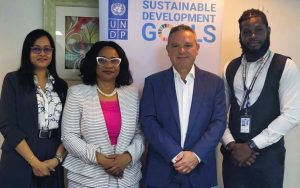
UNDP Guyana’s Programme Analyst for Peace and Governance, Nadira Balram said the more than €10 million project that was launched in 2023 aims to “more effectively manage the criminal cases in Guyana”.
She added that with improved capacities and processes, the intention is to combat the “backlog of cases in Guyana’s criminal justice sector.”
Ms Balram noted that UNDP recently supported the Chambers of the Director of Public Prosecutions (DPP) with the provision of an e-filing system and case assignment and management system.
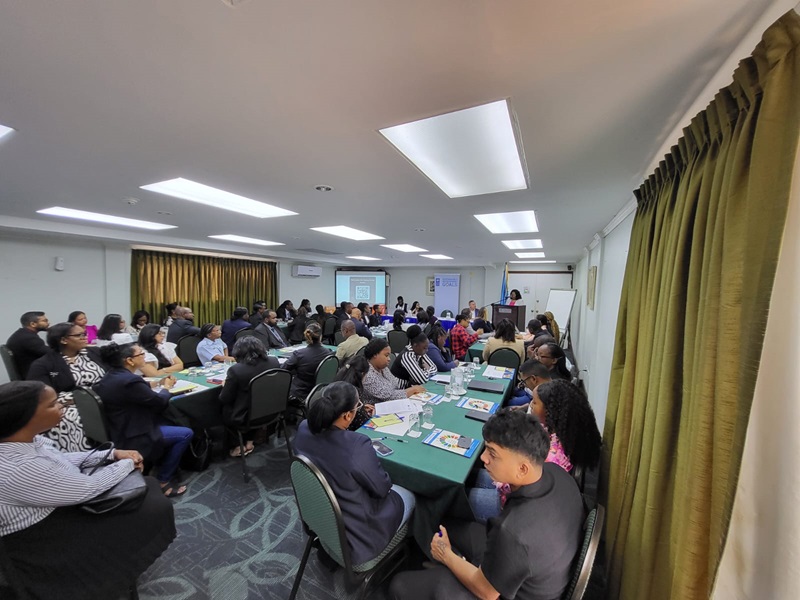
Head of Political Section, EU Delegation to Guyana, Spiro Polycandriotis van Duynhoven told a recent PACE (The Partnership of the Caribbean and the European Union on Justice) Justice Training on Restorative Justice, Criminal Mediation and Children in Conflict with the Law that magistrates, judges, police and prison service personnel were expected to examine how mediation could curb delays in the court system, promote a culture of accountability, reconciliation and reintegration.
He said that approach would allow individuals to take responsibility for their actions, make amends and return to society with dignity and purpose.
He said related benefits of mediation through direct dialogue between offenders and victims fosters out-of-court settlements, reduce burdens on the judicial systems and eliminates the chances of criminal convictions that could affect jobseekers in the long-run.
“An additional benefit of criminal mediation is its role in preventing long-term consequences for individuals involved in minor offences. A criminal record can significantly impact a person’s employment prospect and access to essential services. By minimising formal charges for such cases provide individuals with the opportunity rebuild their lives without the stigma of a criminal conviction,” the EU official added.
In keeping with the 2009 Protection of Children Act, Mr van Duynhoven said the PACE Justice Project’s criminal mediation and restorative justice play a vital role in creating a child-friendly justice system where young people feel safe, heard and supported throughout legal proceedings.
He recommended that judicial systems be adapted to address the unique needs of children while upholding their fundamental rights.
Chancellor of the Judiciary, Yonnette Cummings added that when children find themselves in legal troubles, “we do not have to be punitive with them.” “We do not have to treat them as small adult offenders,” she said.
Instead, she said efforts were continuing to reform laws, change children’s mindsets and paths as part of efforts that take account of their vulnerabilities and capacities to change.
She boasted that Guyana has children’s courts in many of it’s magisterial districts, specially trained judicial officers, and child-friendly rooms with activities and materials.
During the 48-month project in Guyana, Antigua and Barbuda, Barbados, Belize, Dominica, St Lucia, St Kitts and Nevis, and Trinidad and Tobago, the PACE Justice project intends to develop locally-owned purpose-built software for police, courts and prisons which will be designed, tested and scaled across the region with interoperability as a primary functionality.
An official has said these interventions will target several impediments which have strained the efficiency of our justice system, in particular the weakness of police data capture; outdated court case handling systems and processes; paper-based evidence management systems; limited digitalisation of correctional systems processes, and witness tampering protection.