
Last Updated on Tuesday, 11 March 2025, 22:04 by Writer
As Venezuela seems poised to intensify its armed aggression to press its claim to the Essequibo Region, International Relations Professor Mark Kirton recommended Monday that Guyana strengthen its military capacity.
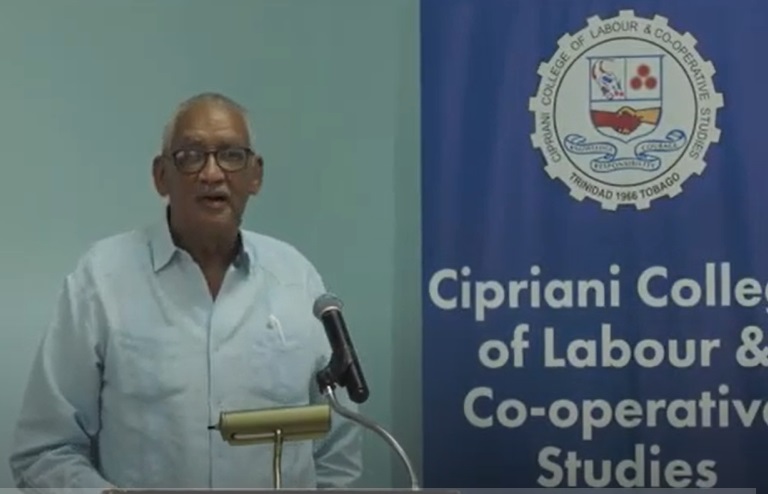
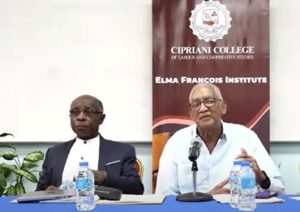
“The current unprecedented level of aggression and the statements related to possible armed intervention and annexation, Guyana has to, at the same time as it increases its diplomatic efforts across the Hemisphere, it must simultaneously seek to upgrade its military asset base for maritime, aerial and ground defence,” he said at a symposium on the Guyana-Venezuela border dispute held at the Cipriani College of Labour and Cooperative Studies (CCLSC) in Trinidad.
With security being the fourth pillar of the 15-nation Caribbean Community (CARICOM) Revised Treaty of Chaguraramas, he said the regional bloc should consider the “enlargement and widening” of the Regional Security System and launch a military observation mission in Guyana. Dr Kirton also said Guyana needs to ask CARICOM to request the United Nations (UN) to support the Caribbean Regional Security System (CRSS) in dispatching a military mission to Guyana to prevent Venezuela from seizing the Essequibo Region in violation of international law.
“CARICOM should consider joining Guyana in a joint approach to the United Nations, to seek the establishment, with the CRSS engaged, of a multilateral military mission in support of local forces as a multinational force which can act as a deterrent to a possible incursion into Guyanese territory and prevent loss of life especially in the border communities,” said Dr Kirton who is the Director of the Centre for International and Border Studies (CIBS). Regionally, he called on CARICOM to be in the forefront in its advocacy for Guyana.
He said the CRSS could assist Guyana in defending its territory, even if temporarily, in light of escalation and intimidation. “If the situation in which there is armed military intervention, while we would have to look for allies in the process, I believe in the first instance there must be some holding capacity which could be done by the enhanced RSS,” he said.
Although the US recently warned Venezuela of “consequences” if aggression towards ExxonMobil’s oil assets in the Stabroek Block continues, Dr Kirton was unsure whether the Trump administration would be keen on putting boots on the ground or if it might be part of a transactional approach.
Former Foreign Affairs Minister of Guyana, Carl Greenidge told the symposium that Guyana could not give any assurance that it would not seek foreign military assistance because that would make the country more vulnerable. He said it was within Guyana’s right to seek required assistance. He endorsed Dr Kirton’s idea of having a multinational force. “There is no problem logistically with organising a multilateral force. It has happened many times and it can happen. We don’t have to depend upon one ally,” he said. Mr Greenidge said the challenge would be the movement of assets including human resources, technology and equipment at short notice.
He noted that Iran provides equipment, resources and training to Venezuela and Russian-made aircraft that can carry nuclear bombs in the region. In contrast to Venezuela, he said Guyana has no defence treaty with any country.
At a time when Venezuelan vessels were over the border, Mr Greenidge observed that, for instance, CELAC, has not said it would assist Guyana ‘Has CELAC (Community of Latin American and Caribbean States) or Latin America said to Guyana ‘we are prepared to render assistance’. It hasn’t at a time when Venezuelan vessels are over the border, at a time when Venezuelan footprints and boots have come over the border…That may be a reflection of the failure on the diplomatic front on our part so we have to bear that in mind,” he said.
Additionally, Dr Kirton said Guyana needs to constantly update the United Nations Security Council (UNSC) whose Charter provides for investigating any circumstance that could endanger international peace. On the diplomatic front also, he said Guyana should have “urgent and sustained interaction” with Brazil which has a diplomatic tradition for respecting borders and international laws and is experienced in the UN-backed peacekeeping mission in Haiti.
The international relations professor said Guyana needs to increase its awareness of its position on the border controversy through the Association of Caribbean Media Workers, religious organisations, the Association of Caribbean States and the Organisation of American States “, especially in the context of the view that the region must continue to be a zone of peace”. The CELAC, he said, must also be integrally involved in promoting adherence to the rule of international law and peaceful resolution of controversies “through internationally established judicial institutions.”
He appealed to CARICOM member states and others in the hemisphere to “provide full and unequivocal support” to Guyana whose sovereignty and territorial integrity are under threat, despite the individual national interests of States. Barbados, Dominica, Grenada, St Lucia, St Kitts and Nevis, and St Vincent and the Grenadines enjoy close relations with Venezuela. Trinidad and Tobago has a bilateral gas exploitation and production agreement with Venezuela.
Domestically, Professor Kirton said that in light of the “clear and present danger” that Venezuela poses, Guyana needs to establish a special unit of professional, academic and other personnel to engage in strategic analysis and policy recommendations. He also reiterated the need for “sustained sensitisation” of Guyanese to avoid misinterpretation, misinformation, information deficits and the emergence of speculation. “This will ensure the nation speaks with one voice,” he said.
Reflecting on the late February gun attack by Venezuelans that left six Guyana Defence Force soldiers injured and the March 1 incursion into Guyana’s exclusive economic zone (EEZ) and communication with at least one of the ExxonMobil-operated oil production vessels in the Stabroek Block, Dr Kirton said those “significant actions” “may be a test of the geopolitical temperature in the region at this time”.
“This escalation in unprovoked action by Venezuela has gained international attention,” he said.
Dr Kirton believed that Venezuela’s plan to elect a Governor for Guyana’s Essequibo Region on May 25, on the eve of Guyana’s 59th independence anniversary, is “clearly intended to increase intimidation of the Guyanese people and government”. The Essequibo Region has never been part of Venezuela’s territory and for more than 60 years had recognised the 1899 Arbitral Tribunal Award of the land boundary with Guyana.
Guyana has asked the UN’s International Court of Justice (ICJ) to issue orders blocking Venezuela from campaigning, preparing for and holding its gubernatorial elections in Guyana’s Essequibo Region. Venezuela does not recognise the ICJ’s jurisdiction to resolve the dispute and instead wants bilateral negotiations in keeping with its misinterpretation of the 1966 Geneva Agreement.