
Last Updated on Sunday, 9 August 2026, 17:03 by Writer
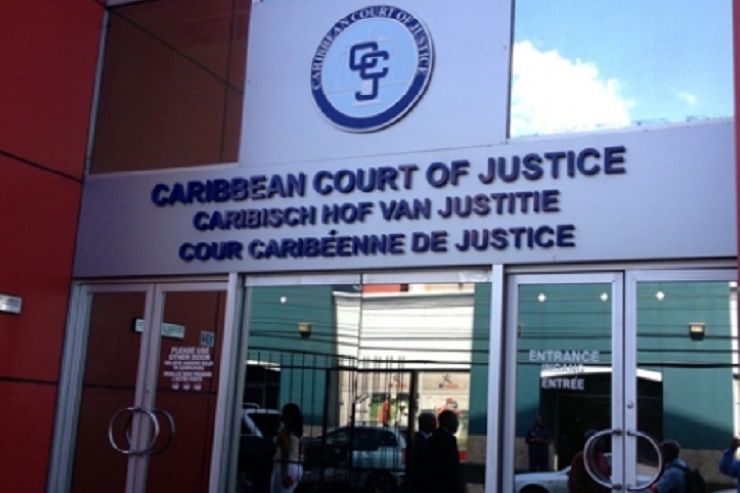
The recent Caribbean Court of Justice (CCJ) case in which Guyanese billionaire businessmen Azruddin Mohamed and his father, Nazar “Shell” Mohamed had challenged an aspect of their extradition proceedings has been cited as part of a broad rift between a number of the CCJ judges and the court’s president, Winston Anderson.
The CCJ did not address the specific allegations of Justice Anderson’s management style and decision-making but stopped short of discrediting the news reports in the Trinidad Express newspaper by saying that publication did not have the full picture.
“The Court is mindful that questions and allegations presented without the benefit of context, background, or an appreciation of the nature of judicial deliberations, collegial discussions, and institutional governance may lend themselves to misunderstanding or mischaracterisation,” the Trinidad-based regional court said in a statement to the Express.
That newspaper reported on a internal email among the CCJ judges quoting Justice Chile Eboe-Osuji who alleged that Justice Anderson had wanted to announce a decision in the case in which the Mohameds had challenged, on the grounds of political bias, home affairs minister Oneidge Walrond’s authorisation of a magistrate to proceed with hearing a United States extradition request for alleged financial crimes.
“In the Mohameds’ case, it was stunning to hear Winston pointedly inform us that he was going to announce a decision of the court at a time and in a manner in which a clear majority of his colleagues had very strongly communicated to him as inappropriate.”
Justice Peter Jamadar also referred to the Mohameds’ case as one of the examples of alleged judicial interference.
He said that case was one of two that relate to the core function of judicial decision-making and impact the rule of law and the due administration of justice—seen through the lenses of judicial independence, impartiality, and integrity of “the Mohamed vs MOHA (Minister of Home Affairs, AG (Attorney General), and Magistrate extradition matter and what I experienced as an attempt to influence the opinions of colleagues that differed from yours in an authoritative manner.”
Justice Eboe-Osuji also said in an email concerning another case that “without prior consultation with colleagues, Winston tried single-handedly to override judicial independence and long-standing CCJ conventions that guided how decisions are rendered when judges disagreed.”
Ultimately, the CCJ on July 29 dismissed the Mohameds case, paving the way for the resumption of the extradition proceedings before Chief Magistrate Judy Latchman.
The Mohameds are wanted by the US to face trial for alleged wire fraud, mail fraud and money laundering linked to their gold trading business.
Before that decision was read by Justice Denys Barrow, the CCJ president said there were three judgements and himself and Justice Barrow had written the lead decision.
He said there was a separate judgement by justices Maureen Rajnauth-Lee, Jamadar, and Arif Bulkan, and a third judgement by justices Chantal Ononaiwu and Eboe-Osuji.
Justice Anderson offered an excuse for Justice Eboe-Osuji’s absence from the delivery of the judgement. “I regret that, for reasons which could not be avoided, Justice Ebo Osuji is not now on this call, and is not likely to be on the call before the judgment is delivered.”
Justice Jamadar, according to the Trinidad Express, also recorded his concerns about a perceived lack of democracy in decision-making.
“What concerns me is what I perceive, certainly potentially, as emerging or creeping patterns of anti-democratic approaches to us as judges of the court in matters that directly and indirectly impact our core functions. If this is indeed so, and I remain hopeful that it is not, this is potentially a threat to the administration of justice in relation to both our OJ and AJ jurisdictions, with implications for the jurisdictions that access this court for the delivery of justice services. I raise this inconvenient and uncomfortable concern, certainly for me because I care deeply about this institution that is the CCJ and believe that we ALL (sic) also do so.”
Concerns were last October raised by Chairman of the Vigilant Political Action Committee (VPAC) Dorwain Bess who alleged interactions between the CCJ and Guyana on Ms Cummings’ exit from the post of Chancellor of the Judiciary and a retirement package.
Mr Bess had said if there was such an out-of-court exercise, that could impact on the image of the court as an independent body and so undermine public confidence in its impartiality.
He had asked for an inquiry by the Regional Judicial and Legal Services Commission to ascertain the nature and extent of any discussion or negotiation between the CCJ President and the Guyana government or any of its agents relating to the retirement or removal of the Acting Chancellor of the Judiciary, the appointment or promotion of senior judicial office-holders, or the participation of the CCJ president in shuttle diplomacy on behalf of the Guyanese government.
The VPAC leader has asked the Commission to assess whether those interactions, once verified, constitute a conflict of interest, or give rise to a perception of lack of impartiality in respect of future or current CCJ matters involving the Government of Guyana.
The CCJ on Friday reaffirmed that its judges remain committed to the tenets of judicial conduct enshrined in the United Nations Bangalore Principles of Judicial Conduct—independence, impartiality, integrity, propriety, equality, competence, and diligence.
“Maintaining public confidence in the Court is fundamental to upholding the rule of law and preserving trust in the administration of justice. The Caribbean Court of Justice remains committed to providing accessible fair and efficient justice for the people and states of the Caribbean Community,” the court said.
The CCJ, the regional judicial tribunal established on 14 February 2001, is the final appellate court for civil and criminal cases in Guyana, Barbados, Belize, Dominica and St Lucia.
The other English-speaking Caribbean Community (CARICOM) member states continue to retain the United Kingdom’s Privy Council as their final appeal court.
The CCJ’s original jurisdiction serves 12 Caricom Member States and is the only court vested with the authority to interpret and apply the Revised Treaty of Chaguaramas.