

Last Updated on Wednesday, 6 May 2026, 8:20 by Written By Denis Chabrol
Venezuela on Wednesday warned the International Court of Justice (ICJ) that if it upholds the validity of the 1899 Arbitral Tribunal Award, the border controversy would remain unresolved.
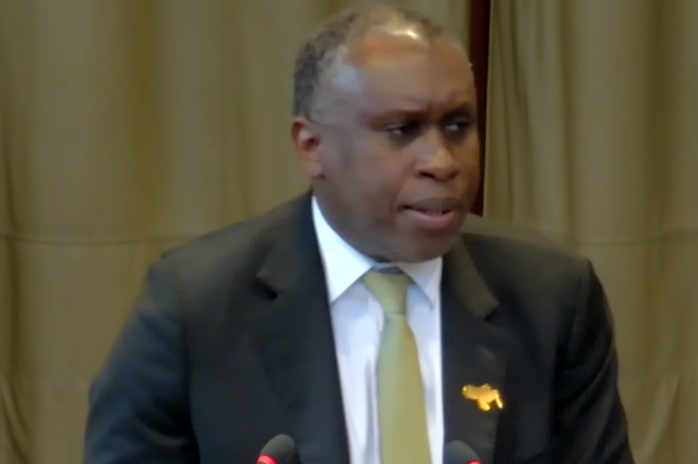
“It would do the opposite and freeze the territorial controversy. This deadlock is precisely what the Geneva agreement was designed to move beyond,” Professor Makane Moïse Mbengue told the court based in The Hague, The Netherlands while also wearing a lapel pin of Venezuela’s purported map that includes the Essequibo Region. Other Venezuelan lawyers – professors Andreas Zimmermann and Antonio Remiro Brotóns – did not wear that lapel pin.
Similarly, Professor Brotóns echoed that if the ICJ dismisses the case by declaring that the validity of 1899 Arbitral Award, it would reduce the Geneva agreement to a “mere empty shell” and 127 years amount to “the final link in the judicial whitewashing of a territorial disposition suffered by Venezuela at the hands of the British Empire.”
He further warned that such a decision would worsen the situation between the two neighbouring South American countries. “This will not put an end to the controversy. On the contrary, it may exacerbate it by driving the parties further apart. It will merely be another step in a never-ending saga that the parties alone can end to a common agreement. No one should have any interest in fueling the conflict,” he said.
Professor Brotóns deplored that for the past 10 years, Guyana, instead of honoring its commitments under the Geneva agreement, and through a mix of amnesia and greed, has sought to take over from the United Kingdom (UK) and has become a usurper itself.
He said Guyana had the audacity to play victim when faced with Venezuela. “Decolonization cannot be exploited to reinforce or perpetuate colonial injustices. The colonial appropriation of the United Kingdom cannot, within the normative framework of decolonization, result in a legal title for Guyana against Venezuela. Venezuela supported Guyana’s independence.”
Representing Venezuela, the Senegalese-born law professor Mbengue contended that the 1966 Geneva Agreement extinguished the 1899 award, a legally binding entitlement, and replaced it with a new framework built on negotiation, mutual satisfaction and equal sovereignty.
He claimed that Guyana agreed to replace the award with a new means of settling the controversy over the 160,000 square kilometre Essequibo Region.
Professor Mbengue said the Geneva Agreement mandates its parties to seek a mutually satisfactory solution bilaterally.
He again warned that the controversy would again be deadlocked if the court upholds the award and that Venezuela and Guyana should find a negotiated settlement through satisfactory solution.
“If the court does not uphold the award, and Guyana refuses to come back to the negotiating table, neither state advances, and the controversy is left to fester. That would not be honoring the Geneva agreement, either,” he said.
Professor Mbengue said that agreement contains provisions to the effect that acts or activities during the agreement could not create claims to sovereignty or prescription.
He further stated that that accord confirmed that the parties understood themselves to be operating in a new legal space where rights remained open and had to be resolved through negotiation.
No mention was made that the Geneva Agreement provides for the United Nations Secretary General to refer the controversy to a judicial mechanism for resolution if the two sides failed to do under the Good Officer mediation process.
Professor Mbengue urged the ICJ panel of judges to consider that the UK did not ignore Venezuela’s allegations of fraud, end the “whole affair” and let the newly independent Guyana inherit the original framework. “Instead, what we have is an international instrument that positively provides in its article eight that Guyana shall become a party to the new framework upon independence as such,” he said.
Guyanese lawyers on Monday showed documentary evidence of Venezuela accepting the 1899 Arbitral Tribunal Award by participating in the demarcation, publication of maps and official statements for more than 60 years until presumed letter by secretary to the tribunal Mallet-Prevost surfaced claiming that there were irregularities in favour of Britain, Guyana’s then colonial power.
Anchoring his arguments on the Geneva Agreement as a form of novation to address the border controversy, he said for more than 50 years, Guyana did not invoke the 1899 award before any international forum, but iInstead, it engaged in negotiations in the Good Officer processes and in other mechanisms established by the Geneva agreement.
“That sustained practice from Guyana reflects precisely the understanding that the award had been superseded, the intention to novate emerges finally from the practice of the United Kingdom, which consistently maintained in its diplomatic practice that former colonies could not simply inherit all obligations of colonial era treaties by automatic succession,” Professor Mbengue added.
He said Venezuela’s position remains that the ICJ should not have ruled in 2020 that it has jurisdiction to hear Guyana’s case on the validity of the 1899 Arbitral Tribunal Award and still “reserves its position on the matter.”
He said even leaving that aside, the novation effected through the Geneva Agreement precludes the court from adjudicating the territorial controversy.
He argued that the real issue before the ICJ, on the basis Guyana has presented to do so, would be to give effect to the 1899 award through the back door of jurisdiction, having abandoned it through the front door of the merits. “International law does not permit that.”
Professor Andreas Zimmermann noted that Guyana’s lawyers largely ignored the Geneva Agreement, although they used it as the basis for filing the case to the ICJ.
He said Guyana brought the case on the basis of the Geneva agreement, but then simultaneously refuses to engage with the legal obligations that follow from it for Guyana. “What is more, Guyana, by not engaging in the substantive interpretation of the Geneva agreement, implicitly acknowledged that it has nothing, nothing to say on the manifold arguments related to the impact of the Geneva agreement on how to solve the boundary dispute, arguments that Venezuela had already brought forward in its written pleadings,” he said.
He stressed that the aim of the jointly approved Geneva Agreement was to resolve “any outstanding controversy”.
He said if Venezuela and the UK had wanted to focus with the specific issue of the 1899 Award, they would have said so, “choosing a wording that would have reflected in the preamble this limited understanding.”
Mr Zimmermann produced excerpts from several official documents by Guyana and Venezuela in an effort to prove its contention that the Geneva Agreement forms the basis for finding a mutually satisfactory agreement.
Discover more from Demerara Waves Online News- Guyana
Subscribe to get the latest posts sent to your email.