

Last Updated on Tuesday, 28 April 2026, 6:35 by Denis Chabrol
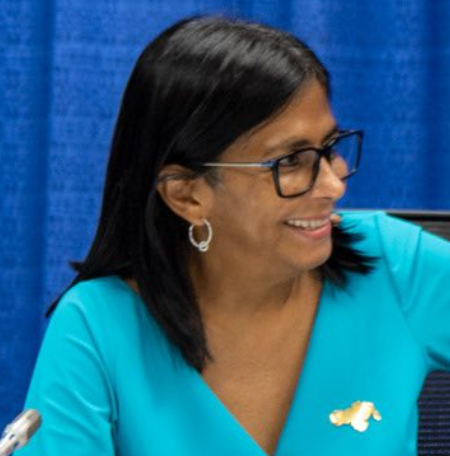
Hours after Venezuela’s President, Delcy Rodriguez wrapped up a second visit to a Caribbean Community (CARICOM) member state while wearing a brooch that “falsely” depicts Essequibo on her country’s map, Guyana’s aviation sector called her choice provocative.
“We call upon our brothers and sisters across CARICOM to remain vigilant and united. Any attempt—symbolic or otherwise—to legitimize Venezuela’s unlawful claim must be firmly rejected. The Caribbean must never provide a stage for territorial adventurism,” the Aviation Operators Association of Guyana (AOAG) said in a strongly-worded statement.
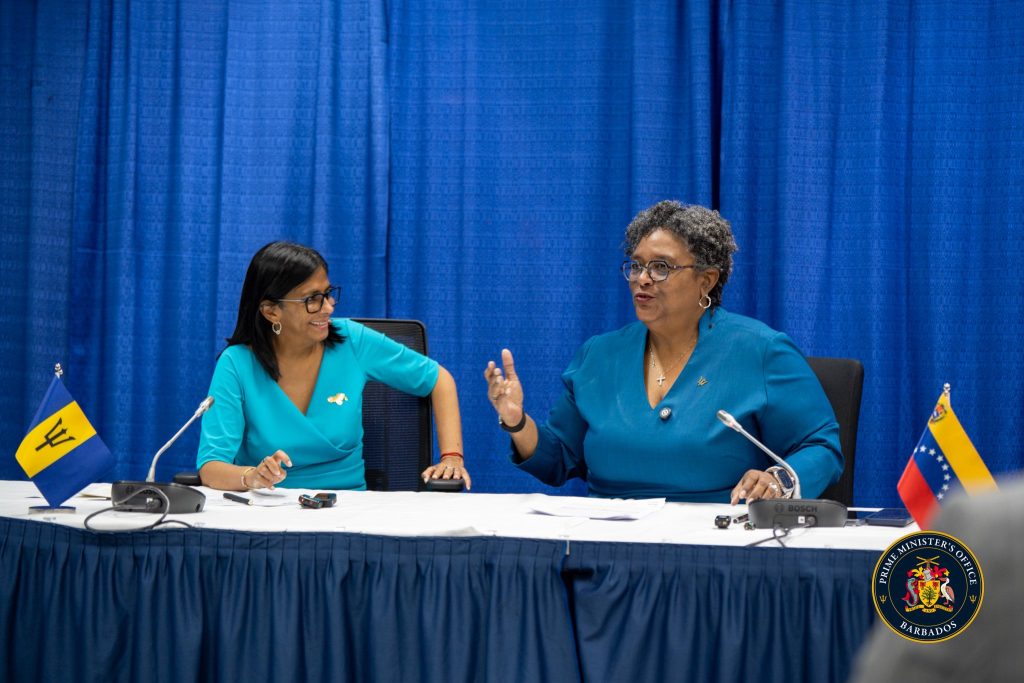
Ms Rodriguez held meetings and a joint press engagement with Barbados’ Prime Minister, Mia Mottley during the former’s visit to Bridgetown on Monday while wearing the brooch as she did on April 9 when she visited Grenada and held talks with that island’s Prime Minister Dickon Mitchell.
CARICOM member states have consistently supported Guyana’s position that Essequibo is part of its territory, but several of the small island states have over the years enjoyed fraternal relations with Venezuela under Hugo Chávez and Nicolás Maduro in turn for concessionary oil prices and other forms support.
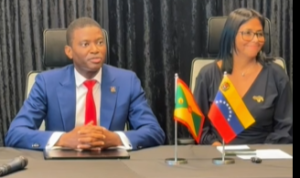
The AOAG deemed as “continued provocative conduct” the Venezuelan leader’s wearing of an “offensive emblem” with Essequibo being part of Venezuelan territory during official engagements with leaders of CARICOM.
“This calculated act is not diplomacy. It is theatrical aggression, wrapped in symbolism and intended to offend, intimidate, and destabilize. It is especially insulting when displayed before the leaders and peoples of CARICOM, a community founded on mutual respect, sovereignty, and the peaceful settlement of disputes,” the association said.
That body of privately-owned domestic carriers said there must be no ambiguity that Essequibo has always been and “shall remain” inseparable a part of the sovereign territory of Guyana.
The International Court of Justice (ICJ) would next month hold several days of hearings for Guyana and Venezuela to present the merits of their case on the validity of the 1899 Arbitral Tribunal Award.
The ICJ could hand down its decision on the case brought by Guyana during the first quarter of next year.
The AOAG says for more than a century, Guyana has exercised peaceful, continuous, and internationally-recognized administration over the Essequibo.
The association said President Rodriguez’s “persistent reliance on cartographic fantasies and nationalist pageantry” does nothing to alter international law or weaken Guyana’s resolve.
“Indeed, such conduct diminishes Venezuela far more than it threatens Guyana. It reflects a government more interested in manufacturing external disputes than addressing internal crises. A badge does not confer sovereignty. A lapel pin cannot erase treaties, arbitral awards, or the will of a free people,” the association said.
Meanwhile, the umbrella Private Sector Commission (PSC) made no reference to the occurrence in Grenada, but called on Barbados, CARICOM and the international community to speak out against such actions by Venezuela.
“We call on the Government of Barbados, a valued CARICOM partner and long-standing friend of Guyana to stand firmly in defence of Guyana’s sovereignty and territorial integrity. Further, we call on CARICOM and all regional and international partners to remain vigilant and unequivocal in their support for the rule of law. Silence or inaction in the face of such deliberate provocation risks emboldening further escalation,” the PSC said.
The PSC also did not name the Venezuelan or Barbadian leaders in its statement but strongly condemned the “deliberate and provocative display of imagery.”
“This act is neither incidental nor benign; it is unacceptable within the framework of international law and responsible diplomacy, and is particularly troubling when it occurs within the territory of Barbados.”
The PSC said that latest incident amounted to a “form of symbolic aggression intended to influence perception, shape narratives, and test international resolve, risking the undermining of regional stability, the erosion of trust, and the weakening of the principles of peaceful dispute resolution.”
Discover more from Demerara Waves Online News- Guyana
Subscribe to get the latest posts sent to your email.