

Last Updated on Thursday, 5 February 2026, 22:10 by Written By Denis Chabrol
Just over one month after American troops captured Venezuela’s President, Nicolás Maduro and took him to the United States (US) to face trial for drugs and weapons, President Irfaan Ali on Thursday said Guyana still faces the same threat over the mineral and biodiversity-rich Essequibo Region.
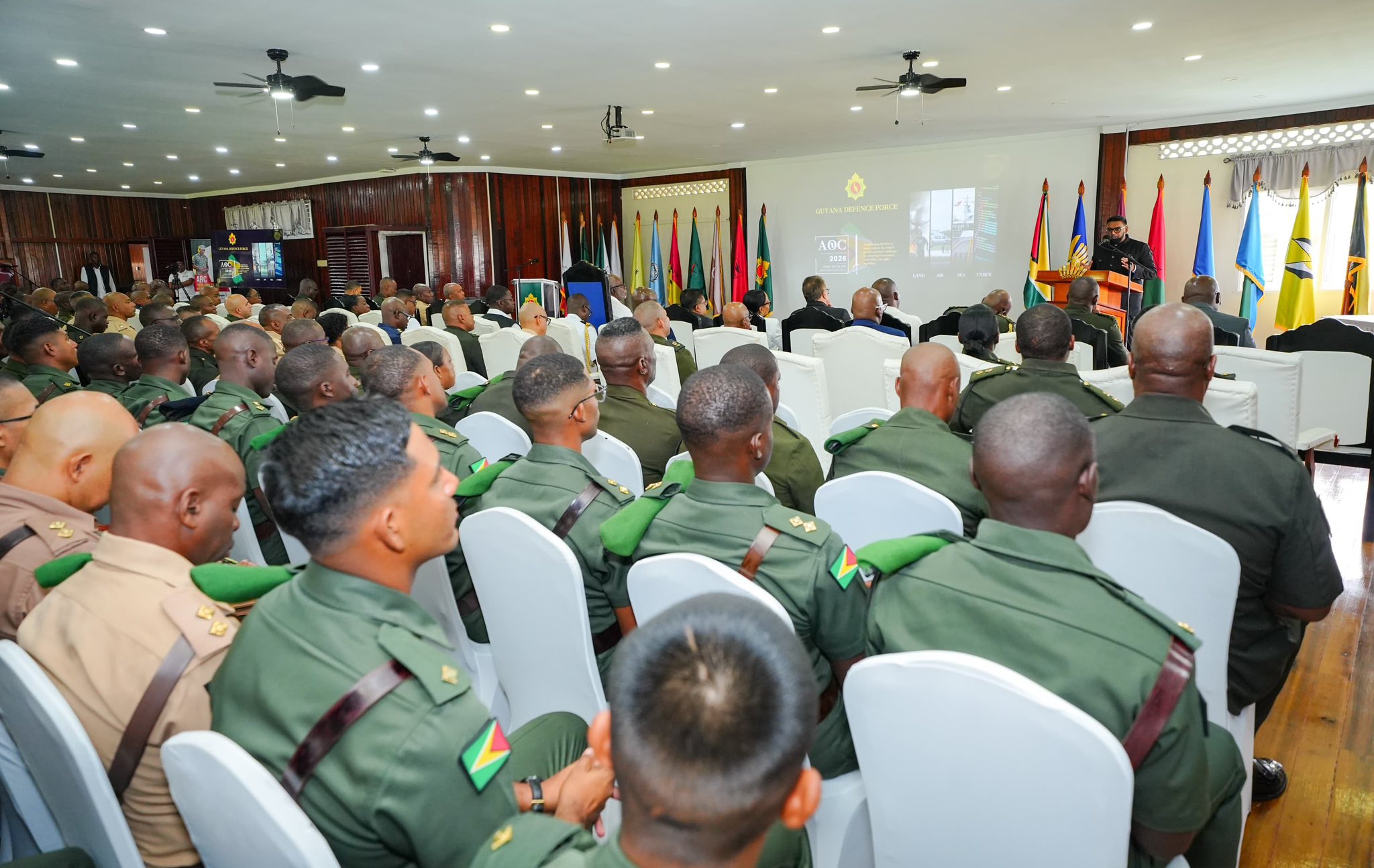
“The present situation in Venezuela does not remove or diminish the threat to Guyana’s territory,” he told the opening of the Guyana Defence Force’s (GDF) annual officers conference at Base Camp Ayanganna.
Since Mr Maduro’s ousting, interim President Delcy Rodriguez, a firebrand aggressor against Guyana and fierce critic of the US, has been enjoying warm relations with the American President Donald Trump.
Political prisoners are being freed and laws have been amended to make Venezuela’s investment climate once again attractive to American oil companies. Seized Venezuelan oil aboard sanctioned oil tankers has been sold and US$500 million made available to the Venezuelan economy.
Suggesting that there was uncertainty, Dr Ali said Guyana must be prepared, ready and vigilant. “Guyana must not drop its guard. Guyana must not blink,” he said.
Apparently speaking to the Venezuelan government which has a record of lashing out at Guyana whenever it speaks out in defence of its 160,000 square kilometre Essequibo Region, he said this country was merely exercising its duties as a sovereign State.
“Preparedness is not provocation. Readiness is not aggression. Vigilance is not hostility,” he said. The President charged the GDF to remain in a state of readiness for any eventuality on land, at sea, and in the air. “Readiness is not something you scramble to assemble when trouble arrives. It is something you build quietly, steadily, and professionally,” he said.
The Venezuelan Navy had entered Guyana’s Stabroek Block in March 2025 and informed exploration and production vessels that they were in Venezuelan waters that had not yet been delimited. The military vessel left the area and returned to Guyana after several hours without further incident.
The President said Guyanese had an “unambiguous duty” to defend their national patrimony from internal and external threats.
While Guyana actively seeks the solidarity of friends and partners, he said Guyanese had a duty to defend their country instead of depending on others to do so. “We cannot outsource sovereignty. We cannot subcontract our defense and we cannot assume that any fairy godmother or godfather will always appear at a decisive moment,” he said.
At a time when Guyana has forged unprecedented close political, military, security and economic relations with the United States and to a lesser extent Britain and France, the Guyanese leader promised that the country’s political independence or sovereignty would not be sacrificed.
He said Guyana has the most expansive, diversified military cooperation and partnership agreement that it has ever seen in its history or that of the Caribbean’s history, or in my opinion, any other defense force has in this region.”
“Our political freedom and independence came at an enormous price, paid in sacrifice, struggle, and resistance to domination. We will never dishonor our legacy by surrendering any of our territory or our independence to anyone. At the same time, we will continue to maintain friendly and cordial relations with all. We believe in good neighborly relations,” he said.
He said cooperation and partnerships are part of the broader defence strategy to enhance training and improve and strengthen the GDF’s capabilities to defend borders, patrol waters, or secure airspace. “They only matter when they are matched by national will and backed by national investment. Cooperation can sharpen skills and expand horizons, but defense must ultimately be driven from within,” he said.
ExxonMobil’s Chief Executive Officer, Darren Woods last week said that supermajor could consider exploring for hydrocarbons in the north-western part of the Stabroek Block nearer Venezuela once there were fewer naval patrols as that would make for “a little more friendly environment.”
Several years ago, a seismic research vessel that was collecting data for ExxonMobil was intercepted by the Venezuelan Navy.