

Last Updated on Friday, 24 October 2025, 6:19 by Written By Denis Chabrol
– Use U.S.-Caribbean Shiprider Agreement to target drug traffickers
– Desist from toppling government
– Warn of collateral damage
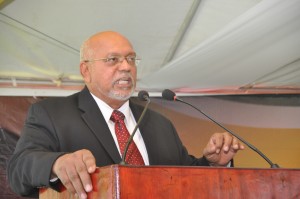
Former Guyana President Donald Ramotar is among 10 former Caribbean Community (CARICOM) leaders who on Thursday called for an end to militarisation of the Caribbean Sea, use of an existing multilateral agreement to hunt drug traffickers and refrain from removing any government by force.
“We are impelled to urge a pull back from military build up to avoid any diminution of peace, stability and development within our regional space that has the potential to pull the region into conflicts which are not of our making,” according to the statement that was issued and also endorsed by former Jamaican Prime Minister Percival Patterson.
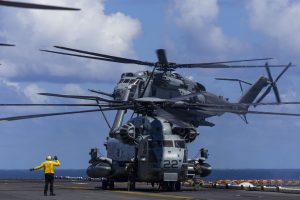
The BBC reports that there are at least 10,000 American troops as well as dozens of military aircraft and ships, that have been deployed to the Caribbean as part of the operation.
Others, who signed on to the statement are former Prime Minister of Antigua and Barbuda, Baldwin Spencer, Said Musa and Dean Barrow of Belize; Freundel Stuart of Barbados, Edison James of Dominica, Tilson Thomas of Grenada, Bruce Golding of Jamaica and Kenny Anthony of St Lucia.
Former Trinidad and Tobago Prime Minister Keith Rowley on Friday supported the statement.
Stressing the importance of maintaining the Caribbean as a zone of peace and its trade, transportation, tourism and fishing as being important economic drivers for regional livelihoods, the former regional leaders said of immediate relevance and overarching significance, is the Shiprider Agreement with the United States (U.S.) which was concluded after intense and delicate negotiations.
“We subscribed to the Shiprider Agreement to ensure that illicit drug traffickers could be tracked, pursued, searched and lawfully apprehended without extrajudicial killing and the destruction of that which could provide conclusive evidence of criminal operation,” they said.
The U.S. military has destroyed several of what the Donald Trump administration alleged were narcotics-laden boats and semi-submersible watercraft that were bound for American shores. At least 37 persons, including two nationals of Trinidad and Tobago, have been killed in those airstrikes.
Trinidad and Tobago’s Prime Minister Kamla Persad-Bissessar has repeatedly endorsed the U.S. military action in the Caribbean, saying that those efforts were aimed at tackling transnational crime that has contributed to a steep rise in violent crime in her country.
But the former CARICOM leaders said since their countries’ independence, Caribbean states have consistently refrained from permitting the hosting of military assets, which have the potential to lure the region into conflicts which are “not of our own making.”
“We urge adherence to this exercise of our collective sovereignty to avoid endangering our citizens in any cross fire or suffering collateral damage and economic harm,” they said.
Soon after the statement by the former CARICOM leaders, Trinidad and Tobago’s Ministry of Foreign and CARICOM Affairs announced that the USS Gravely (DDG-107) will visit that twin-island republic from October 26 to 30, mooring in Port of Spain, while the 22nd U.S. Marine Expeditionary Unit will conduct joint training with the Trinidad and Tobago Defense Force (TTDF) during the same period.
“The U.S. military services’ presence in Trinidad and Tobago highlights the U.S. commitment to regional security and cooperative efforts in the Caribbean. The visit strengthens U.S.-Trinidad and Tobago military-to-military cooperation through expert exchanges focused on core infantry tactics, maintenance procedures, and advanced medical capabilities, leveraging the TTDF’s facilities to enhance tactical proficiency and enhance mutual trust. These efforts strengthen interoperability, reinforce long-term defense cooperation, and improve operational readiness among partner forces,” the ministry said.
Venezuela’s Nicolás Maduro-led administration and several analysts believe that the military deployment to the Caribbean Sea and President Trump’s authorisation for the Central Intelligence Agency to embark on an operation inside that South American country are aimed at toppling him from power to grab the country’s huge oil reserves.
But the ex-CARICOM leaders, citing their experience, publicly expressed their apprehension about the increased military security build-up and the presence of nuclear vessels and aircraft within the Caribbean archipelago. “We and successive Heads have remained steadfast in our repudiation of external intervention to effect regime change. Regardless of the changes flowing from the swings of the electoral pendulum in our democracy, we have insisted that military action in our maritime waters should be governed by international law and not effectively deny due process,” they said.
Dating back to 1972 when the Caribbean leaders had gathered at Chaguaramas, Trinidad with then Prime Minister Dr. Eric Williams as the chairman, the former CARICOM leaders said it was accepted that peace was a dominant factor in shaping the social and political framework for Caribbean development.
“As a result, the “zone of peace” has been codified and become a cornerstone in the architecture of our Caribbean sovereignty and the axis for our relationship with the countries of our Hemisphere, Europe and the world at large.
From this platform, our Region has maintained that established international law and conventions, rather than war and military might, should prevail in finding solutions to seemingly intractable problems,” they said.
The former Guyana President and his nine other CARICOM leaders said they fully support the preparedness of CARICOM leaders to “assist in the peaceful resolution of all conflicts and disputes” to maintain the rule of law and strengthen security within their region in the spirit of the friendly relations that exist between the Community and their Hemispheric neighbours.
“The gravity of present signals demands that we use all existing channels for dialogue to perpetuate a Zone of Peace on the edifice of respect for our sovereignty, international conventions, and the rule of law. We therefore fully support the preparedness of our Leaders of the Caribbean Community to assist in resolving all conflicts and disputes by constructive dialogue.
They said that throughout the years, Caribbean nations have espoused and practiced the fundamental premise of the United Nations Charter that “all disputes can and must be resolved through negotiation and dialogue.”
The former CARICOM leaders reiterate their unequivocal support for the sovereignty and territorial integrity of nations in the Community. There are territorial disputes between Guyana and Venezuela, Belize and Guatemala, and Guyana and Suriname.