
Last Updated on Saturday, 17 October 2026, 9:43 by Written By Denis Chabrol
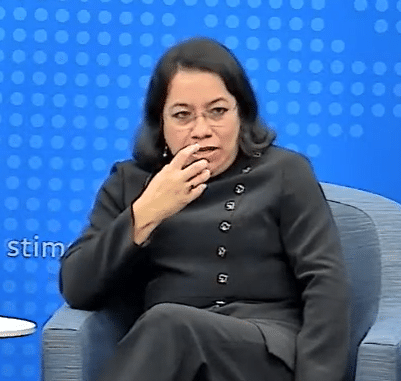
Guyana’s nominee for the post of Secretary-General of the United Nations (UN), Ambassador Carolyn Rodrigues-Birkett and the six other candidates received a vote of “discourage,” effectively a veto, from a permanent UN Security Council member in the latest informal poll, a diplomat said Friday.
The French news agency, AFP, reported that US media reports suggest Washington opposes all of the seven contenders in the race.
Even if a candidate earns the required nine votes from the 15 available in the Security Council, they must also avoid a veto by the five major powers- Britain, China, France, Russia and the US- which are deeply divided. Once a candidate clears those bars, their name will go to the General Assembly of all UN members for confirmation.
The Associated Press reported that the three leading candidates — U.N. trade chief Rebeca Grynspan of Costa Rica, U.N. nuclear chief Rafael Grossi of Argentina, and Guyana’s U.N. ambassador, Carolyn Rodrigues Birkett — all received two red “discourage” votes, according to two diplomats who spoke on condition of anonymity because the poll was private.
Ms Rodrigues-Birkett’s veto came one day after she told the Stimson Center in a discussion that she did not know that the United States (US) was opposed to her because of Guyana’s position that Israel’s attack on the Palestinian people in Gaza amounted to genocide. “I have no information from the United States that they have any position on my candidacy,” said Ms Rodrigues-Birkett, Guyana’s Permanent Representative to the UN, adding that reports were the work of creative media.
She also defended her position on Palestine, saying that remained consistent with Guyana’s position before its overwhelming election to the Security Council as a non-permanent member for 2024-2025. “I cannot answer for the United States but let me say that Guyana was elected with 191 of 192 votes and we took that as an overwhelming mandate of the General Assembly and throughout our campaign, we told everyone that we are not going to bend when atrocities are committed, when international law is violated wherever it is committed. We would speak up on this wherever it is committed and whenever it is committed and that’s what Guyana did on the Security Council. That voice was my voice representing my country. What I’ve heard in this campaign for Secretary General is that you need a Secretary General that is only biased to the UN Charter and to international law. That is not in contradiction to what I did for my country in the Security Council,” she said.
Friday’s vote was the first time in the anonymous informal polling that Britain, China, France, Russia and the United States used colored straws to indicate their vetoes, while the Security Council’s 10 elected members continued to use plain markers. Each of the 15 Security Council members must anonymously assign each candidate one of three labels: “encourage,” “discourage,” or “no opinion.”
Washington’s envoy to the UN Mike Waltz refused to comment on the report, but said Friday: “We have always said we just simply need the best.” On the question of new contenders joining the race, Waltz said “countries, if they want to to put more candidates in, that’s certainly within their sovereign rights.”
Among those considered by diplomats to be potential entrants are Nickolay Mladenov, the high representative for Gaza under the US-backed “Board of Peace,” and the UAE’s minister of state for foreign affairs Lana Nusseibeh. Turkey’s Feridun Hadi Sinirlioglu, Secretary-General of the Organization for Security and Co-operation in Europe (OSCE), has also had his name floated.
Grynspan performed best on average in the first five rounds of informal polling, again coming top Friday — despite the two vetoes.
The other candidates are Macky Sall of Senegal, Ecuador’s Ivonne A-Baki and Maria Fernanda Espinosa, and Uganda’s Olara Otunnu.
The outgoing secretary-general, Antonio Guterres of Portugal, ends his second five-year term on December 31, 2026.
The Security Council straw poll was devised in the early 1980s in an attempt to break a deadlock between two candidates shut down by vetoes. The informal mechanism has persisted, in various forms, despite criticism from countries opposed to the opaque process.
It is tradition that the UN’s top job should rotate between different regions. Under that premise, the role should go to a candidate from Latin America this time. There are many candidates from the region, though Sall and Otunnu hail from Africa.