


Last Updated on Thursday, 14 May 2026, 22:43 by Written By Denis Chabrol
The United States (US)-based Carter Center, while praising the transparency of Guyana’s 2025 general and regional elections in contrast to efforts to rig the 2020 results, is recommending a redraw of the now 24-year-old electoral boundaries to take account of an increase in the population.
“The Carter Center recommends that a constitutional review process consider carefully Guyana’s electoral system and corresponding methods of delimiting boundaries to ensure that equal suffrage is upheld,” the Center says in its report on the September 1, 2025 general and regional elections.
The polls saw the re-election of the People’s Progressive Party Civic (PPPC) with a wider majority and an upset of the opposition with the newly-formed We Invest in Nationhood (WIN) becoming the leading opposition party with 16 seats and the People’s National Congress Reform-led A Partnership for National Unity becoming number two in the 29-seat opposition.
The Carter Center made out a case for the delimitation of the electoral constituency boundaries because the 2022 national census that was released on January 12, 2026 shows that Guyana’s population has changed in the past 24 years since the boundaries were last drawn.
The observer mission notes in its report that the Representation of the People Act gives the Guyana Elections Commission (GECOM) the power to divide the country into polling districts — though these districts cannot cross regional boundaries — and, within districts, polling divisions.
The Center, which has been observing elections in Guyana and otherwise engaged in this country’s development planning since 1992, adds that international standards indicate that the delimitation of boundaries should be reviewed with regularity.
The Center says its recommendation is in line with international standards which state that constituency boundaries should be drawn in a way that preserves the principle of equal suffrage, so that every voter has roughly equal voting power, allowing voters or residents to be represented in the National Assembly on a roughly equal basis.
The Center asked Guyana to consider amending the law to require regular review of the delimitation of boundaries, to adjust boundaries based on the current population, and to reduce deviation to under 10%.
The apportionment criteria, the Center says, should be publicly available and include details such as the number of residents, number of registered voters, number of actual voters, or a combination of them.
“Reforming laws related to boundary delimitation and addressing the large gap between electoral quotients for obtaining seats in small and large electoral constituencies will allow Guyana to more fully respect the principle of equal suffrage,” says the Center.
The background to the recommendation is that Guyana’s unique and complex electoral system makes boundary delimitation equally complex because 40 of the parliamentary seats are assigned based on the assumption of a single national constituency and an additional 25 seats are divided across Guyana’s 10 regions using the “geographic component” with an assumption that the population is equally divided across these 25 seats.
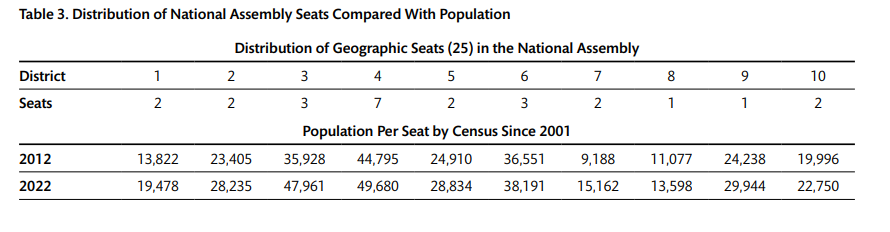
According to the Carter Center, distribution of seats across regions was last established in 2001 through legislation passed by parliament and has not been adjusted since, although censuses have since been conducted in 2012 and again in 2022.
The Center backed up its argument of a significant variance between constituencies that undermines the international democratic principle of equal suffrage with figures.
Like other regional and international observer missions, the Carter Center’s report on the 2025 general and regional elections also raised concerns weak campaign finance regulation, misuse of state resources magnifying incumbent advantage, unequal media access, limited civil society engagement, and barriers to political participation for marginalized groups.
Meanwhile, the Center, founded by former US President Jimmy Carter, credited election legislative reforms that arose out of the flawed tabulation system for the 2020 polls. “Overall, the post-2020 reforms were positive,
contributing to a more efficient and transparent tabulation process that better ensured results reflected the will of the electorate.
Carter Center observers found that the tabulation process in 2025 was conducted in a reasonable or very
good manner across all 17 of the tabulation centers, with increased transparency through the public posting
of Statements of Poll (SoPs) and the timely uploading of these to GECOM’s website.