

Last Updated on Friday, 27 March 2026, 23:14 by Writer
By Nigel Westmaas

Extensive historical research, including the Slave Voyages database, estimates that approximately 30,745 slave vessels transported shackled enslaved Africans to the Caribbean and the Americas over the four centuries’ long Atlantic slave trade. These voyages carried millions of Africans in chains, marking the most devastating and far-reaching systems of human exploitation in recorded history.
On Wednesday, the United Nations heard Ghanaian president John Mahama put forward a resolution declaring the transatlantic trade “the gravest crime against humanity.” A total of 123 nations, including from the African Union and Caricom territories including Guyana, voted in favour of the resolution. Fifty-two countries abstained, among them several European countries central to the historical slave trade including Portugal, United Kingdom, Netherlands, France, and Spain. Three countries voted against the resolution, Argentina, Israel and the United States. The KOLUMN Magazine, in response to the vote, argues that the abstentions were “politically convenient for states whose wealth, institutions, and imperial reach were entangled with slavery and colonial extraction. The abstention camp effectively said: yes, this was horrific; yes, its legacy remains; yes, racism persists; but no, do not convert that recognition into language that might sharpen claims.” In the case of the US no vote, Kolumn argues that the US “understood the vote not as an abstract history seminar but as part of a live reparations debate. In other words, the United States seems to have recognized exactly what supporters intended: that naming the crime at the highest diplomatic level could strengthen material claims down the road. That appears to be what spooked it.”
The resolution stated that “the trafficking of enslaved Africans and racialized chattel enslavement of Africans as the gravest crime against humanity by reason of the definitive break in world history, scale, duration, systemic nature, brutality and enduring consequences that continue to structure the lives of all people through racialized regimes of labour, property and capital.”
This resolution builds on earlier international recognition. The 2001 Durban Declaration already recognized slavery and the slave trade as crimes against humanity; it was adopted in 2001 at the World Conference against Racism 2001 Durban, held in Durban, South Africa under the auspices of the United Nations.
The UN vote on Wednesday 25th represents an important step in the recognition of the horrors endured by millions of Africans and Ghana and its supporting members “ viewed the resolution as a step toward accountability for a trade that carried at least 12.5 million Africans across the Atlantic and whose consequences remain visible in racial inequality today.”
In Guyana’s case, there is still considerable work to be done to strengthen public education about what the trade meant for the enslaved, how structural inequalities persisted even after emancipation, and how racial theories including “scientific racism” itself a byproduct of the trade, continue to shape stigma toward Blackness, whether conscious or unconscious.
The arrival of slave ships in Guyana attained its height in the period between the 1790s and just before the abolition of the slave trade (as distinct from slavery itself) in 1807. While the Guyana enslaved population numbers pale in comparison to larger slave societies like Jamaica and Haiti, they still represent immense human suffering and degradation. The expanding body of research, including data from the Slave Voyages database, provides for valuable insights that would be useful in any public education on the horrors of slavery and other forms of degradation and exploitation including indentureship and wage labour among others.
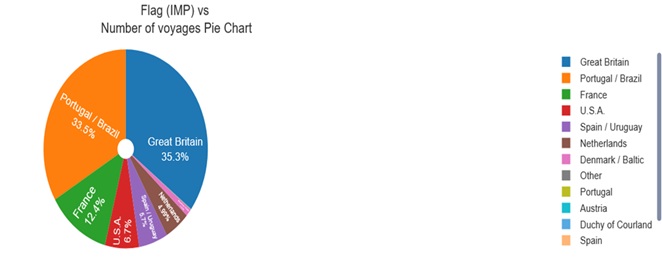
It would be surprising to many, but Portugal outranks the United Kingdom as the second largest participant in the transatlantic slave trade in terms of size/as the pie chart indicates.
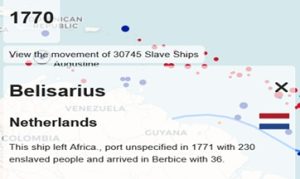
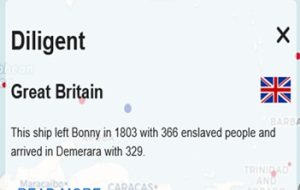
In terms of ship movement, the database for Guyana records both the national ownership of vessels and the number of enslaved people who embarked from African ports, as well as those who ultimately disembarked on Guyana’s soil. What is significant, though not surprising, is that deaths occurred on every voyage, sometimes at staggering levels. One striking example is the Belisarius, a Dutch ship, that left Africa with 230 souls in 1771 and arrived in Berbice with only 36. In another case, the British carrier, Diligent, departed with 366 enslaved individuals and arrived in Demerara with 329. While the losses on the latter voyage were lower, they still underscore the immense human suffering which the modern public can only grasp in abstract terms.
These records in general make clear that the transatlantic slave trade was not only vast in scale but also relentlessly brutal in practice at all stages of enslaved people’s lives. Each voyage and landing was not incidental but routine, yet even these records cannot fully capture the terror, the dislocation, and dehumanization endured by millions. Still, the evidence that does exist remains essential to confronting the reality of the system.
In this vein, the recent vote at the United Nations carries weight beyond symbolism. That recognition, however, must be matched by sustained efforts in both formal and public education on the issue of slavery and its links to modern inequalities of the descendants of the enslaved. The detailed knowledge now available, including ship logs, mortality figures, embarkation and disembarkation records – now provide for open, and comprehensive public awareness of slavery that can include school curricula, public history initiatives and national conversations that can help move it beyond abstraction of the incalculable human suffering.
Finally, to underscore the distance between abstract understanding of slavery and the lived reality, we can turn to Alvin O. Thompson’s powerful but little-known work, A Documentary History of Slavery in Berbice, 1796-1834. In it he cites a document that underlies the terror of enslavement. The document records an investigation into a complaint by an enslaved woman named Rosa (Roosje) from Plantation L’Esperance in Guyana in 1819. Rosam, who was pregnant at the time, was forced to pick coffee on her knees. The estate manager demanded that the driver Zondag, flog Rosa in spite of her condition. Even the driver tried to be considerate of her condition but the manager insisted: “give it to her till the blood flies out.” To summarise her testimony, Rosa stated she was “flogged; the whip broke, and I was flogged with carracarras…On Sunday evening I miscarried; I was five months gone with child; the labour was hard. The midwife had to force it; the child was dead, one eye was out, the arm broken, and a stripe visible over the head , which must have been done with the double whip…”
This account, like millions more that are unrecorded, strips away any remaining abstraction. It forces a confrontation with the physical and psychological violence that defined slavery, whether on the ship or on the plantation, and the human lives behind the statistics.